

From Vague Wishes to Lean Reality: The 5-Step Resolution Protocol
Published on: Jun 30, 2026
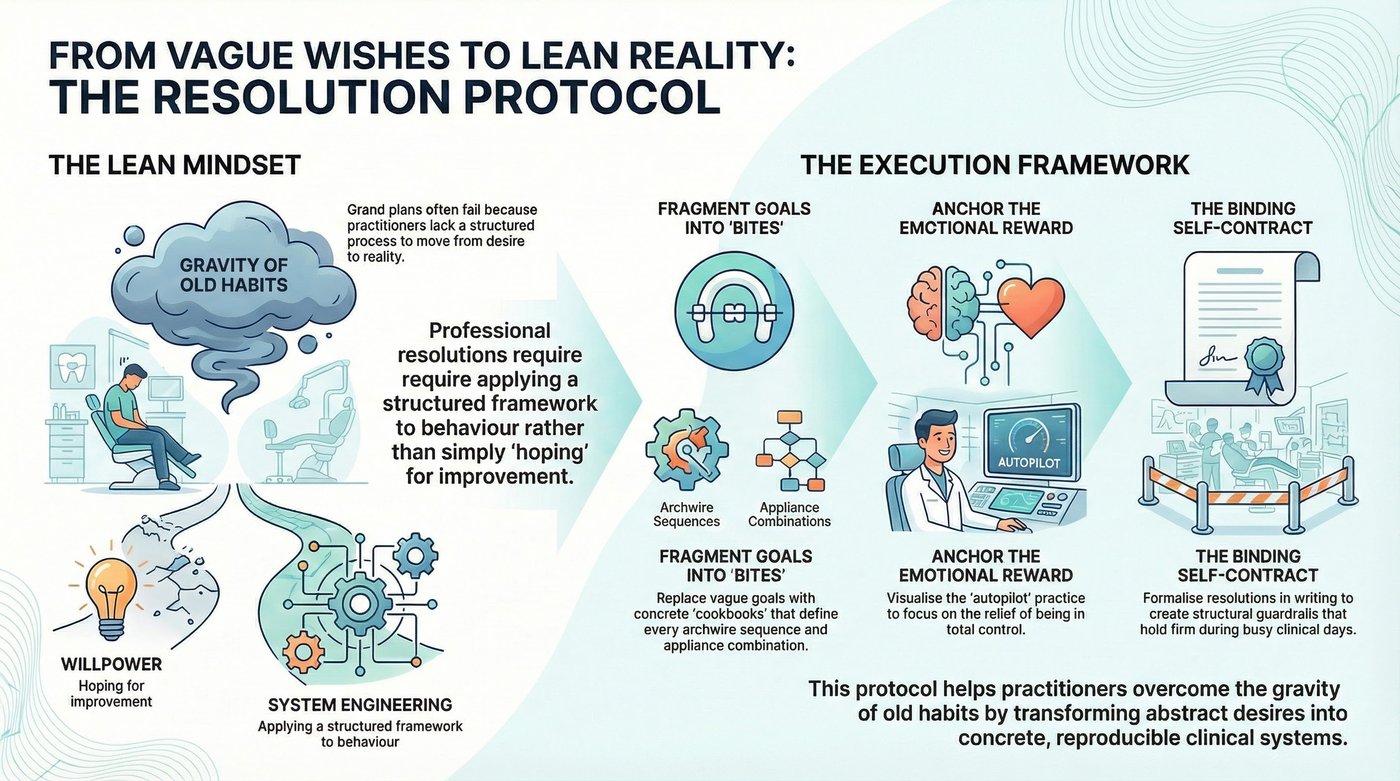
The Gravity of Old Habits
We’ve all experienced the “Monday Morning Surge”—returning from a seminar or starting a new year with grand plans to redesign the practice, implement new software, or finally systemize clinical workflows. Yet, within weeks, the familiar gravity of old habits pulls us back. This inertia stems from the comfort of established, albeit inefficient, processes that require little cognitive load. We find ourselves complaining about the same stresses because we lack a structured process to move from a vague desire to a permanent change in our professional reality.
In lean orthodontics, change isn’t about willpower; it’s about system engineering. This means viewing your practice not as a collection of clinical talent but as a manufacturing line where processes must be standardized, measured, and repeatable. To keep your professional resolutions, you must move away from “hoping” for a better practice and start applying a structured framework to your behavior. This shift in perspective is the mark of true leadership: recognizing that personal stress is a predictable failure of the practice management system.
Step 1: Fragment the Goal into Actionable “Bites”
Vague goals like “I want less stress” are the primary reason for failure. To a lean thinker, stress is a symptom of a broken system, not a personal flaw. If you want a more relaxed treatment day, your resolution must be concrete: “I will implement a standardized cookbook for my mechanics,” ensuring consistent delivery and predictable chair time.
This means defining every archwire sequence and appliance combination in advance so you aren’t reinventing the wheel at the chairside. For example, a concrete bite defines the exact six-tray setup for all Phase II starts and mandates its use. Small, actionable changes—like blocking two hours a week for “deep work” (e.g., P&L review, team training module creation) or ending complex meetings by 4:00 PM—are the foundation of practice efficiency. These micro-changes create momentum, proving to the team that change is possible and manageable.
Step 2: Anchor the Emotional Reward
Clarity of “Why” is your fuel. You must anchor the feeling of success in your mind, linking the abstract resolution to a tangible emotional outcome. Imagine the sensation of leaving the practice on time, knowing every patient received high-quality care because you used reproducible clinical packages. This isn’t just a personal reward; it’s a reduction in staff burnout and improved team morale, which directly impacts patient experience.
When you focus on the relief of being in control rather than the “work” of the change, the effort becomes worth it. In dental leadership, we call this “visualizing the autopilot,” where the system runs smoothly without constant personal intervention. This focus on the long-term, stable outcome helps overcome the inevitable short-term resistance and friction associated with adopting new protocols. If the destination feels profoundly rewarding—e.g., reduced staff turnover—the journey becomes sustainable.
Step 3: The Binding Self-Contract
In a lean mindset, clarity is everything. We respect legal contracts with employees, yet we often break the promises we make to ourselves. To succeed, you must write your resolution down, detailing the specific metrics and deadline. Treat it as a binding commitment with no notice period, framing the change as an operational mandate, not a personal wish.
This formalization acts as a structural guardrail, helping you stay the course when the clinical day gets busy and chaotic. The contract should identify an accountability partner—another clinic leader or a trusted colleague—to whom you must report weekly progress, transforming a private aspiration into a public commitment. This layer of external accountability prevents the chaos of the chairside from hijacking your systemic resolution.
Step 4: Isolate the “Trigger” and Replace the “Routine”
Systemic failure often occurs at a predictable point: the “trigger.” The goal is not merely to create a new habit but to identify the specific cue that triggers the old, inefficient routine. In a dental setting, a trigger might be “A new patient record arrives at the front desk” or “The assistant calls me over for an unscheduled appliance repair.” The old routine (haphazard filing or improvisational repair) must be interrupted.
Your resolution must specify the new routine that immediately follows that trigger. For instance, if the trigger is a new patient record, the new routine is “Immediately route the chart to the designated Treatment Coordinator for a 10-point intake checklist before it enters the doctor’s queue.” By isolating the exact moment the system breaks down and replacing the ingrained routine with a systematic protocol, you actively engineer efficiency. This surgical precision ensures the change targets the root cause of inefficiency rather than its symptoms.
Step 5: Engineer for Failure (The Buffer)
Even the most robust systems will encounter friction. The final step is to build an intentional buffer, or margin of safety, into your newly implemented system. This recognizes that occasional failure is inevitable but must not be catastrophic. For a high-volume practice, this might mean instituting a 15-minute “flex buffer” between high-stress procedures like complex extractions or appliance deliveries.
This buffer is critical because it prevents a small delay in one appointment from cascading and causing a total system collapse by midday. If a digital system fails, the buffer ensures the team has a designated, practiced manual backup protocol—the “system for when the system fails.” Acknowledging and planning for setbacks is not pessimism; it is a critical component of lean management, ensuring the longevity and resilience of your professional resolutions.
Conclusion: From Intention to Integration
The transition from a practice defined by “vague wishes” to one built on “lean reality” is not a single event but a continuous application of the 5-Step Resolution Protocol. By fragmenting goals, anchoring rewards, formalizing commitments, replacing inefficient routines, and engineering for failure, you transform clinical stress into systematic success. True dental leadership is found in this discipline—the willingness to move beyond the surgeon’s hands and into the architect’s mind, building a practice that serves both the patient and the provider with predictable excellence.