

From Micromanagement to Mastery: The Six Levels of Clinical Delegation
Published on: Jul 4, 2026
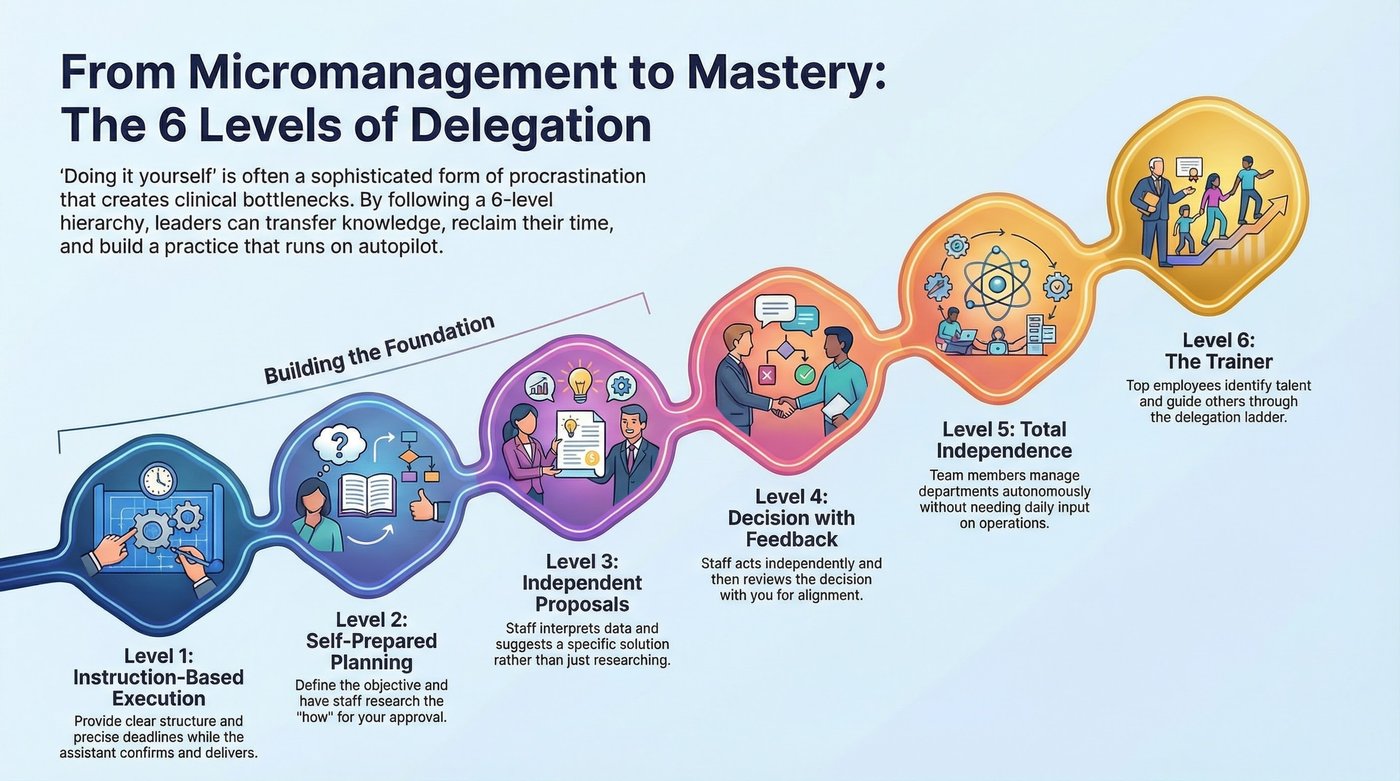
The Procrastination of “Doing It Yourself.”
Many orthodontists fall into a common leadership trap: the belief that doing a task themselves is “faster and better” than teaching someone else. In the world of lean orthodontics, we recognize this for what it truly is—a sophisticated form of procrastination. By avoiding the work of knowledge transfer, you chain yourself to the treatment chair and create a bottleneck that stifles practice efficiency. This self-imposed constraint leads directly to doctor burnout and limits patient throughput, regardless of clinical skill.
The short-term gain of bypassing training always results in long-term operational fragility. The hidden cost of “doing it myself” includes decreased staff morale and high turnover, as team members feel untrusted or unchallenged. Knowledge transfer is not a chore; it is the highest-leverage investment a clinic leader can make.
To move your clinic toward a state of operational excellence, you must stop micromanaging and start navigating the hierarchy of delegation. This isn’t just about offloading chores; it is about building a self-sufficient team that allows the practice to run on autopilot while you focus on high-level clinical strategy. This strategic focus should encompass complex case planning, financial oversight, and long-term marketing initiatives.
Level 1 & 2: Building the Foundation of Trust
Delegation is a ladder, and every team member starts at Level 1: Instruction-Based Execution. At this stage, your role is to provide a clear structure and precise deadlines. The assistant’s job is to confirm understanding and deliver the result. This foundational level relies heavily on meticulously documented Standard Operating Procedures (SOPs).
Trust at Level 1 is not based on judgment but on the capacity to follow a checklist, such as sterilization protocols or a complex patient check-in script. Any deviation is a sign that the documented process is unclear or the initial training was insufficient.
As trust grows, you move to Level 2: Self-Prepared Planning. Here, you define the objective, but the employee researches the “how” and submits a plan for approval. This shifts the mental labor of research away from the doctor, fostering critical thinking within your staff. For example, instead of ordering all supplies yourself, you task a staff member with researching three vendors and proposing the best purchasing strategy.
The submitted plan requires a detailed review, transforming this stage into a crucial coaching opportunity. When you approve the plan, you are validating their initial critical assessment, reinforcing their professional development.
Level 3 & 4: Developing Clinical and Administrative Judgment
The true transformation begins at Level 3: Independent Proposals. The employee no longer just researches; they interpret the data and suggest a solution, complete with a rationale. This is used for nuanced administrative tasks, like proposing financial arrangements for a complex treatment plan or optimizing the schedule to accommodate last-minute patient emergencies.
This stage requires the team member to connect the what (the data) with the why (the practice’s values and financial health). Their proposal must be a complete argument, forcing them to own the anticipated outcome.
This is followed by Level 4: Decision with Feedback. At this stage, the employee acts independently and then reviews the decision with you. This feedback loop is vital for dental team performance. It allows them to handle time-sensitive, non-critical decisions immediately, such as a minor chairside bracket repositioning adjustment or resolving a minor billing discrepancy.
If they made a choice you wouldn’t have, it’s a signal that they are missing background information or a specific “Lean Eye” perspective. Providing that context—rather than criticism—is what aligns their judgment with your standards. The debrief must focus on systemic learning: what process was missing that led to the different outcome.
Level 5 & 6: The Autopilot Practice
Level 5 is Total Independence, the hallmark of middle management. These are the team members who have internalized your standards so deeply that you can “trust them blindly.” They manage their departments without needing your input on daily operations. Examples include a clinical coordinator who independently manages all inventory, equipment maintenance, and clinical staffing, ensuring optimal resource allocation.
These leaders have developed a keen sense of when a decision crosses the threshold from operational to strategic, knowing exactly when to elevate a concern. They are the operational bedrock, allowing the doctor to fully delegate the entire domain.
Finally, we reach the gold standard, Level 6: The Trainer. At this level, your top employees are identifying talent and guiding others through the first five levels. They are the institutional knowledge preservers, ensuring your operational system is self-sustaining and scalable. When you reach this stage, you have successfully made yourself dispensable for daily tasks. You provide a keyword—like “new patient protocol”—and the system executes perfectly, because the Level 6 trainer guides the rest of the team.
Conclusion: Empathy in Talent Management
Reaching the gold standard of delegation requires a mix of structure and empathy. The structure provided by the six levels is the roadmap for professional growth, setting clear expectations for advancement. Empathy is required to understand individual career aspirations.
Not every employee desires to reach Level 6, and that is perfectly fine. Your role as a leader is to identify who has the drive for management (Level 5/6) and who excels at Level 1 execution (technical mastery). Leveraging technical specialists where they thrive is just as important as nurturing future managers. By mastering this hierarchy, you reclaim your time, reduce the chaos in your clinic, and finally allow your practice to run like a precise Swiss clockwork. The ultimate ROI is a scalable, stress-reduced practice model built on mutual trust and aligned judgment.