

From “Glued On” to Clinical Mastery: The Disciplined Integration of Orthodontics
Published on: Jun 24, 2026
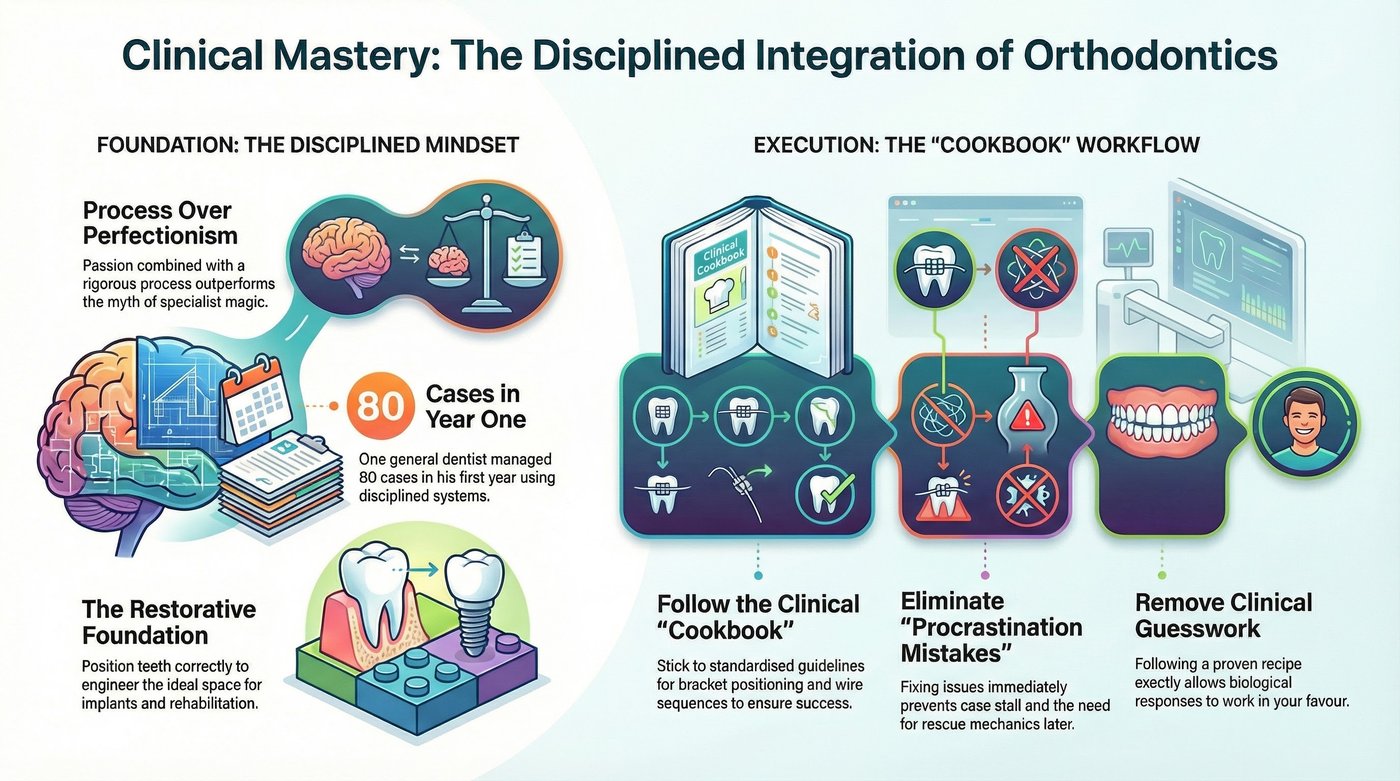
Many general dentists are paralyzed by the myth of “specialist magic”—the idea that orthodontic movements are governed by arcane secrets known only to those with decades of exclusive practice. This psychological barrier often leads to a cycle of perpetual referral that fragments the patient journey and leaves the primary dentist without control over their most complex reconstructive cases.
When you outsource the foundation of a case, you outsource the outcome. As I discussed with my colleague Dr. Fabian Schmidinger, the reality of clinical excellence is far more accessible than the industry suggests. Passion combined with a rigorous, repeatable process beats unguided perfectionism every single time.
The transition from a “glued on” approach—where brackets are placed without a long-term vision—to clinical mastery requires a shift in leadership. It is about moving from being a technician who reacts to tooth movement to a clinician who architects the entire biological environment.
In Dr. Schmidinger’s first year of integrating orthodontics, he successfully managed 80 cases while maintaining his full-time general dentistry duties. He didn’t achieve this through raw genius or by working eighty hours a week; he achieved it by being ruthlessly disciplined with his chairside systems.
He treated the orthodontic workflow as the “missing link” that empowered his surgical and prosthetic outcomes. By aligning the arches himself, he ensured that implant sites were optimized and restorative margins were predictable. This proof of concept shows that with a structured system, clinical success is a predictable result of following a proven recipe.
For the clinic leader, this means the return on investment isn’t just in the orthodontic fee. It is found in the reduced stress of restorative phases and the increased lifetime value of a patient who receives comprehensive care under one roof.
Following the “Cookbook”: Why Discipline Outperforms Creativity
The biggest mistake a dentist can make when starting with orthodontics is trying to be “creative” with mechanics. In Lean Orthodontics, we provide a “cookbook”—a set of strict, standardized guidelines for bracket positioning and wire sequences that remove the cognitive load from the clinician.
Standardization is the enemy of clinical error. When every case starts with the same diagnostic rigor and follows a calibrated sequence of nickel-titanium to stainless steel wires, you create a baseline for troubleshooting. If a case isn’t progressing, you don’t wonder if the “art” was wrong; you check which step of the science was missed.
Successful integration requires you to stick to these safety rails. Like Fabian, you must be willing to admit that early cases are a steep learning curve that requires humility. By following the recipe exactly, you allow the predictable mechanics and the patient’s biological responses to work in your favor.
When you eliminate guesswork, you eliminate the micro-delays that lead to “treatment creep.” A case that should take 18 months often stretches to 24 because of small, creative deviations. Staying disciplined means respecting the biological timeline and the engineering principles of the appliance.
The Procrastination Trap: The High Cost of Cutting Corners
Efficiency in a multidisciplinary clinic is often ruined by small, undisciplined “procrastination mistakes.” Perhaps the waiting room is overflowing, so you rush a bonding procedure, or you skip placing a trans-palatal arch (TPA) because you don’t feel like banding a molar that afternoon.
These moments of “I’ll do it next time” are the seeds of clinical failure. A bracket that is 1mm off-center today will result in a tooth that is rotated three months from now. The cost of fixing that rotation—re-bonding, new wires, and extra appointments—is ten times higher than the five minutes saved during the initial rush.
From a lean leadership perspective, these shortcuts are major forms of waste (Muda). A poorly bonded bracket or a skipped anchorage component will eventually cause the case to drift or stall, leading to “rescue mechanics” and emergency visits that disrupt your high-value surgical schedule.
True mastery involves recognizing these moments of weakness and fixing the issue immediately. If a bracket isn’t perfect, take it off and redo it now. Discipline at the chairside is what separates a “dabbler” from a professional clinician. It is the commitment to doing the right thing when no one is watching but the cephalometric tracing.
Orthodontics as the Restorative Foundation
For a dentist focused on high-end results, orthodontics is the ultimate foundational asset. You cannot place a perfect implant or perform a flawless full-mouth rehabilitation if the teeth are not in the correct three-dimensional position. Orthodontics is the tool that moves the “pillars” to where the “roof” belongs.
By taking control of the orthodontic phase, you take control of the entire treatment plan. You no longer have to hope that an external specialist will create the exact 7mm of space you need for a lateral incisor implant; you engineer that space yourself to the sub-millimeter level.
This total control results in superior aesthetics, better functional occlusion, and a much higher level of professional fulfillment. When the restorative dentist is also the orthodontist, the synergy is undeniable. You aren’t just moving teeth; you are building a legacy of excellence through disciplined integration.