

From Generalist to Expert: The Strategic Roadmap for Orthodontic Expansion
Published on: Jun 24, 2026
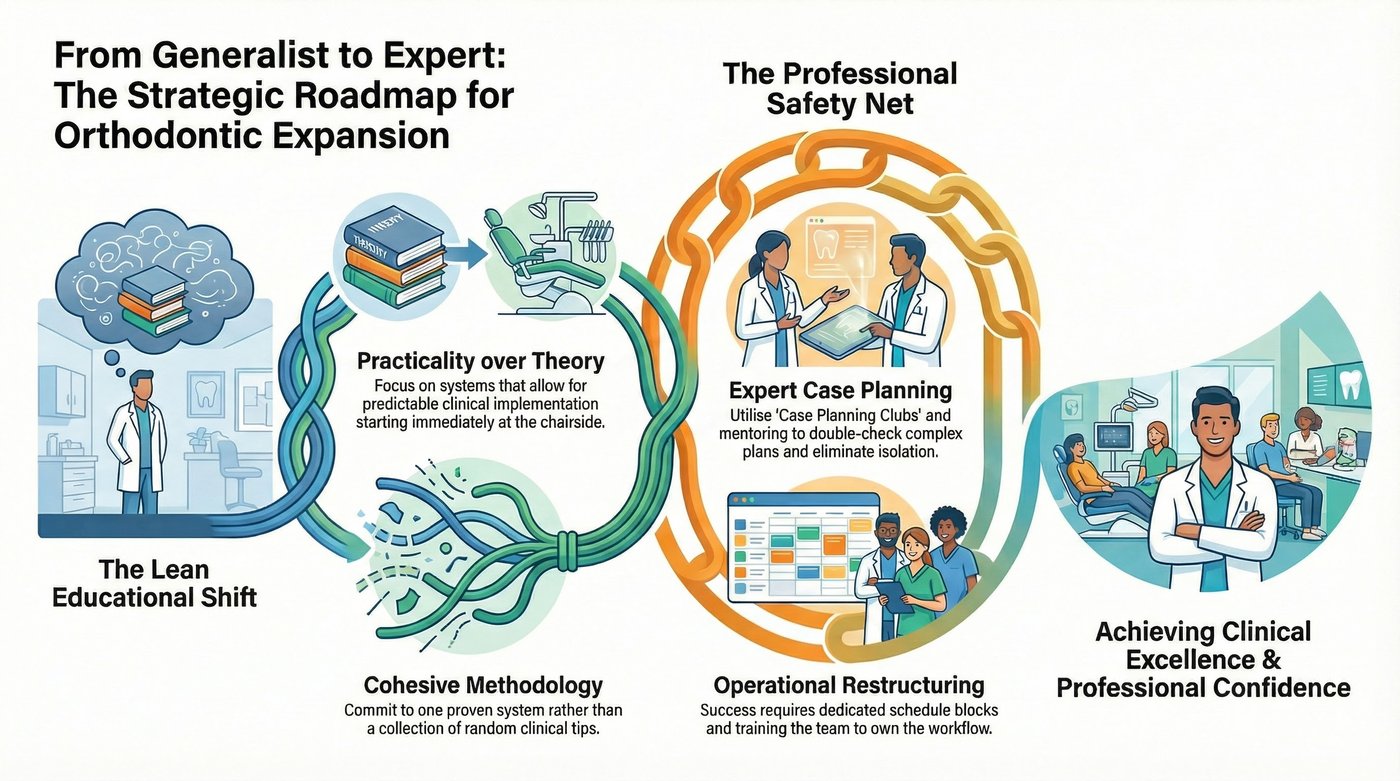
Integrating a new specialty into an established general practice is a significant leadership challenge. It requires more than just a weekend course; it requires a fundamental shift in how you view your clinical education and your professional safety net.
The complexity of shifting from restorative procedures to biomechanical tooth movement demands a strategic mindset from the clinic owner. It’s not simply about acquiring a new skill, but about redefining your practice’s core service offerings and internal operational flow.
Many dentists find that traditional university programs are too theoretical, offering hours of classroom lectures that fail to translate to the actual chairside reality of a busy clinic. These academic approaches often lack the necessary focus on efficient patient flow, team delegation, and profitability metrics vital for a private practice setting.
To build a thriving orthodontic department, you need a system that is practical, reproducible, and supported by expert guidance. This involves implementing standardized protocols for diagnostics, appliance placement, and progress tracking, minimizing variations that lead to extended treatment times.
By following a lean roadmap, you can revitalize your passion for dentistry and provide a valuable service to your community without the risk of professional isolation. This systematic approach transforms orthodontics from a complicated procedure into a predictable, revenue-generating pillar of your practice.
Practicality over Theory: Choosing the Right Educational Path
The “Lean Orthodontics” philosophy focuses on what actually works at the chairside, optimizing every appointment for time and clinical impact. For a general practitioner, your time is your most valuable resource, and every hour spent on non-billable training must yield immediate clinical returns.
You do not need to spend months studying abstract orthodontic history; you need a system that teaches you how to move teeth safely, predictably, and efficiently starting on Monday morning. This immediate applicability is crucial for rapid skill acquisition and for building the case volume needed to achieve mastery quickly.
Look for educational formats that prioritize clinical implementation, such as hands-on patient training or deep dives into specific appliance mechanics. A successful program will teach you to delegate routine tasks, empowering your assistants to manage steps like bond removal or digital scanning, thereby freeing your time for core clinical decisions.
The goal is to build a department that serves your patients at a specialist level. This requires a commitment to a proven system, not merely a collection of random “tips and tricks.” When you commit to a cohesive methodology—for instance, standardizing your bracket prescriptions and archwire sequences—your clinical results remain consistent, and your confidence as a leader grows. Consistent outcomes are the foundation of a strong referral network and reduced chair time per patient.
The Professional Safety Net: Mentorship and Case Planning
One of the greatest fears for general dentists entering orthodontics is the “difficult case” that goes off track, leading to patient dissatisfaction or prolonged treatment. The fear of litigation or needing an expensive specialist rescue often creates a psychological barrier to starting orthodontic services in the first place.
In rural or underserved areas, where specialists may be miles away, this fear can prevent you from starting meaningful treatments that your community desperately needs. Taking on these local cases not only serves the community but also solidifies your practice’s position as a comprehensive health provider.
A lean leader understands that expert intelligence does not mean knowing everything; it means knowing where to find the answer rapidly and reliably. This intelligence is operationalized through a robust support structure.
Successful practitioners utilize “Case Planning Clubs” and regular mentoring to act as a clinical safety net. These structured peer-review sessions allow you to submit digital records for external analysis, catching potential issues like root proximity or anchorage loss before they manifest clinically. Having an expert double-check a complex plan or confirm a mechanical strategy provides the peace of mind required to take on more challenging cases. This ongoing support ensures that you never feel alone at the chairside and that your patients always receive the highest standard of care.
Strategic Commitment: Is It for You?
Before expanding your practice, you must be honest about your intentions and the required commitment. If you are simply looking for “extra cash” without the effort of restructuring your clinic, orthodontics will only add to your stress by creating fragmented appointments and inefficient scheduling. The success of a specialty hinges on dedicated resources, not just incidental time.
However, the investment yields significant returns if you are willing to:
Structure your schedule into dedicated blocks, treating orthodontic patients on specific days or halves of days to streamline equipment and staff allocation.
Train your team to take ownership of the workflow, utilizing checklists and delegation to maintain treatment momentum and patient satisfaction.
Commit to a lean, simplified system of mechanics, which reduces inventory and minimizes the learning curve for both you and your clinical staff.
Then, orthodontics can become one of the most rewarding and profitable departments in your practice. It is a discipline built on long-term relationships and transformative results. The consistent, recurring appointments foster deep patient loyalty and predictable recurring revenue streams. By adopting a lean leadership mindset, you can successfully bridge the gap between general dentistry and orthodontic mastery, building a practice that stands for clinical excellence and operational efficiency.
Conclusion:
The journey from a general practitioner managing simple tooth movements to a leader overseeing a thriving orthodontic department is a testament to strategic commitment. This expansion is not defined by clinical complexity alone but by a structured operational framework. Embracing a ‘Lean Orthodontics’ philosophy, prioritizing practical, chairside-applicable education, and establishing a robust professional safety net through mentorship are the three critical pillars of success. By systematically applying these principles—from dedicated scheduling to team empowerment and consistent case review—you transform risk into predictability. Ultimately, successful orthodontic integration elevates your practice, securing a new source of stable revenue while delivering life-changing comprehensive care to your community. This strategic move defines the future of your professional legacy.