

From Friction to Flow: Mastering Error Management in the Orthodontic Practice
Published on: Jul 5, 2026
The Emotional Tax of Clinical Criticism
In the high-pressure environment of an orthodontic clinic, negative feedback can feel like a personal attack. Whether it’s a parent frustrated by a scheduling delay or a patient critiquing a minor detail of the practice experience, our natural instinct is often defensive. We feel the urge to justify, explain, or push back immediately. However, in the world of lean orthodontics, we recognize that this reactive state is a form of emotional waste that clouds professional judgment and stalls practice growth.
True dental leadership isn’t about being perfect; it’s about having a systemic, repeatable way to handle the human element of friction. To move from a stagnating practice to one that thrives on a culture of continuous improvement, we must learn to transform these moments of conflict into opportunities for operational excellence.
The Four-Second Reset: Breaking the Reactive Cycle
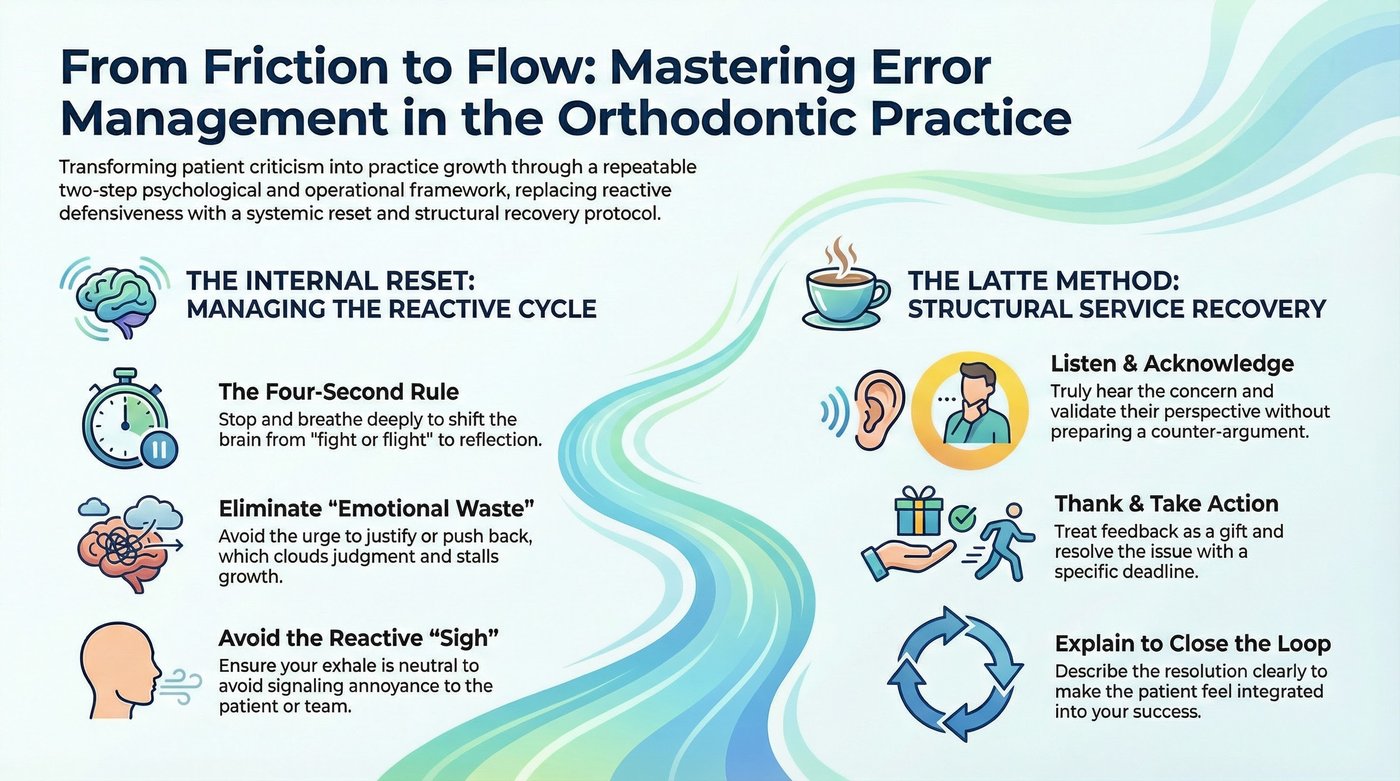
Before addressing the specifics of a complaint, a leader must first manage their own internal state. I advocate for the four-second rule. It is deceptively simple but incredibly powerful: when presented with criticism, stop and breathe. Inhale deeply and exhale slowly—avoiding the “sigh” that can signal annoyance.
This brief pause acts as a biological reset. It shifts your brain from the “fight or flight” reactive mode to a reflective, leadership-focused state. In the heat of a busy clinical day, this one breath provides the space needed to think before speaking, ensuring that your response is constructive rather than defensive.
The LATTE Method: A Structural Approach to Service Recovery
To remove the stress of “not knowing what to say,” every member of a high-performing team should master a structured protocol for handling complaints. I use the LATTE method, an acronym that provides a reliable roadmap for service recovery:
Listen: Truly pay attention to the background of the concern. Instead of preparing a counter-argument, ask the person to tell you more.
Acknowledge: Validate their perspective. You are not necessarily agreeing with every detail, but you are acknowledging that their concern is heard and taken seriously.
Thank You: In a lean environment, feedback is a gift. It is far better to have a direct complaint you can fix than to have a patient complaining behind your back where you have no power to improve.
Take Action: This is where many fail. You must solve the issue and, ideally, provide a clear deadline. Promising an answer by a specific time prevents the “administrative bloat” of a patient having to follow up.
Explain: Close the loop. Describe what you did to resolve the problem. This final step makes the person feel truly integrated into your practice’s success.
Error Management as a Competitive Advantage
As orthodontists, we operate in the hospitality and service sector as much as we do in medicine. A well-handled error can actually result in a more loyal patient than if the error had never occurred. When a patient sees that you take their concerns seriously and act decisively, their trust in your orthodontic practice management increases.
Conclusion: Turning Stepping Stones into Excellence
By implementing a structured way to handle criticism, you strip away the chaos of emotional reactions. You lead your team with calm confidence and ensure that every mistake becomes a valuable lesson. Stop fearing criticism and start using it as a stepping stone toward a more efficient, high-performing practice.