

From Firefighting to Flow: Measuring and Managing Practice Efficiency with Lean Principles
Published on: Jun 15, 2026
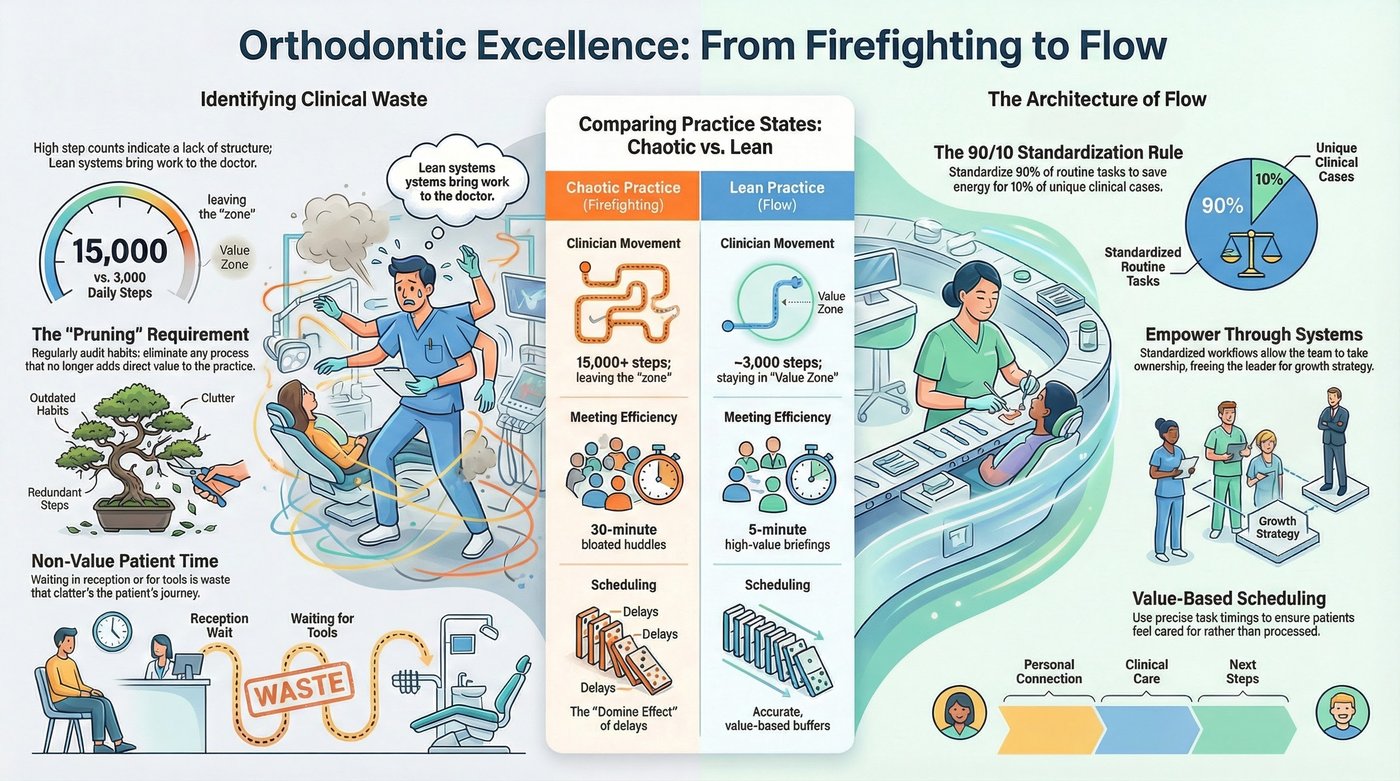
Many orthodontic practice owners end their day feeling physically and mentally exhausted, yet they struggle to pinpoint exactly what caused the fatigue. They have spent the day in a state of “chaotic motion”—running between chairs, answering redundant questions, and managing minor crises. In the world of Lean Orthodontics, this is a clear sign of system failure.
To achieve operational excellence, we must move away from the “busyness” of manual labor and toward the efficiency of systems thinking. By measuring waste and standardizing workflows, we can transform the practice into a high-performing environment that preserves the energy of everyone involved.
The “Step Count” Metric: Measuring Wasted Motion
A fascinating way to measure practice efficiency is through motion. If a clinician ends their day with 15,000 steps on their fitness tracker, it often indicates a lack of lean structure. It means they were forced to leave their “zone” to find instruments, speak to staff, or handle issues that the system should have managed.
In a lean-optimized clinic, the doctor should stay in the “value zone.” A successful, low-stress day might only result in 3,000 steps. This isn’t about being lazy; it’s about the system bringing the work to the doctor in a perfectly prepared state. When you reduce wasted motion, you reduce physical fatigue and increase your ability to focus on the patient in front of you.
The “Pruning” Process: Keeping Habits Lean
Even the best management habits can turn into waste if they aren’t regularly audited. For example, many practices implement a morning briefing to improve dental team performance. Initially, these are five-minute “huddles” packed with value. However, over time, they often bloat into thirty-minute discussions that eat into clinical time.
Lean management requires a commitment to constant pruning. Every system in your practice—from how you order supplies to how you conduct meetings—must be reviewed periodically. Ask your team: “Is this still adding value?” If we stopped doing this today, what would happen?” If the answer is “nothing,” then the process is a waste and should be eliminated.
Maximizing the Patient Journey via Value-Based Scheduling
The patient journey in orthodontics is often cluttered with “non-value” time. From the patient’s perspective, the value is in the consultation, the adjustment, and the final result. Waiting in the reception area or sitting in a chair while a technician looks for a tool is a waste.
By applying lean principles to your schedule, you can create a “buffer” for the day. If you know exactly how long a technical task takes, you can schedule it accurately and use the remaining time for high-value patient interaction. This ensures that the patient feels cared for and respected, rather than processed. It also prevents the “domino effect” where one late appointment ruins the entire afternoon.
Leadership through Standardization
The foundation of practice efficiency is standardization. When every team member knows exactly how a “standard case” is handled, the cognitive load on the practice owner is reduced significantly.
Standardize the routine: Ensure that 90% of clinical tasks follow a strict, repeatable protocol.
Focus on the exceptions: Save your energy for the 10% of cases that require unique clinical decision-making.
Empower the team: A standardized system allows the team to take ownership of the workflow, freeing the leader to focus on growth and strategy.
Conclusion: Restoring Flow to Your Clinic
Lean is not a one-time project; it is a continuous journey toward excellence. By focusing on eliminating waste—whether it is wasted motion, wasted time, or wasted energy—you create a practice that is both highly profitable and deeply fulfilling to lead.
Stop being the “firefighter” of your clinic. Start being the architect of flow. By subtracting the waste, you give yourself and your team the space to perform at your absolute best, delivering a patient experience that is second to none.