

From Firefighter to Leader: Scaling Your Clinic Through Strategic Delegation
Published on: Jun 15, 2026
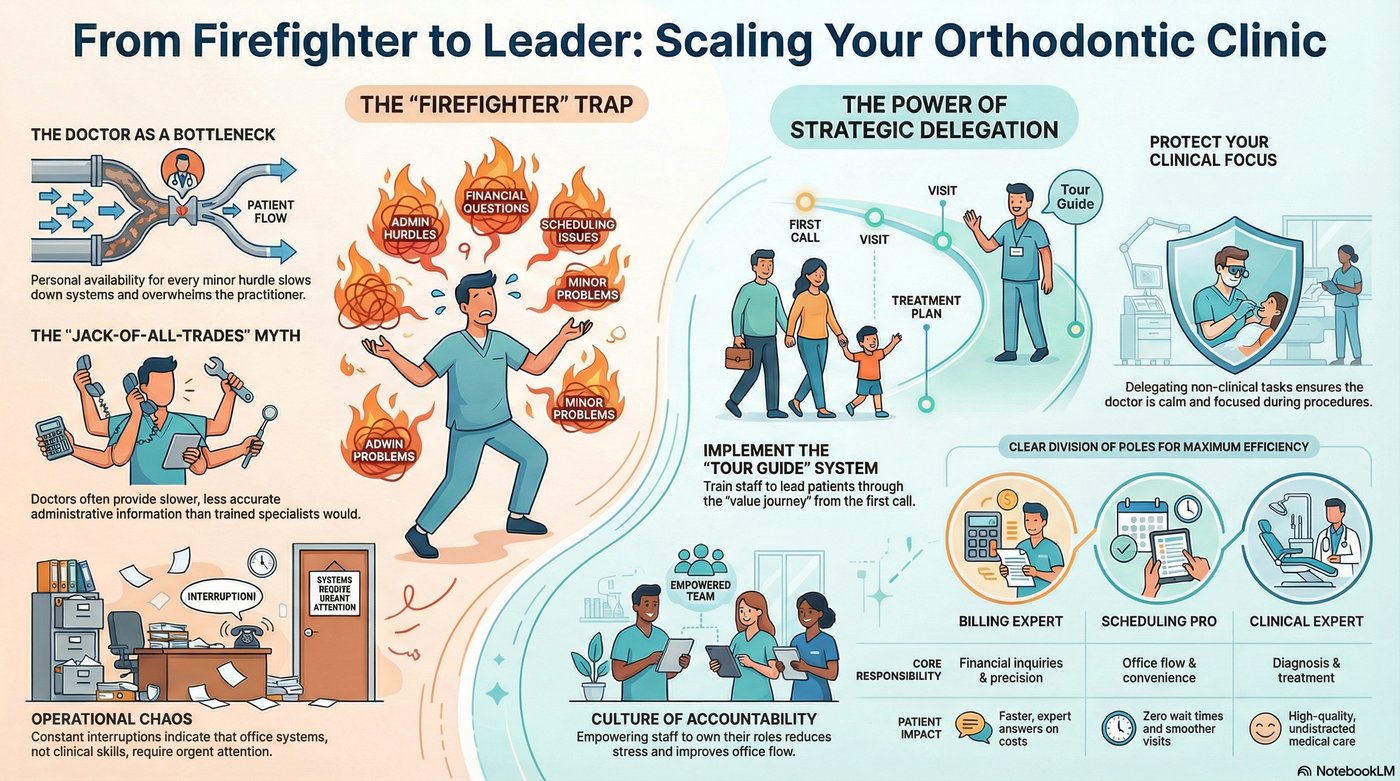
One of the most common pitfalls for orthodontic practice owners is the “firefighter” syndrome. This occurs when a doctor feels that providing excellent service means being personally available for every question, every concern, and every minor administrative hurdle. While the intention is often to provide high-touch care, the result is usually the opposite: a bottlenecked system where the doctor is overwhelmed, the team is underutilized, and the patient experience suffers from delays.
True dental leadership is not about doing everything yourself; it is about building a system where the right people handle the right tasks at the right time. To improve dental team performance and overall practice efficiency, we must move away from the idea that the doctor is the only one who can provide “good service.”
The Myth of Total Doctor Availability
Many practice owners operate under the misconception that “good service” is synonymous with “doctor access.” They fear that if they don’t answer a billing question or personally handle a scheduling conflict, the patient will feel neglected. This mindset actually harms the patient journey in orthodontics.
When a doctor tries to be a jack-of-all-trades, they become a master of none in the eyes of the customer. A patient with a complex insurance question doesn’t actually need to speak to a doctor who is preoccupied with a clinical procedure; they need to speak to a billing expert who has the time and specialized knowledge to solve their problem immediately. By trying to do everything, the doctor often provides slower, less accurate information than a trained specialist would.
Role Specialization and Practice Efficiency
In the framework of lean management in dentistry, efficiency is found through the clear division of roles. Your clinic should function like a well-oiled machine where each “touchpoint” in the customer journey is managed by a professional dedicated to that specific area.
The Billing Expert: Handles all financial inquiries with precision and transparency.
The Scheduling Pro: Manages the flow of the office to ensure zero wait times and maximum convenience.
The Clinical Expert (The Doctor): Focuses exclusively on diagnosis, treatment planning, and the execution of high-quality orthodontic care.
By delegating these non-clinical interactions, you are not distancing yourself from the patient; you are actually improving their experience. They receive faster answers from the people best equipped to give them, and they receive better clinical care because their doctor is focused, calm, and not distracted by administrative fires.
Leadership Thinking: Building the “Tour Guide” System
A leader’s primary job is to design the system that guides the customer through the practice. Think of your team as a group of expert guides. From the moment a prospective patient calls, your staff should be trained to lead them through the “value journey.”
This systematic approach takes the pressure off the clinical side of the practice. If the team has effectively communicated the value and the process, the doctor can step into the exam room and focus on what they do best. When the team handles the “customer” aspects of the journey with excellence, it builds a foundation of trust that makes the clinical work smoother and more successful.
Reducing Chaos through Operational Excellence
If you find yourself constantly interrupted or feel that your practice is in a state of perpetual “controlled chaos,” it is a sign that your systems—not your clinical skills—need attention. Orthodontic practice management is, at its core, the management of flow.
When you empower your team to take ownership of their specific roles, you create a culture of accountability. This high-performance environment reduces stress for everyone involved. The doctor is no longer a firefighter rushing to put out administrative blazes; they are the captain of the ship, providing the vision and the clinical expertise that drives the practice forward.
Conclusion: Focusing on Clinical Mastery
The goal of implementing these systems and embracing the patient-as-customer philosophy is to protect your time as a clinician. Excellence in medicine requires focus. By building a team that excels at service, billing, and logistics, you free yourself to pursue clinical mastery.
Don’t be afraid to step back from the administrative front lines. When you lead your team to handle the “customer” journey, you aren’t just improving your bottom line—you are creating a professional environment where both your staff and your patients can thrive. Excellence in leadership and excellence in medicine are two sides of the same coin; it’s time to master both.