

From Dust to Digital: Why Video-Based Quality Management is the Future of Orthodontics
Published on: Jul 6, 2026
The Failure of Traditional Quality Management
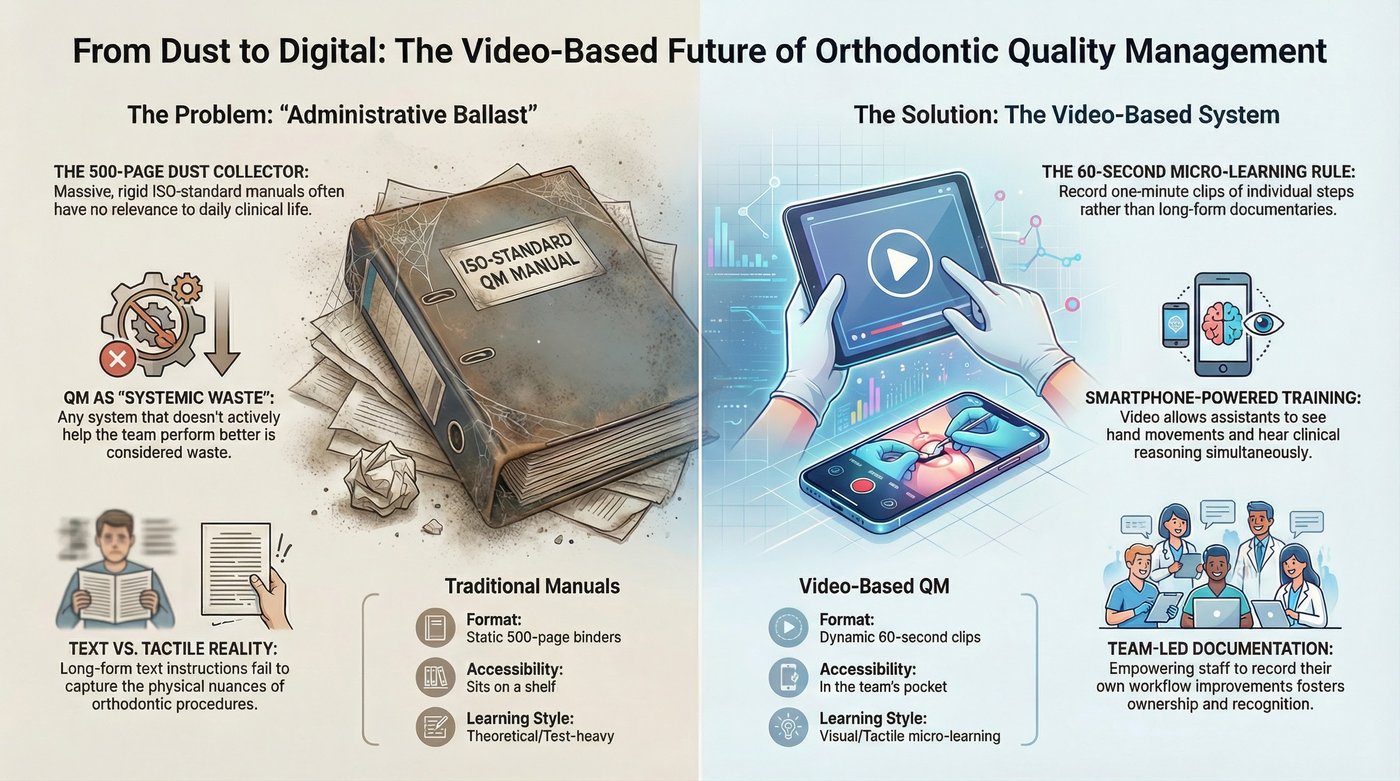
For decades, orthodontic practice management has been synonymous with the “QM manual”—a massive, five-hundred-page binder that sits on a shelf collecting dust. Many clinic owners, in an attempt to be professional, hire specialized agencies to create these manuals according to rigid ISO standards. The result is often an overblown disaster filled with terminology that has no relevance to the daily life of a dental assistant or a clinician.
When a manual is too thick to read and too complex to follow, it ceases to be a tool for quality; it becomes administrative ballast. In lean management in dentistry, we believe that any system that doesn’t actively help the team perform better is a form of waste. To achieve true practice efficiency, we must strip away the useless paperwork and move toward a living, breathing system that reflects the reality of our clinical work.
The Power of the Smartphone in Your Pocket
The most effective tool for modern quality management is already in your pocket. Instead of writing long-form text instructions that no one will read, the modern leader utilizes video documentation. This shift is not just about technology; it is about human psychology. We are visual learners, especially when it comes to the “tactile” nature of orthodontic procedures.
Creating a work instruction should be as simple as taking out your phone and recording a sixty-second clip. Whether it is the specific way you set up for indirect bonding or the exact steps for placing a mini-implant, a video captures the nuances that text cannot. When an assistant can see the hand movements and hear the clinical reasoning simultaneously, the learning curve is shortened dramatically.
Micro-Learning: The One-Minute Rule
A common mistake in dental leadership is trying to document everything in one go. This leads back to the “mountain of paperwork” problem. Instead, focus on micro-learning. A work instruction does not need to be a fifteen-minute documentary. In fact, it shouldn’t be.
By focusing on small, individual steps, you make the information digestible. A one-minute video explaining a specific change in a workflow is far more likely to be watched and implemented than a long-form lecture. This modular approach allows you to build a digital library of standards that can be updated instantly as your techniques evolve.
Turning Documentation into a Team Asset
Quality management should not be a top-down mandate; it should be a shared resource. When you empower your team to use their phones to document improvements, you foster a culture of dental team performance and ownership. If an employee finds a way to shave thirty seconds off a chairside procedure, they can record a quick video to show their colleagues.
This removes the “fear of documentation.” Suddenly, QM is no longer a chore—it is a way for the team to gain recognition for their ideas. If you prefer written text for quick reference, you can use the dictation feature on your phone to convert these videos into searchable transcripts. This ensures the information is accessible at all times, even in a busy clinic where watching a video with sound might not be practical.
Conclusion: A Living System for a Modern Clinic
The transition from static paper manuals to dynamic video documentation is a hallmark of a high-performing orthodontic practice. It aligns your standards with the way your team naturally communicates and learns. By stripping away the administrative noise and focusing on practical, visual guidance, you ensure that your quality management system actually does its job: making the work lighter, faster, and more successful. Stop writing about what you do and start showing it.