

From Crisis to Control: Ending the “Firefighter” Cycle in Your Practice
Published on: Jun 10, 2026
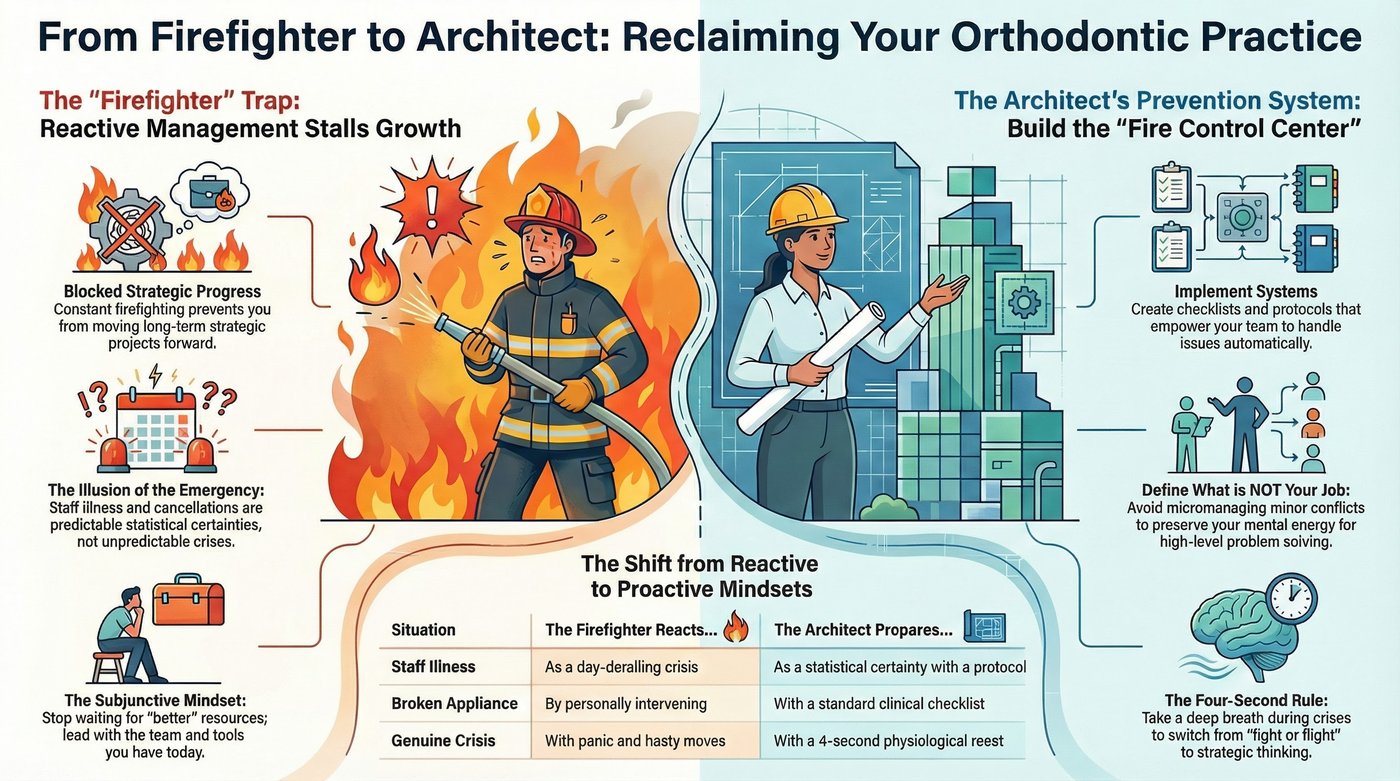
Many orthodontists and dental leaders start their workday with a clear strategic plan—perhaps focusing on team training, marketing integration, or new technology. Yet, they often find this vision completely derailed by 10:00 AM. A key staff member calls in sick, a complex bracket repair is squeezed into an already full schedule, or a billing dispute erupts at the front desk, demanding immediate attention. By day’s end, you feel utterly exhausted, yet you haven’t moved a single long-term project forward. This cycle is the “firefighter” trap—a state of constant reactive management that is the single biggest barrier to sustainable practice growth and personal fulfillment.
True dental leadership is fundamentally not about how proficiently you handle every small emergency; it is about how many predictable crises you prevent from ever occurring through superior systems. To scale your practice, attract high-value talent, and reclaim your time, you must shift your mindset entirely. Stop being the chief “solver of all problems” and transition into the role of the architect who designs a resilient, self-managing operational system. This deliberate shift moves the practice from daily chaos to predictable, efficient control.
The Illusion of the Emergency
The first, critical step in clinical and administrative leadership is defining what truly constitutes an unforeseen “fire.” Most issues categorized as daily emergencies are nothing more than predictable, high-frequency occurrences that simply lack a pre-built system for resolution. This distinction is vital for maintaining focus and delegation.
Consider common examples in a busy practice setting:
A staff illness is not a genuine fire; it is a statistical certainty, demanding a cross-training protocol and a designated floater system.
A patient cancellation or no-show is not a fire; it is a normal, measurable part of the business, requiring an active waitlist management protocol and confirmed communication systems.
A broken appliance or loose bracket is not a fire; it is a standard clinical event that requires a standardized, documented procedure for repair and scheduling, handled entirely by the auxiliary staff.
If these routine events consistently require your personal intervention, it is a clear symptom that your practice lacks effective fire prevention mechanisms. Effective “fire prevention” in a lean dental practice necessitates a quality management system filled with visual checklists and unambiguous Standard Operating Procedures (SOPs). These protocols empower your team to handle 90% of issues automatically and independently. When the team must dictate your next move because structure is absent, you have essentially forfeited control of your business and become a perpetual servant to low-level tasks.
The Cost of the “Subjunctive” Mindset
Many successful practice owners fall into the “subjunctive trap,” a paralyzing form of wishful thinking. This is the counterproductive belief that if they had better, more experienced employees, or if they had more physical chairs and space, then they could finally implement proper leadership and systematic change. Lean management philosophy teaches us the opposite: you must commit to leading and optimizing with the exact resources you have available right now. Waiting for the “perfect” team or facility is merely a sophisticated form of procrastination that guarantees continued stagnation.
The primary solution is rarely more resources, but clearer, better role definitions, beginning with the leader. You must rigorously define a job description for yourself as the CEO. Ask yourself: “What are the three most critical, non-delegable tasks only I can do to grow this practice, and what is not my job?”. If you are still approving minor supply orders or personally arbitrating a minor scheduling conflict, you are micromanaging your way into exhaustion and stifling team growth. Your true value lies in providing the strategic “fire control center”—the robust protocols, decision matrices, and necessary tools—that genuinely empower your team to resolve issues and act confidently without constant recourse to you. This strategic enablement transforms reactive employees into independent problem-solvers.
Developing “Nerves of Steel”
While most crises are preventable with good systems, a genuine, unforeseen “real fire”—like major equipment failure, a system-wide IT crash, or a serious patient adverse event—will eventually hit. In these high-stakes moments, most practitioners react with a sudden jolt of panic. This immediate, emotional response often leads to hurried, ill-considered decisions that inevitably create exponentially more work, rework, and potential legal exposure later on.
Professional leadership demands the ability to quickly recognize the true scope of a situation, precisely assess its potential impact, and execute a measured solution with absolute calm. You must be the stabilizing force in the room. One of the most effective tools for immediate emotional regulation is the four-second rule. When a situation feels overwhelming, or your heart rate rises, pause to take four full seconds to simply inhale deeply and exhale fully. This brief, physical reset interrupts the limbic system’s “fight or flight” reactive mode and forces your brain back into a rational, strategic state. This pause is the definitive difference between an expensive, panicked mistake and a calculated, professional leadership move. Training your entire leadership team in this same tactical pause ensures predictable stability under pressure.
Conclusion: Leading with Strategic Intent
You fundamentally cannot build a robust, profitable future while your time and energy are constantly dedicated to chasing smoke and extinguishing smoldering issues. By actively systematizing the predictable occurrences and diligently delegating the common, daily tasks, you successfully free up the essential cognitive and mental energy required for high-level problem solving, strategic planning, and visionary leadership. This is the critical work that truly drives sustainable practice growth and allows you to look beyond the immediate operational horizon.
Stop defining your role by how quickly you can personally solve every smoldering administrative or clinical issue. Start redefining your role as the strategic leader who ensures the fire never has the conditions to start in the first place. When you make the deliberate move from reactive management to proactive, system-based control, you achieve two primary outcomes: you drastically improve your practice’s efficiency, patient experience, and profitability, and far more critically, you improve your own quality of life, personal focus, and career sustainability. This systematic approach is the only path to achieving true professional autonomy and scalable success.