

From Conflict to Catalyst: The Leadership Art of Professional Complaint Management
Published on: Jun 13, 2026
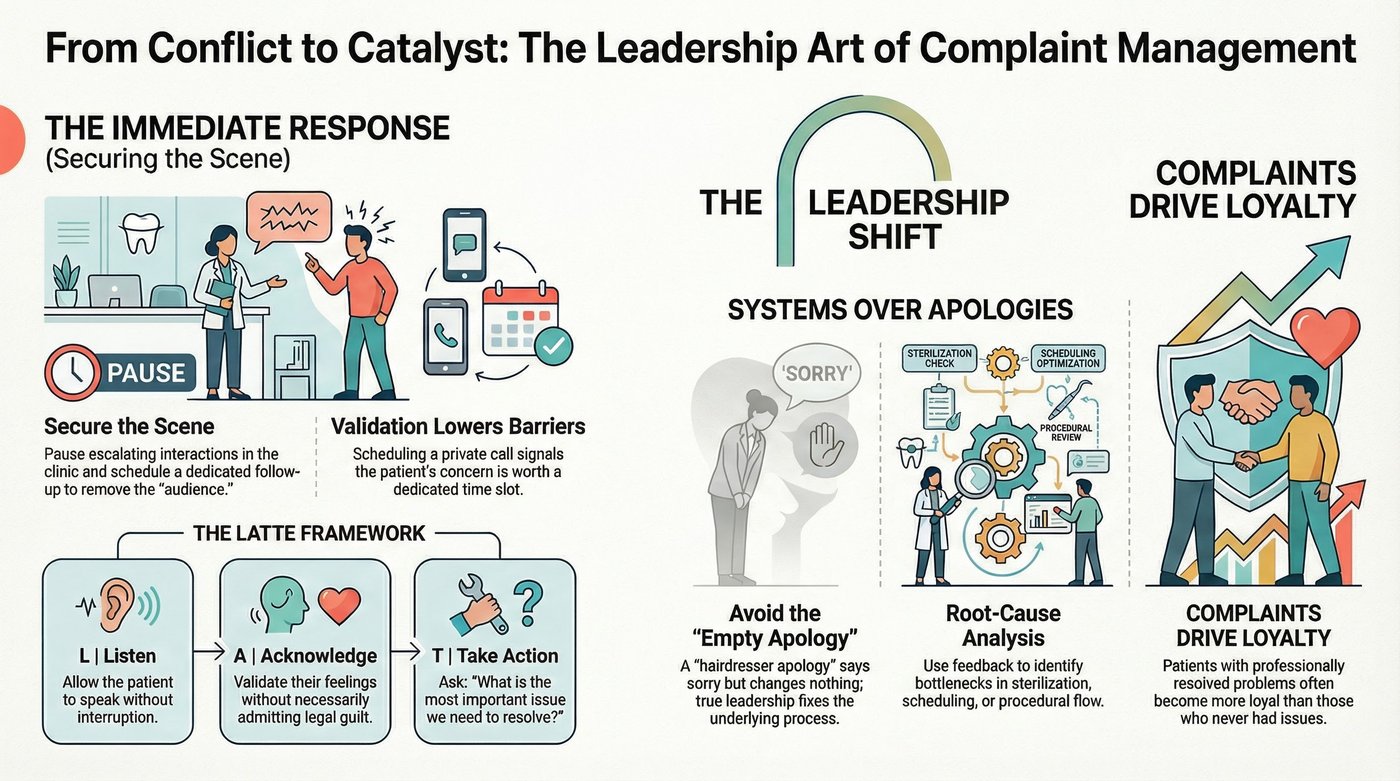
Many orthodontists view patient complaints as a personal attack or a sign of clinical failure. Some even claim they never receive complaints at all—a statement that usually reveals a profound lack of accessible feedback channels rather than a state of clinical perfection. In the realm of elite dental leadership, a complaint is not a nuisance; it is a “crime scene” rich with forensic evidence. It functions as a critical stress test that reveals exactly where your operational systems are brittle and where your clinical or administrative team needs immediate support.
Leaders must reframe this moment from one of defensiveness to one of data collection. These grievances, whether minor or major, provide an unfiltered look into the patient experience that internal audits often miss. Failing to capture this critical feedback ensures that the systemic issue will simply recur with the next patient, leading to churn and reputation damage.
To turn a dissatisfied patient into a loyal ambassador, you must move away from emotional reactivity and toward a structured, professionalized management system. This approach protects your team’s mental health by establishing clear protocols, simultaneously reducing anxiety and driving predictable practice growth through service excellence.
Securing the Scene: The De-Escalation Strategy
When a patient is upset, they often present a “cloud of grievances,” where the root cause is obscured by a fog of minor frustrations. They may jump from the lack of parking to a perceived slight at the front desk, often fueled by external personal stresses unrelated to their treatment. The instinctive reaction for any staff member is to defend themselves or their colleagues immediately. However, a professional leader acts like a detective: the first priority is to secure the scene and control the environment.
This process begins with isolating the conversation. Allowing a heated discussion to play out in the reception area damages the trust of every nearby patient, signaling a lack of control and professionalism. Implement a mandatory protocol to move any escalating complaint to a private, non-clinical office instantly. This maneuver creates a psychological boundary that limits the patient’s ability to use public performance as leverage.
If a patient begins to escalate in a busy clinic, the most professional response is to pause the interaction and schedule a formal follow-up. By saying, “I can see this is important, and I want to give you my full attention, which I can’t provide right now between patients. Let’s speak privately at 6:00 PM.” You achieve two critical things: De-escalation and Validation.
De-escalation: You remove the “audience” and the immediate, performance-driven tension, forcing a cooler discussion later. This time buffer allows both parties—the patient and your staff—to process the situation rationally and prepare for a solution-focused meeting.
Validation: You signal that their concern is worth a dedicated time slot away from the clinical hustle, which immediately lowers their defensive barriers and communicates respect for their time.
Dissecting the Complaint with the LATTE Method
To handle the actual conversation, your practice must rely on structured, repeatable frameworks like the LATTE method. This systematic approach ensures that even under significant pressure, your response remains professional, comprehensive, and empathetic, preventing staff from improvising poorly.
Listen: Allow the patient to speak without interruption, taking notes on key factual points, not just emotional declarations. Active listening means using non-verbal cues and paraphrasing periodically to ensure complete accuracy regarding their claims.
Acknowledge: Validate their feelings without ever admitting clinical or legal guilt. Phrases like “I understand that this was a frustrating experience for you” acknowledge the feeling without agreeing with the cause. This is a crucial distinction for risk management and protecting the practice.
Take Action: Move past venting to resolution by asking the critical question: “Of everything you mentioned, what is the single most important issue we need to resolve today?” This forces the patient to prioritize their grievances and clearly defines the scope of the required solution.
Thank: Sincerely thank them for the feedback; it is invaluable, raw data your practice wouldn’t have otherwise. Expressing gratitude shifts the dynamic from confrontation to one of collaborative problem-solving.
Explain: Clarify the precise, actionable steps you and your team will take immediately to ensure the issue does not happen again. This explanation must focus on future prevention and systemic corrections, not past excuses or justifications.
The Trap of the “Empty Apology”
A common, yet devastating, failure in orthodontic practice management is the “hairdresser apology”—the quick “sorry” that masks an intent to change absolutely nothing. An apology without a subsequent, deep root-cause analysis is not just insufficient; it is a wasted opportunity for systemic improvement and waste reduction. Leaders must transition from simply comforting the patient to a forensic investigation of the internal process.
For example, if a patient complains about a long wait, the default response is often a weak apology centered on busyness. Instead, the leader must drill down into the operations using objective metrics. Analyze the schedule: Was there a technical bottleneck in the sterilization room? Did an assistant fail to set up trays on time? Did a specific, complex procedure take longer than the allotted time, indicating a systemic flaw in booking methodology?
True leadership means using the complaint as the trigger to fix the underlying, repeatable process. Once the system is corrected—perhaps by adjusting booking times or staggering hygiene appointments—you can report back. When you can go back to the patient and say, “Because of your feedback, we have restructured our afternoon flow to prevent that delay for all future patients,” you have proven your competence, demonstrated tangible care, and transformed a negative event into a net positive reputation gain. This creates an evidence-based feedback loop that solidifies patient trust far more effectively than a simple gift card.
Conclusion: Building a Resilient Practice
A complaint is, unequivocally, a gift of information—a free consultation on how to make your practice better and more efficient. By investing in a standardized, professional protocol for conflict resolution, leaders create a self-correcting culture of continuous improvement across all staff levels, from the reception desk to the operatory. This shifts the practice’s mindset from one that fears mistakes and hides them to one that actively uses every failure as fuel for operational and clinical excellence.
Ultimately, mastering complaint management is a fundamental leadership skill that moves beyond clinical expertise into strategic business management. It is the ability to maintain composure under fire, gather essential data, and execute a correction that proves your practice’s commitment to patient well-being, even when systems fail. Remember, a patient who has a problem solved professionally, transparently, and effectively is often far more loyal and advocates more fiercely for your brand than one who never had a problem at all. This level of service recovery transforms potential detractors into your most resilient ambassadors. The investment of time and training in this area is not overhead; it is a direct investment in the long-term reputation, resilience, and profitability of the practice.