

From Clinician to Architect: Navigating the Transition to a Scaling Practice Network
Published on: Jun 9, 2026
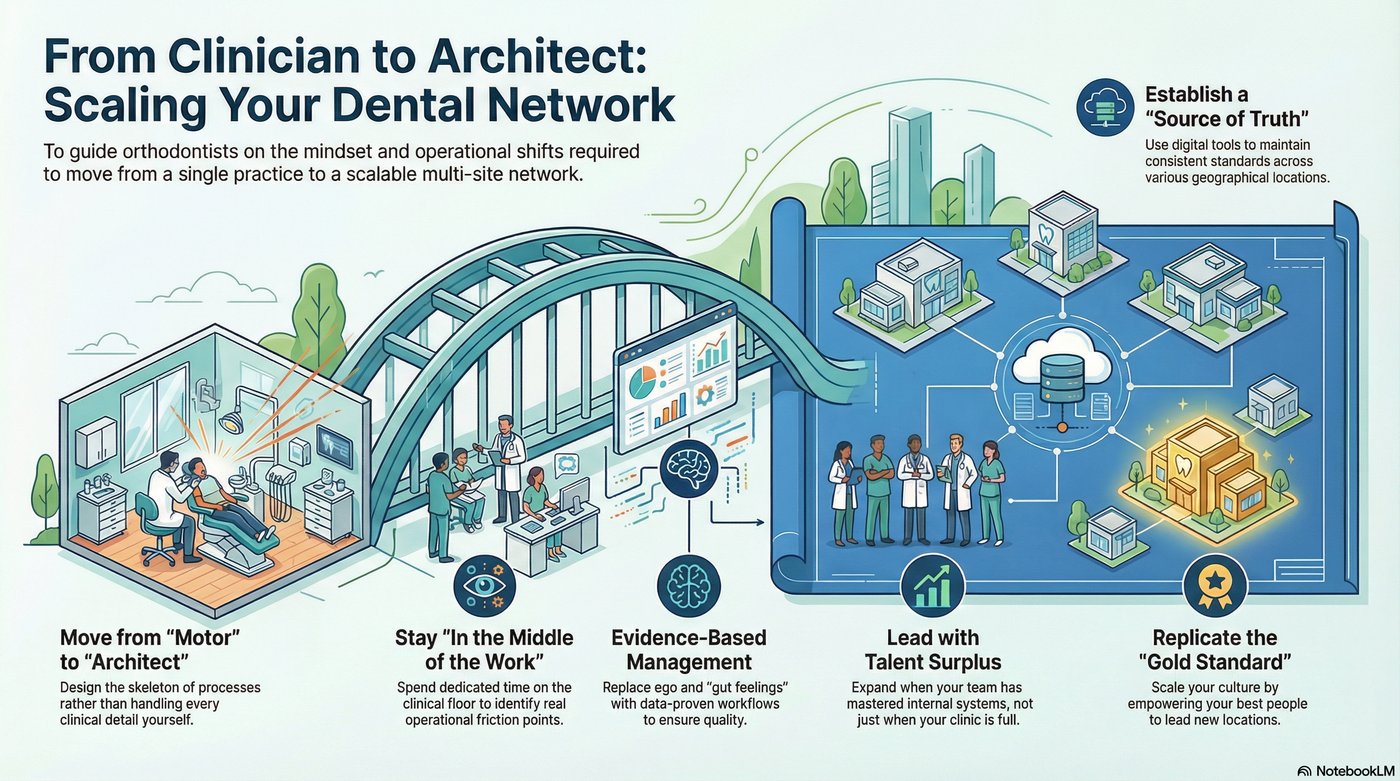
Most orthodontists eventually reach a plateau where their personal clinical output becomes the “ceiling” for their practice’s growth. They are working more hours, seeing more patients, but their revenue and personal freedom have stalled. This is a crucial pivot point: the practice cannot grow beyond the doctor’s individual capacity, leading inevitably to burnout and stagnant profitability. Expanding from a single location to a scaling network is the ultimate entrepreneurial leap, but it requires a fundamental shift in identity: you must move from being the primary “motor” of the clinic to being the “Guardian of the System.”
The journey to a multiple-practice model is not just about physical expansion; it is about the radical systemization of your expertise. This involves defining standardized clinical protocols, such as specific bracket placement techniques and wire sequencing, that ensure predictable patient outcomes regardless of the treating doctor. Success at scale depends on creating a concept that functions independently of your physical presence at every chair.
The Catalyst for Systems-Thinking
Many practitioners view remote management as a modern luxury, but for those aiming for a high level of focus, it is a necessity. Drawing from the “clinical consultant” model—where doctors maintain academic edges while overseeing various locations—we see a more diverse and colorful professional life. This model is fundamentally about leveraging cognitive capital, applying high-level knowledge across sites rather than dedicating physical labor to the chair.
However, this model only works if the doctor is incredibly efficient. When you are managing multiple sites, your time on-site becomes precious. This forced efficiency is the catalyst for building a lean organization. It transforms your on-site hours from patient treatment time into audit time, focusing on critical bottlenecks like supply chain logistics or scheduling flow rather than clinical minutiae.
You begin to use digital tools not because they are “techy,” but because they are the only way to maintain a “Source of Truth” across a geographical distance. Centralized cloud-based Practice Management Systems (PMS) are vital for unifying patient records, treatment plans, and standardized forms across every location.
Scaling Talent: When to Open the Second Location
A common mistake is opening a second practice simply because the first one is full. A better indicator for expansion is a surplus of talent. This means you have a core team—perhaps a lead assistant or an associate—who not only possesses outstanding clinical skills but has also fully internalized and mastered your internal operational systems. When you have built a team of outstanding, well-trained employees who have mastered your internal systems, it becomes inefficient to keep them all in one building.
Instead of letting that skill set stagnate, you expand to a new location to replicate your existing “Gold Standard” one-to-one. Utilizing top performers to bootstrap the new office ensures cultural and clinical fidelity from day one. In a star-shaped expansion pattern, you can benefit from marketing synergies while ensuring that each office has its own local patient base. This geographic strategy allows for shared administrative functions, such as centralized billing or HR, optimizing overhead costs. This is the essence of dental leadership: scaling your culture by empowering your best people.
The “Guardian of the System” Role
As you scale from one practice to three, five, or more, your role must evolve. You cannot be the lead clinician in five places at once. You become the architect who designs the skeleton of the processes, while your subject matter experts handle the details. This architectural role involves defining Key Performance Indicators (KPIs) for clinical associates and office managers, focusing on metrics like case acceptance rates and adherence to treatment time estimates.
However, you must never fully leave the clinical floor. Staying “in the middle of the work” for a dedicated portion of your week is the only way to truly understand the friction points in your systems. This involves performing system audits during a rotation, rather than taking on a full patient load. Most of your leadership becomes remote—using video chats and digital platforms to connect with a team of forty-five or more—but your clinical days keep your “Guardian” role grounded in reality.
Evidence-Based Management
In clinical orthodontics, we rely on evidence to guide our treatments. To scale effectively, we must apply that same rigor to management. We don’t implement a new workflow because of a “gut feeling” or because a professor once said so; we research, test, and document the results. A practical example is piloting two different scheduling templates (e.g., block vs. wave) to determine which one measurably reduces patient wait times and staff stress across a quarter.
This evidence-based approach removes the ego from leadership. It replaces “because the boss said so” with “because the data shows this works.” This fosters a transparent culture where staff feel empowered to flag system failures, knowing the outcome will be system improvement, not personal blame. This level of clarity is vital when managing large teams. It ensures that even when you are not in the room, the quality of care remains high and the “Value Stream” remains uninterrupted. The Value Stream encompasses the entire patient journey, and data ensures efficiency at every step, from initial consultation to retention.
Conclusion: The Path to Operational Freedom
Scaling your practice is a process of constant learning and refinement. It requires a high tolerance for frustration and a commitment to professionalizing every internal structure. The commitment involves investing in the training, technology, and leadership team necessary to sustain multi-site operations. When you successfully transition from a single practice to a network, you aren’t just increasing your revenue; you are increasing your impact by delivering consistent, high-quality care to a larger community.
By building a system that is independent of your individual effort, you create a sustainable legacy that provides high-quality care to a larger population while giving you the freedom to lead with strategic vision. Stop being a prisoner of your own clinical output and start building the network that reflects your true potential. Embracing the Architect role is the key to unlocking true operational freedom and maximizing your professional legacy.