

From Chaos to Scalability: Why Hierarchical Processes are the Key to Lean Leadership
Published on: Jun 24, 2026
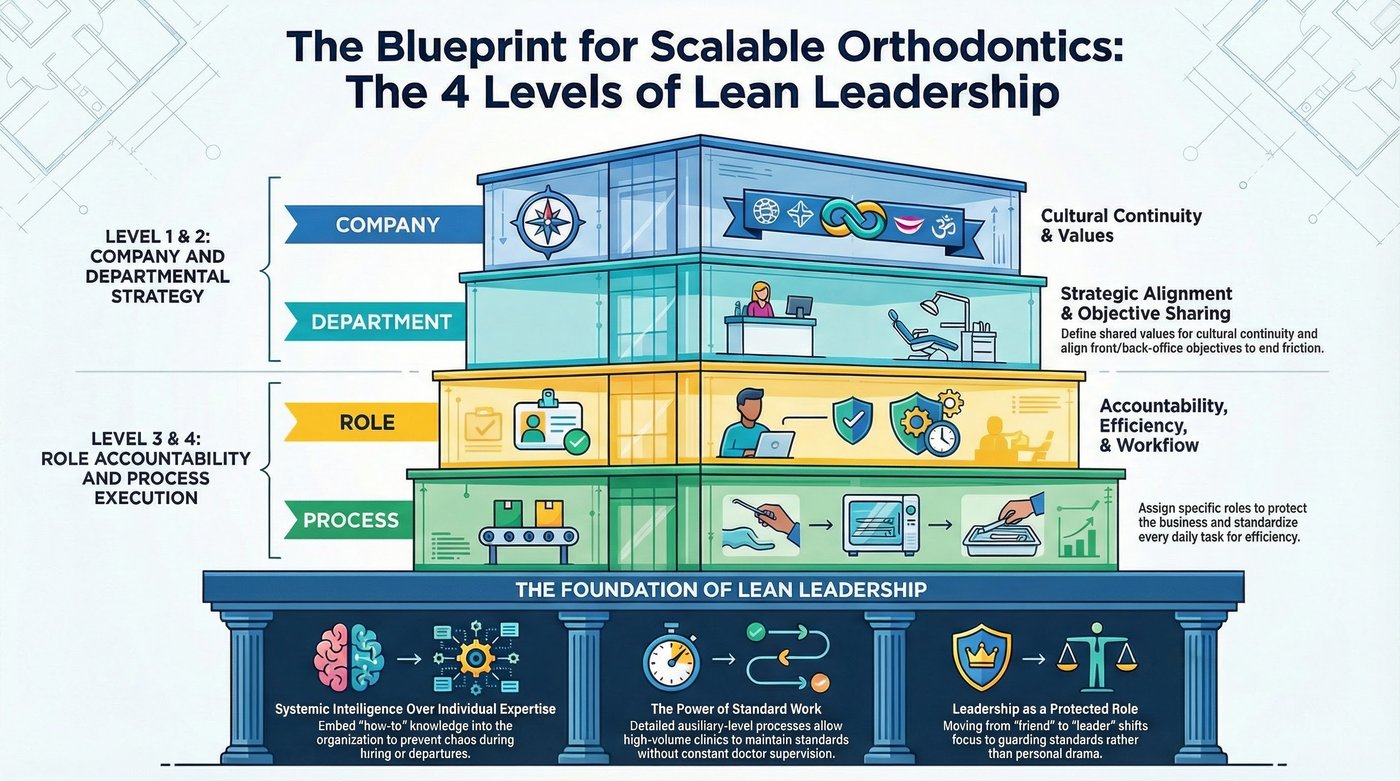
The primary reason many orthodontic clinics fail to scale is not a lack of clinical skill, but a lack of structural clarity. This often manifests as a dependency on tribal knowledge, where critical operational steps are undocumented and exist only in the minds of the owner or a few long-term employees.
When this “how-to” intelligence is not codified, the practice becomes a victim of its own success. Rapid growth without standardization leads to inconsistent patient experience and administrative bottlenecks. Every new hire adds to the chaos, requiring repetitive training, and every staff departure feels like a paralyzing crisis, taking core knowledge with them.
To achieve true operational excellence, you must build a practice where the “expert intelligence” is embedded into the organization itself—a single source of truth for all operations. By structuring your practice through four distinct levels—Company, Department, Role, and Process—you create a resilient, self-managing system that empowers your team and protects your time as a leader.
The Hierarchy of Actions: Organizing the Daily Workflow
Many colleagues view Quality Management (QM) as a static binder of instructions, primarily meant to satisfy external regulators during an audit. In the context of Lean Orthodontics, we redefine QM as a dynamic hierarchy of actions explicitly designed to maximize efficiency and reduce waste in daily clinical flow.
A lack of clearly documented processes forces your team into “unproductive motion”—wasted time spent searching for materials, clarifying ambiguous clinical instructions, or correcting work due to inconsistencies. This non-value-added activity erodes profitability and increases staff frustration.
The highest value comes from defining your processes down to the auxiliary level, covering tasks like instrument sterilization protocols or orthodontic tray preparation and restocking procedures. This level of granular detail facilitates “Standard Work,” which means every task is performed the most efficient, proven way, every time.
For example, a standardized wire-changing procedure guarantees consistent quality whether the assistant has three months of experience or ten years. This systematic approach is the bedrock that allows a high-volume clinic to maintain the highest clinical standards without the doctor needing to hover or micromanage every single chairside interaction.
Protecting the Business: The “Role” of the Leader
For many practice owners, the transition from being a clinical peer to an organizational leader is the hardest shift. This struggle is often rooted in the fear of being perceived as mean, aggressive, or unapproachable when enforcing standards.
The key to overcoming this is defining leadership as a distinct, organizational Role rather than a personality trait. When you adopt this mindset, the emotional weight of accountability discussions shifts entirely. Your role as the leader is specifically defined as the protector of the business’s long-term viability and the guardian of the established process standards.
If an employee fails to follow a documented Standard Work process—such as inconsistent infection control—addressing that lapse is not a personal confrontation. Instead, it is a clinical and operational necessity aimed at protecting the patient, the team, and the practice’s reputation.
When your team understands that everyone—from the doctor to the newest sterilization tech—is playing a specific, defined role to serve the ultimate patient outcome, the internal culture transforms. This fosters professional accountability where constructive feedback replaces personal drama.
Departmental Alignment: Ending the Internal Conflict
A true lean practice cannot afford the operational drag caused by internal friction between the “front” (administration) and “back” (clinical) of the office. This friction is almost always rooted in a siloed perspective, where departments do not understand the core objectives, constraints, and metrics of the other.
For example, the clinical team may view the administration as “pushy” for scheduling back-to-back appointments, failing to appreciate the revenue cycle management required to keep the practice viable. Conversely, the administration may see the clinical team as “slow,” not grasping the necessary time and focus required for clinical precision and safety protocols.
The solution lies in defining a clear, mutually supportive Departmental Objective for each function. This step aligns both groups toward a singular, patient-centric mission. You establish a shared understanding: the administration team strategically “sells” the doctor and chair time, and the clinical team flawlessly “delivers” the promised value and outcome.
When both teams measure success through a common metric—such as Patient Throughput Rate or On-Time Start Percentage—they naturally begin collaborating to eliminate delays and waste, rather than assigning blame. This departmental synergy is the foundation of a high-performance, stress-free environment.
The Scalability Secret: Cultural Continuity
The foundational, overarching layer is the Company level, which ensures that as your organization inevitably grows, your core culture remains intact and replicable. If you are planning to open a second or third satellite location, the only safeguard against quality degradation is a comprehensively defined history, mission, and set of non-negotiable values that every employee lives by.
These documented values serve as a moral operating system, guiding decisions when Standard Work processes do not explicitly cover a situation, such as handling a complex patient complaint or navigating an ethical ambiguity. This continuity is the true scalability secret, turning multi-site practices from a logistical headache into a cohesive brand experience.
Ultimately, structure is not synonymous with restriction; it is the prerequisite for professional freedom. It grants your team the freedom to act with speed and confidence because they intimately understand the rules of the game and their boundaries. It grants you, the leader, the freedom to disengage from day-to-day firefighting to focus on high-level strategy and clinical mastery, secure in the knowledge that the operational ‘machine’ is running correctly. Start defining your four hierarchical levels today, and transform your practice into a lighthouse of professional excellence.
Conclusion
Operational excellence in a dental or orthodontic practice is not an abstract goal, but a direct result of codified structural clarity. By systematically implementing the four hierarchical levels—Company, Department, Role, and Process—leaders successfully transition from crisis managers to strategic architects.
This defined structure eliminates dependency on individual knowledge (tribal knowledge), instills “Standard Work” for consistent patient care, and resolves internal friction through clear departmental alignment. Embracing this hierarchy transforms the practice from a reactive collection of individuals into a resilient, scalable business “machine.” The investment in documented process is an investment in freedom—for the team to perform confidently and for the leader to achieve true mastery.