

From Black Hole to Dashboard: Building a Lean, ROI-Driven Marketing System
Published on: Jun 25, 2026
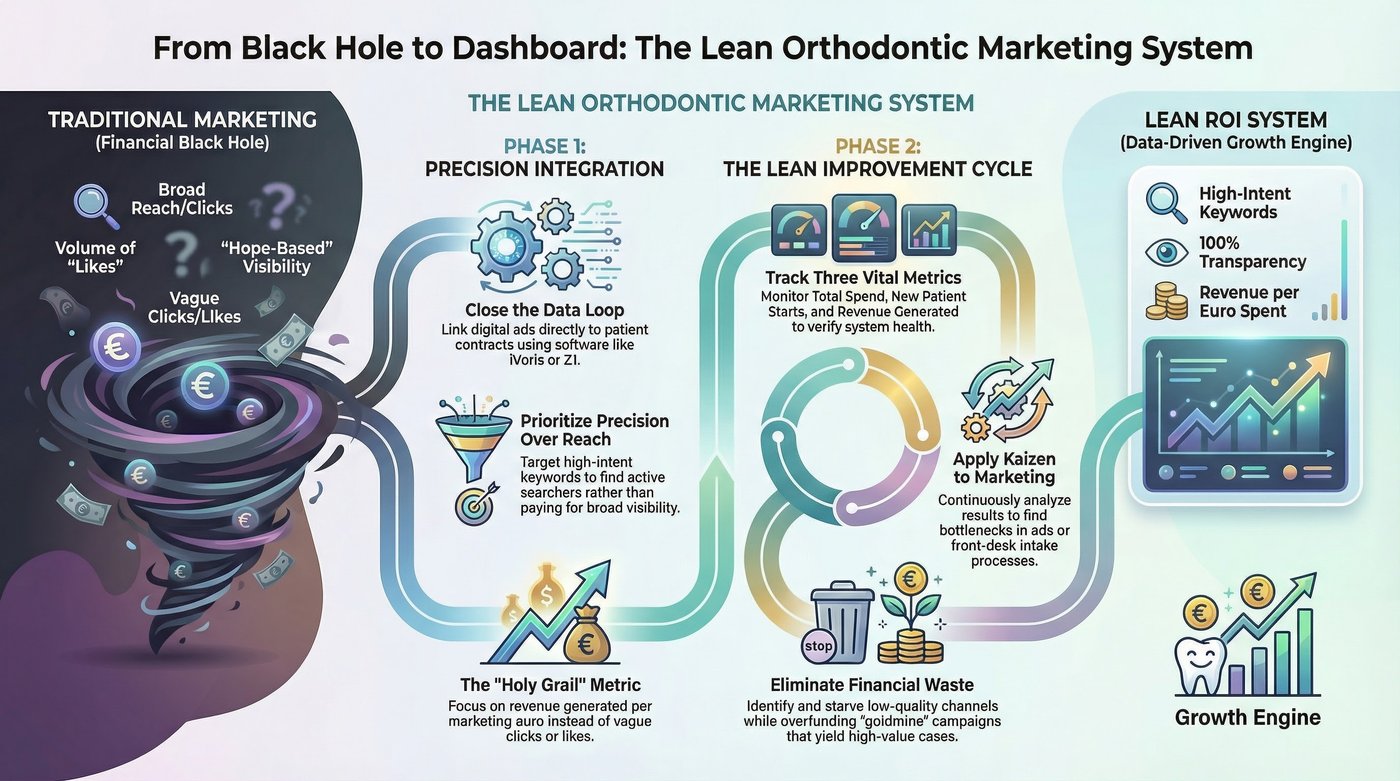
In many orthodontic practices, online marketing is treated like a financial black hole. Clinic owners invest thousands of euros into various digital channels, hoping that the phone will eventually ring. This “hope-based” marketing is the antithesis of lean management. In a lean practice, every resource—especially capital—must be deployed with precision and tracked for its measurable return on investment (ROI).
To achieve operational excellence in patient acquisition, we must move past vague metrics like “clicks” or “likes” and start focusing on the only metric that truly matters: revenue generated per marketing euro. By building a connected, data-driven system, you can transform your marketing from an unpredictable expense into a transparent growth engine.
Closing the Loop: Integrating Marketing and Management Software
The traditional frustration for orthodontists is the inability to link a specific advertisement to a specific patient contract. This data gap creates immense waste. You might be overfunding a campaign that attracts low-quality leads while starving a channel that is a goldmine for high-value cases.
The solution is to “close the loop” by integrating your digital marketing platforms with your practice management software (such as iVoris or Z1). Using unique tracking numbers and digital identifiers, you can follow a patient’s journey from the moment they click an ad for “Clear Aligners” to the moment they sign their treatment contract.
When your system can tell you that a specific Google Ads campaign cost 500 euros but generated 10,000 euros in clinical revenue, you have achieved total transparency. This is the “holy grail” of marketing efficiency, allowing you to make leadership decisions based on hard data rather than gut feeling.
The Power of Precision Targeting over Broad Reach
A lean orthodontist understands that paying for “reach” is often a waste of money. You don’t need the entire city to see your name; you need the small percentage of people who are actively searching for orthodontic solutions to find you.
Unlike traditional print media, Google Ads allow you to pay for relevance. By targeting specific keywords and localized geographic areas, you ensure that your budget is only spent on high-intent users. This precision targeting reduces the “cost per acquisition” (CPA) and ensures that your team’s time is spent answering inquiries from qualified leads rather than window shoppers.
The Lean Cycle: Measure, Analyze, Improve
The philosophy of continuous improvement (Kaizen) applies to marketing as much as it does to clinical chairside efficiency. You do not need to be a data scientist to master this; you simply need a dashboard that highlights three key metrics:
Total Spend: How much did we invest this month?
New Patient Starts: How many patients actually began treatment from these leads?
Revenue Generated: What is the total value of the contracts signed?
If the revenue consistently exceeds the cost, the system is working. If not, you analyze the bottleneck. Is it the ad itself, or is the breakdown happening at the front desk during the initial phone call? By treating marketing as a measurable system, you can identify and fix inefficiencies, ensuring your practice continues to grow without unnecessary financial waste.
Conclusion: From Uncertainty to Strategic Growth
Transitioning from a “black hole” approach to a lean, ROI-driven marketing system is not merely about tracking numbers; it is about reclaiming control over your practice’s future. By integrating your management software, targeting with precision, and embracing the Kaizen cycle of continuous improvement, you eliminate financial waste and ensure that every marketing euro serves as a catalyst for growth. Ultimately, a data-driven marketing strategy provides the clarity needed to lead your practice with confidence, turning patient acquisition into a transparent and predictable engine for success.