

Framing and Finance: The Psychological Shift to High-Performance Sales
Published on: Jun 28, 2026
The Power of the “Frame”
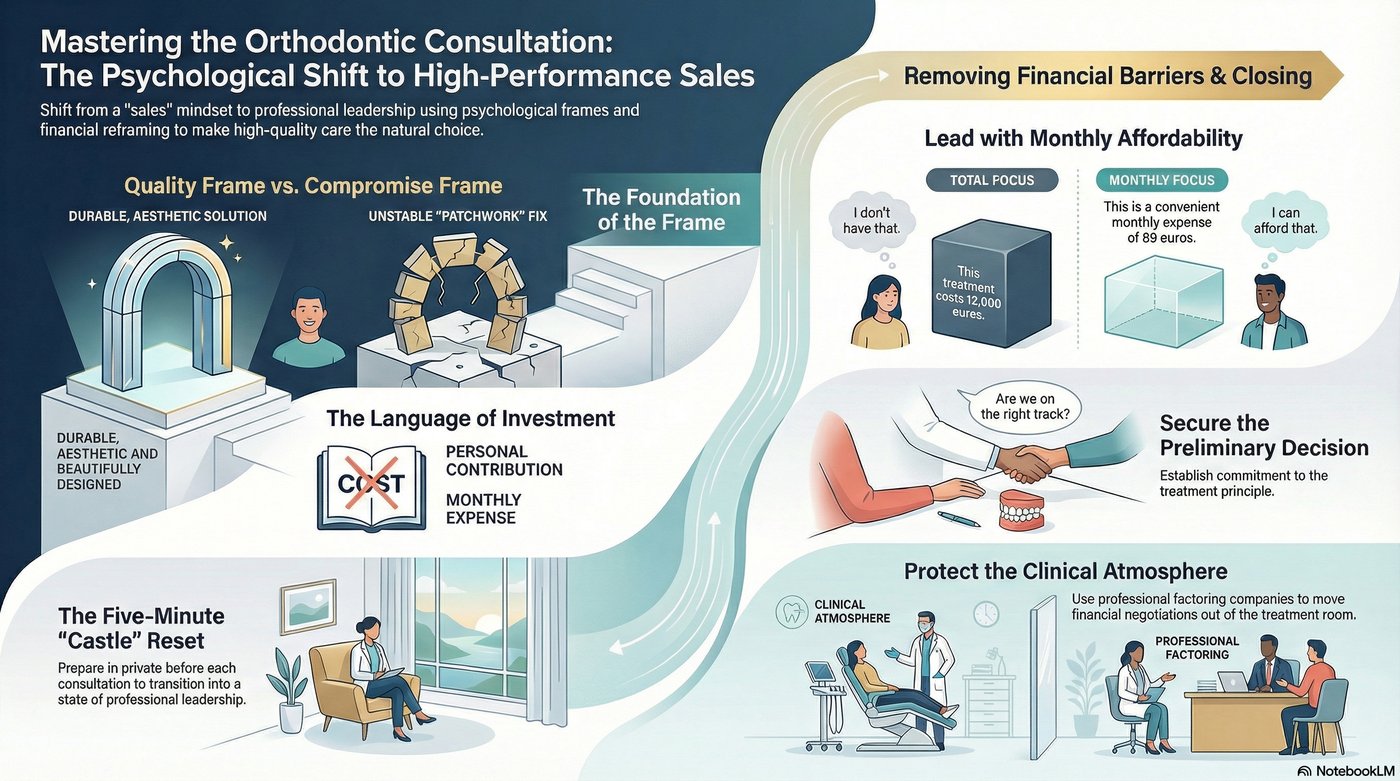
In orthodontic practice management, “Framing” is the art of giving a patient a choice between two distinct realities. This is a foundational principle of psychological leadership, designed to simplify complexity into a clear decision path. Instead of overwhelming patients with a catalog of clinical options, the high-performance practice deliberately creates two clear mental frameworks for them to evaluate.
The first, the Compromise Frame, must be presented as a legitimate—yet ultimately limited—solution. This frame is an emergency fix or a “patchwork” approach that addresses the immediate pain point but carries inherent risk. Clinic leaders must articulate that while this path requires less initial personal contribution, it is often inadequate, unstable in the long run, and may lead to future health complications or require costly remediation. It is the path of immediate gratification that sacrifices long-term stability.
Conversely, the Quality Frame is positioned not as an expenditure, but as a commitment to comprehensive, enduring health. This is a proper, high-quality treatment that is durable, aesthetic, and fully functional. It addresses the root cause and aligns the patient with their ultimate health goals. The contrast must be stark: one frame represents recurring risk; the other represents lasting value.
When you use your language, professional space, and confident body language to clearly separate these two paths, the patient’s brain naturally gravitates toward the frame that represents quality and long-term stability. This is not salesmanship; it is professional guidance. You don’t need complex jargon to explain this dichotomy; the psychological “pull” of quality, durability, and peace of mind is universal and undeniable. Your role is to clearly illuminate the two futures the patient can choose between.
The “Cost” vs. “Expense” Mindset
To improve your practice efficiency and case acceptance rate, you must strategically eliminate the word “cost” from your financial discussions. In the subconscious mind, “cost” feels like money being forcefully ripped away for an unclear, non-beneficial purpose, triggering the powerful psychological force of loss aversion. Instead, consistently speak about the personal contribution or the manageable monthly expense. This seemingly minor linguistic shift reframes the patient’s perspective from sacrifice to sustainable investment.
Clinic leaders must recognize that our true competition is not another dental practice; it’s any major consumer expenditure competing for the patient’s disposable income. It is the high-end car dealership, the luxury vacation planner, or the electronics store. Critically, these industries rarely, if ever, lead their discussions with a daunting five-figure total price. They anchor the conversation on accessibility and monthly affordability.
Total Focus: “This comprehensive treatment plan costs 12,000 euros.” (The patient’s immediate, subconscious brain response is: I don’t have that kind of lump sum available.)
Monthly Focus: “This is a convenient monthly expense of 89 euros, making elite care accessible today.” (The patient’s subconscious brain registers: I can afford that monthly commitment.)
Leading the dialogue with a predictable, manageable monthly amount entirely removes the immediate “financial wall” that stops treatment acceptance cold. It democratizes elite care by focusing on cash flow, not capital outlay. Furthermore, utilizing a professional third-party factoring company is a non-negotiable strategic step. It further protects the vital doctor-patient relationship by removing all friction and stress associated with financial negotiations from the clinical setting, ensuring the atmosphere remains purely focused on patient health and professional care. This outsourcing is a hallmark of high-performance practice management.
The Preliminary Decision: Closing the Loop
A high-performance consultation must never end vaguely or without a definitive preliminary decision. The aim is to secure a “micro-commitment” that validates the consultation and preserves the integrity of your professional expertise. A clear, closing question is essential: “Based on the comprehensive plan we’ve discussed, are we fundamentally on the right track together?”
This specific phrasing secures acceptance of the principle of the treatment plan without requiring an immediate, irrevocable financial commitment. It acknowledges that the patient may still need to discuss final logistics with a partner, review their schedule, or coordinate insurance details. However, you must establish unequivocally whether the plan itself is conceptually accepted.
Allowing a patient to leave the clinic without this preliminary commitment means your specialized expertise and valuable time were essentially “talking into the air”—an ungrounded exchange that will require you to start the entire persuasion process from scratch during the follow-up call. By closing the loop with this decisive question, you establish a psychological commitment that shifts the entire patient journey forward. The patient leaves having already committed to the idea of quality care, setting the stage for the administrative team to effortlessly move the process to acceptance on autopilot. This is the difference between a high-converting consultation and a waste of clinical time.
Conclusion: Mastery of the Click
High-performance case acceptance is not a result of luck or aggressive selling; it is the inevitable outcome of a disciplined process. By following this precise chronological sequence—starting with Preparation and Positivity, moving to Framing and Financial Clarity, and culminating in the Preliminary Decision—the combination lock of the consultation will open reliably. This refined, standardized methodology replaces the stress and uncertainty of traditional “sales” with the empowering satisfaction of professional, ethical leadership. Start today by reviewing your patient journey and implementing these psychological keystones. Take five dedicated minutes in your “castle” before your next consult to mentally map out your frames and financial language, and watch your practice’s results change overnight.