

Forensic Problem Solving: From “Who” to “How” in Clinical Excellence
Published on: Jun 2, 2026
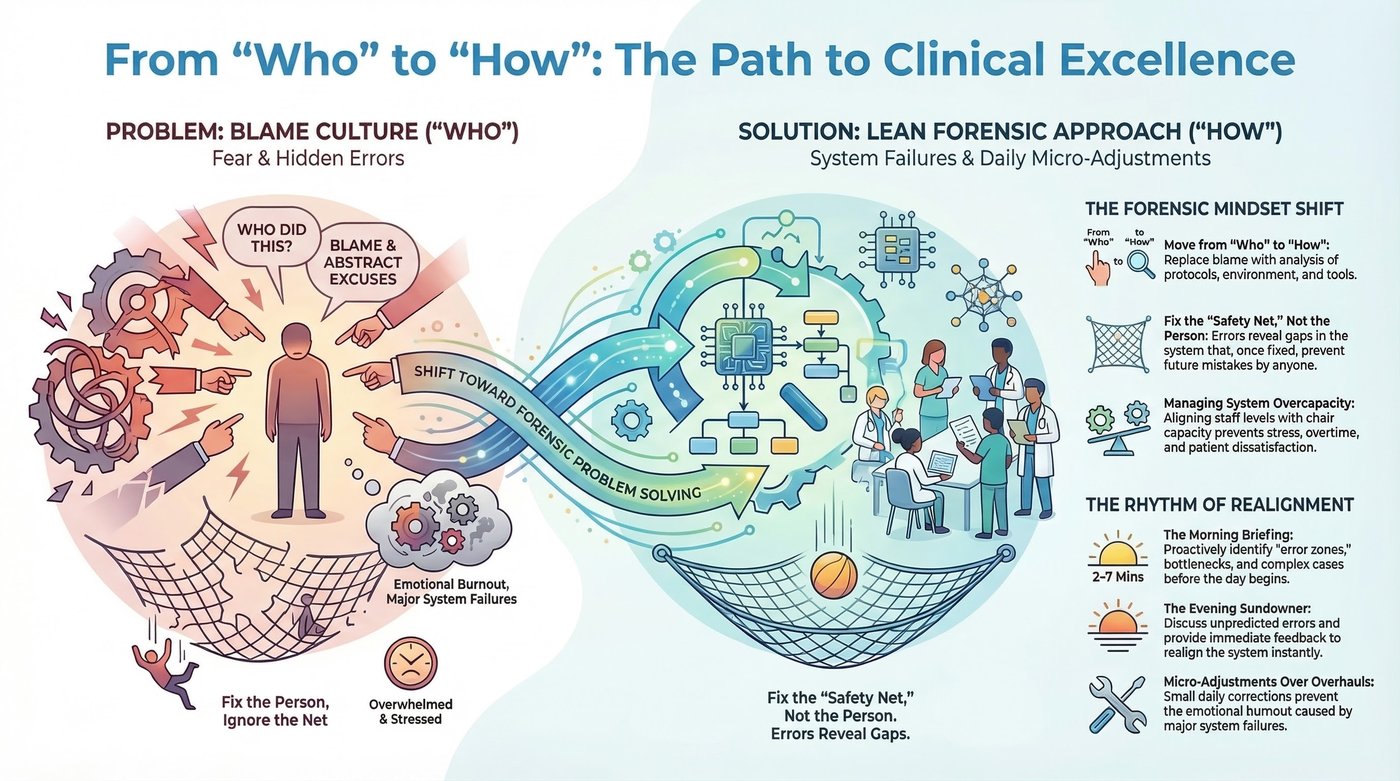
When something goes wrong in the clinic—a retainer comes loose or a patient is scheduled incorrectly—the traditional response is to ask “Who did this?” and “Why?” This reactive approach is deeply flawed for any high-performing practice committed to long-term growth and staff retention. In a lean practice, we must consciously avoid these questions because of the toxic culture they breed. Asking “who” immediately establishes a hierarchy of blame, creating a culture of fear where valuable team members feel compelled to hide errors to protect their job security. This suppression of mistakes prevents the discovery of critical systemic weaknesses. Furthermore, asking “why” often solicits abstract, subjective excuses, which do not offer concrete, actionable solutions that can be hard-coded into your operational workflow. This line of questioning stalls genuine process improvement. To achieve true operational excellence and build a self-correcting system, we replace these emotional and defensive inquiries with two forensic questions that focus entirely on process: How did it happen? and What did it lead to? These investigative prompts shift the focus from personal failure to process breakdown, enabling objective data collection.
The Crime Scene Analysis of Error
By asking “how,” we commit to analyzing the situation like a true crime scene investigator, meticulously examining the specific sequence of actions and the environmental context surrounding the event. This involves looking beyond the surface mistake to the contributing factors, which might be subtle yet impactful.
Was the protocol unclear? For instance, did the written Standard Operating Procedure (SOP) for sterilization or patient handoff contain ambiguous steps, leaving room for interpretation?
Was there a distraction in the environment? Perhaps a busy front desk or a loud phone call momentarily diverted the assistant’s attention during a critical chairside procedure.
Was a tool malfunctioning? A piece of equipment might be nearing its end-of-life cycle, providing intermittent performance that contributed to the procedural failure.
The reality is that if a competent, valued employee makes a mistake, it rarely indicates negligence. Instead, it invariably reveals a fundamental gap in the practice’s “safety net” or signals a critical training opportunity that must be immediately addressed. Consider the high-volume dental lab: if impressions are consistently rejected, the error lies not with the technician, but with inconsistent materials or a lack of defined post-impression checks. By systematically fixing the weak link in the process—the system itself—you ensure that the identical error cannot be made by anyone else in the future. This disciplined approach is how you build a resilient practice that grows stronger, more efficient, and more profitable with every documented challenge. It transforms errors from liabilities into high-value data points.
Micro-Adjustments: The Rhythm of Realignment
In a lean-managed clinic, we institutionalize the management of these operational signals through the daily rhythm, known as the heartbeat of the practice: the morning and evening briefings. These structured, short meetings are your primary mechanism for proactive risk management and instantaneous course correction.
The Morning Briefing (2–7 minutes): This is a forward-looking intelligence session. We actively review the day’s schedule to identify potential “error zones”. This might include identifying bottlenecks like an especially difficult implant case requiring extra setup or complex cases where mistakes are inherently more likely to occur. The goal is to pre-align resources, confirm roles, and verbally mitigate predictable risks before the first patient arrives.
The Evening Sundowner: This crucial meeting provides immediate, unemotional feedback. We dedicate a few minutes to discussing the “unpredicted errors” or “near misses” of the day and realign the system instantly. This isn’t about finger-pointing; it’s about documenting the “how” and assigning ownership for a fix to the system, not the person. For instance, if a sterilization indicator failed, the evening huddle documents how it happened and commits to retraining on that one procedure the next morning.
This continuous improvement cycle is the difference between a top-tier tennis player making a slight, nearly invisible adjustment to their wrist angle mid-match, versus having to halt the game for a total, emotional overhaul of their coaching strategy. Small, daily micro-adjustments prevent the emotional spiral of mounting frustrations that often leads to staff burnout and attrition. They ensure the practice consistently stays on the precise path to clinical and operational excellence.
Managing the “System Error” of Overcapacity
One of the most insidious and common practice mistakes is a fundamental failure to adjust to reality. This most often manifests as pushing staff and resources beyond sustainable limits. If a key hygienist calls in sick, working at “four-chair capacity” with a “three-chair team” is a guaranteed system error. It directly guarantees high staff stress, accumulated overtime costs, and inevitable patient dissatisfaction. This imbalance signals a system on the verge of failure.
A truly lean, perceptive leader recognizes the severe consequences of overcapacity and acts decisively to realign the schedule early. This might mean quickly calling temporary staff, rescheduling non-urgent follow-ups, or temporarily reducing daily patient volume to match available capacity. Excellence is not defined by never making mistakes. Rather, it is measured by how quickly and effectively you can definitively name the systemic problem and adjust your trajectory back to the standard of care. By embracing every single error, scheduling conflict, or equipment failure as valuable, non-personal data, you foster a culture of transparent accountability. You build a practice that is not only highly successful but is also sustainably healthy, profitable, and equitable for everyone involved.
Conclusion
This philosophical shift—from “who” to “how”—changes your practice’s DNA, creating a non-punitive environment where mistakes are surfaced, documented, and systematically eliminated at the root cause. This forensic methodology guarantees a more robust, reliable, and predictable patient experience for clinic leaders. Furthermore, it significantly reduces staff stress, improves retention, and enhances your bottom line through optimized workflows. Embracing this disciplined, system-focused approach is the essential blueprint for sustainable, scalable clinical excellence in modern dentistry.