

Forensic Orthodontics: Using Systems Thinking to Resolve Patient Friction
Published on: Jun 13, 2026
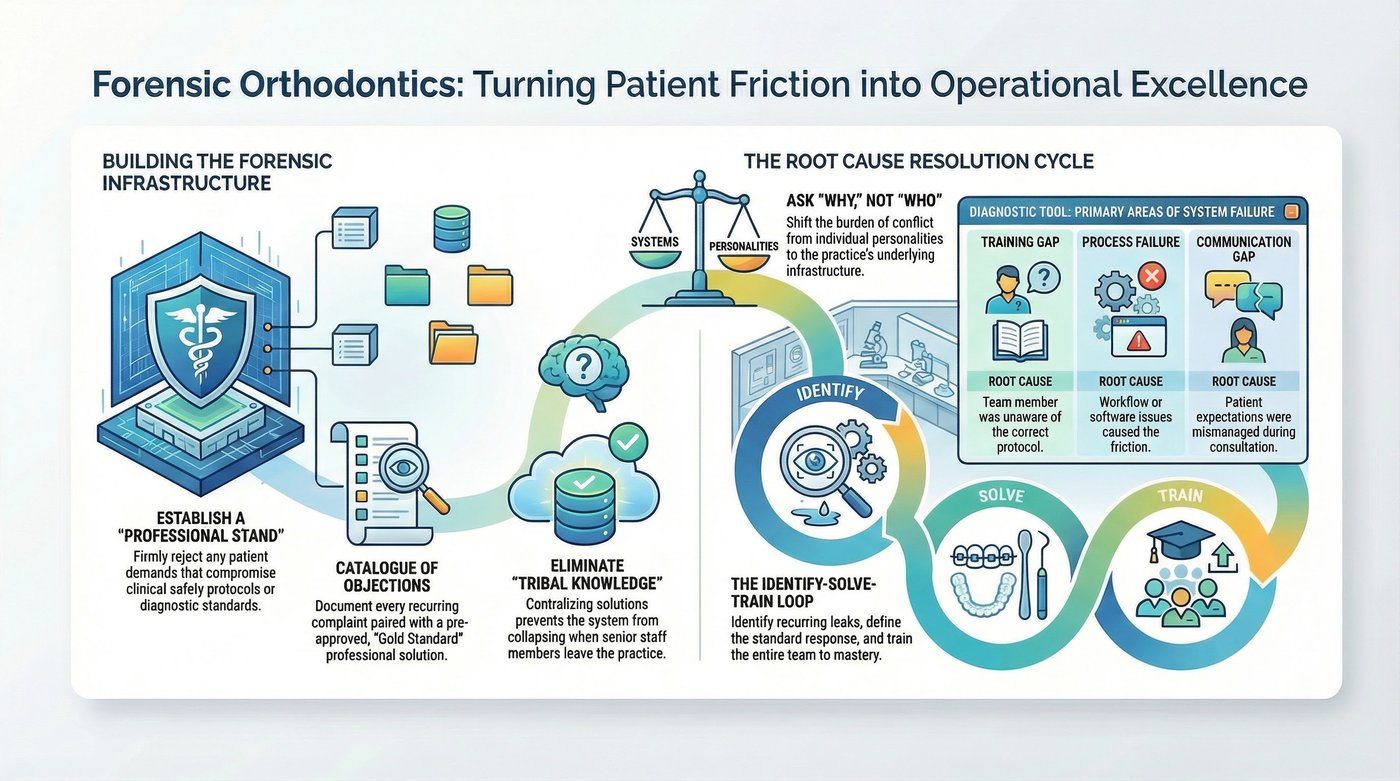
In Lean Orthodontics, we treat every operational friction point as a source of waste. A patient complaint is the ultimate indicator of a “system leak.” However, many practices lack the forensic tools to document, analyze, and prevent these leaks from recurring. To achieve true operational excellence, you must move beyond the “he-said, she-said” of daily drama and implement a systematic “Catalogue of Objections.”
Every negative interaction represents a failure in the patient journey. If a patient is frustrated by a long wait time or a billing error, it is rarely the result of a single person’s malice. More often, it is a symptom of a bottleneck in the schedule or a lack of clarity in financial protocols. By viewing these moments as data points rather than personal attacks, the leadership can begin to repair the underlying machinery of the clinic.
This approach shifts the burden of conflict from the individual’s personality to the practice’s infrastructure, empowering your dental team to handle even the most difficult interactions with confidence.
When systems are weak, employees are forced to improvise. This leads to inconsistent messaging and increased stress for the staff. A robust forensic system provides the team with a reliable script and a clear chain of command, ensuring that the practice remains a calm, professional environment regardless of the patient’s temperament.
Establishing Boundaries: The Professional Stand
Being “customer-focused” does not mean being a doormat. Part of clinical leadership is knowing when to reject a complaint that compromises professional standards. If a patient demands to skip a diagnostic X-ray or ignore a safety protocol, a “soft” apology is the wrong response.
In many modern clinics, there is a fear that a firm stance will lead to a negative online review. However, compromising safety for the sake of a five-star rating is a dangerous precedent. True leadership involves educating the patient on the “why” behind the protocol. For example, explain that skipping an X-ray prevents the doctor from seeing potential root resorption, which could lead to permanent tooth loss.
A professional stands firm: “We have this process to ensure your safety and the quality of your result. We cannot deviate from it.” By providing a clear structure, you protect the practice forensically and maintain the integrity of your medical service. This transparency actually builds trust with high-quality patients who value expertise over mindless compliance.
Consider a scenario where a patient wants to remove braces early for a wedding against clinical advice. A system-driven practice has a pre-prepared “Informed Refusal” protocol. This document the clinical risks and ensures the patient understands the consequences, moving the conversation from a subjective argument to a documented medical decision.
The “Catalogue of Objections and Solutions”
One of the greatest risks to a practice is “tribal knowledge”—when only the senior receptionist or the doctor knows how to handle a specific complaint. If that person leaves, the system collapses.
Tribal knowledge creates a hierarchy where new employees feel inadequate. When a new assistant is confronted by an angry parent regarding a broken bracket, they shouldn’t have to hunt down the office manager to find out what to say. The solution should be readily accessible in the practice’s operating manual, allowing for immediate resolution.
Operational excellence requires documentation. Every common objection or complaint should be recorded in a central catalogue, paired with a pre-approved, professional solution.
This catalogue acts as a “Living FAQ” for the entire team. It should include everything from “Why is my treatment taking longer than expected?” to “Why did my insurance not cover this specific procedure?” Each entry should include a script that is empathetic yet firm, ensuring the brand voice remains consistent across all touchpoints.
Identify: What are the top 5 recurring complaints?
Solve: What is the “Gold Standard” response that aligns with our practice values?
Train: Ensure every team member, from the apprentice to the associate, knows these responses by heart.
This empowers your team. When a shy employee knows exactly what to say when a patient complains about a bill, their performance and confidence skyrocket, and the patient receives a consistent, professional experience.
Practicing these scripts during morning huddles or team meetings turns theory into muscle memory. Over time, the team stops fearing conflict because they have the tools to de-escalate it. This reduces staff turnover and creates a culture of preparedness rather than one of reactive anxiety.
Root Cause Analysis: The Lean “Why”
When a complaint is documented, the leadership task is to perform a root-cause analysis. We don’t ask who made the mistake; we ask why the system allowed the mistake to happen.
Blaming individuals leads to a “cover-up culture” where mistakes are hidden to avoid punishment. In a lean environment, a mistake is a gift because it exposes a flaw in the process. If a patient was double-booked, don’t blame the scheduler; investigate why the software allowed the overlap or why the scheduling rules were not clearly defined.
Training Gap: Did the team member not know the protocol?
Process Failure: Is the current software or workflow causing the issue?
Communication Gap: Was the patient’s expectation mismanaged during the consultation?
By fixing the root cause, you ensure that the same “crime” isn’t committed twice. This is the essence of lean management in dentistry: the continuous refinement of the system to eliminate the waste of conflict and dissatisfaction.
A practical example would be a recurring complaint about clear aligner fit. A root-cause analysis might reveal that the 3D scans are being taken too quickly or that the lab turnaround time is too long, causing teeth to shift before the trays arrive. Fixing the scan protocol or the shipping logistics eliminates the complaint at its source.
Conclusion: Transforming Stress into Structure
Mastering the patient journey in orthodontics means preparing for the bumps in the road. By creating a structured framework for complaint management, you protect your practice, your team, and your reputation. Stop dreading the “difficult” patient and start seeing them as the consultant who is showing you exactly where your practice can grow. When you replace emotion with evidence, you move one step closer to a truly lean, high-performing clinic.
The ultimate goal is a self-healing system where the team identifies, solves, and documents friction points without needing constant intervention from the doctor. This level of forensic precision allows the orthodontist to focus on what they do best: creating beautiful smiles and providing world-class clinical care, while the system handles the complexities of human interaction.