

Forensic Management: The Science of Developing Your Leadership Voice
Published on: Jun 9, 2026
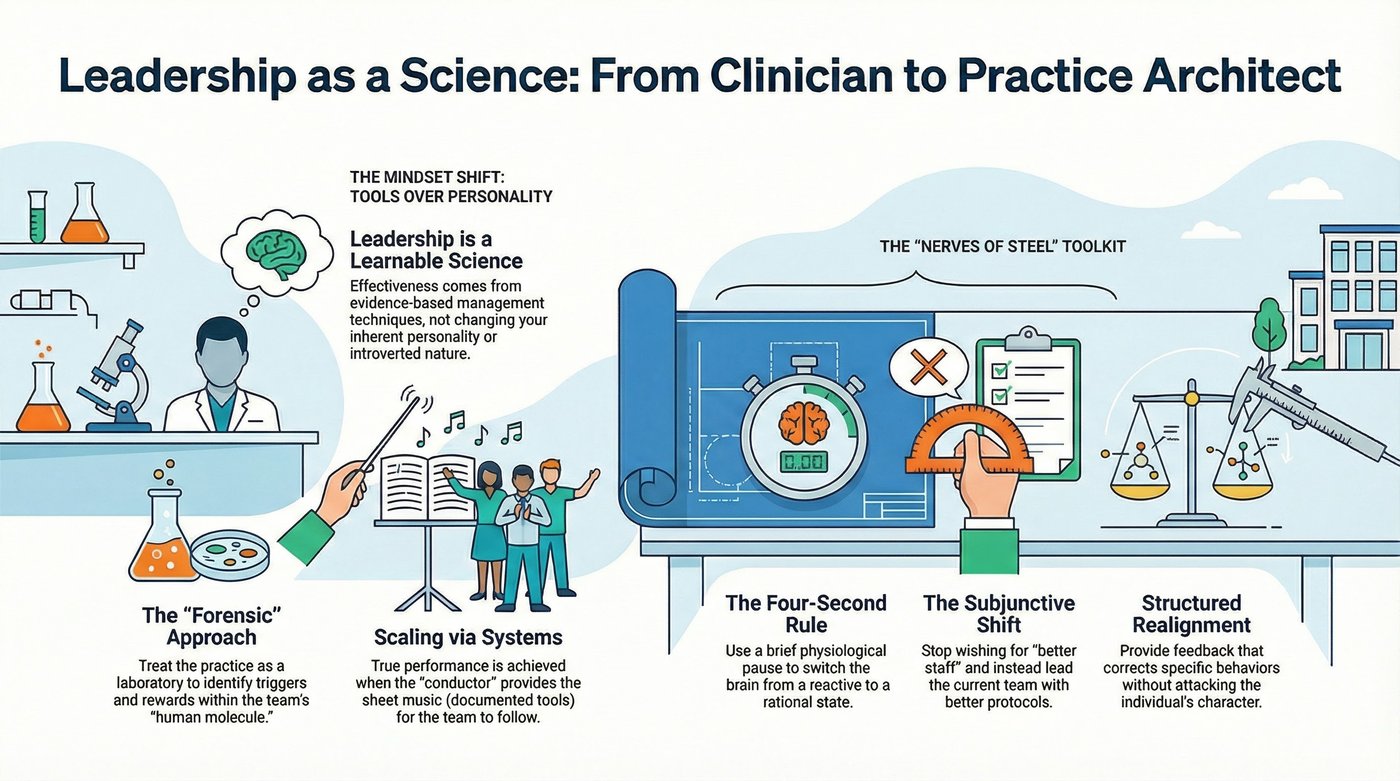
For many orthodontists, the idea of “learning to lead” feels abstract compared to the concrete nature of clinical work. We are comfortable with the physics of force systems, but we feel lost when it comes to the psychology of team performance. However, if we look at leadership through the lens of organizational psychology, it becomes a forensic exercise in identifying triggers, actions, and rewards. This mindset shift is critical for clinic owners moving from a single chair to managing a multi-operatory or multi-location enterprise.
Organizational psychology in a dental practice involves charting the human element with the same rigor used for a complex patient case. It means forensically examining the etiology of system failures—be it chronic scheduling inefficiencies, communication breakdowns during patient handoffs, or persistent staff turnover. Leadership, viewed this way, is the design and maintenance of a high-performance “Leadership Operating System” that ensures smooth, predictable outcomes, even under pressure.
Mastering leadership is about transitioning from a reactive practitioner to a proactive architect of human behavior. It requires a willingness to study the mechanics of the “human molecule” within your practice and apply structured tools to maintain equilibrium. This proactive approach transforms the leader from the main problem-solver into the chief system-designer, freeing up clinical time and mental bandwidth.
The “Quiet” Leader: Breaking Cultural Barriers
Dr. Martin Baxmann often shares his own journey of coming from a culture where silence was the norm. He had no natural inclination for public speaking or leading large teams. His success was not the result of a personality shift, but the result of studying management as a science. He understood that professional competence in clinical care must be matched by professional competence in people management.
This is a vital lesson for every introverted or “quiet” practitioner. You do not need to change your personality to be an effective leader; you need to change your toolkit. Instead of relying on charisma or spontaneous motivation, the introverted leader leverages structure to communicate clearly. They use non-verbal systems to define expectations.
By using specific communication strategies and evidence-based management techniques, you can provide the clarity and boundaries your system needs to stay stable. For example, instead of confronting a team member publicly, the quiet leader institutes scheduled, structured 1:1 meetings for performance review. They utilize project management software to communicate tasks and deadlines non-verbally, ensuring accountability is tied to a digital record, not an emotional conversation.
The practice’s culture, therefore, is not built on the leader’s vocal energy, but on the defined “non-negotiables” of the practice’s operation—the standard procedures that eliminate ambiguity. This provides the team with a clear framework of what good performance looks like, which is the definition of stable leadership.
Training the “Nerves of Steel”
Clinical excellence requires steady hands; leadership excellence requires “nerves of steel”. In a high-pressure clinical environment, such as managing a late-running schedule or a minor clinical emergency, the team looks to the leader to set the emotional tone. If the leader panics or shows visible stress, the entire operational system becomes chaotic. The team reflects the mood and certainty of the person at the top.
Developing this level of poise is a learnable skill, not an innate trait. It involves applying psychological tools under pressure:
The Four-Second Rule: Taking a brief physiological pause to switch the brain from a reactive to a rational state. When an assistant drops an expensive instrument or a patient is anxious, this four-second mental stop prevents emotional contagion and allows for a calm, systemic response instead of a knee-jerk reaction.
The Subjunctive Shift: Stopping the internal, self-defeating dialogue of “If I had better staff…” and instead leading the team you have with better protocols. Leaders must recognize that their primary leverage is in improving the system, not wishing for perfect people. This means designing detailed, robust checklists for every critical function, from sterilization to insurance pre-authorization, making performance less reliant on individual genius.
Structured Realignment: Learning how to give feedback that corrects the behavior without attacking the person. A real-world dental example is using the Situation-Behavior-Impact (SBI) framework. Instead of saying, “You are disorganized,” a leader might state, “During the late-day recall appointments (Situation), the charts were not prepped (Behavior), which resulted in a ten-minute delay for the next patient and a poor patient experience (Impact). Let’s review the closing protocol.” This method focuses entirely on the process and its measurable effect.
The Scaling Power of Systems
The ultimate goal of mastering leadership as a skill is the ability to scale. When your leadership is based on a set of documented tools rather than your individual charisma, the practice can function—and thrive—even when you are not in the building. Scaling success—whether opening a satellite clinic or adding an associate—is impossible if the success is tied solely to the founder’s presence.
True dental team performance is achieved when the “conductor” has provided the sheet music. When everyone knows the tempo, the cues, and the rules of the house, the harmony is maintained. This level of synchronization is only possible when leadership is treated as a professional requirement rather than a personality trait.
Documented systems (Standard Operating Procedures or SOPs) are the currency of scale. They standardize the patient experience, ensure financial consent is always secured, and guarantee clinical consistency across providers. By delegating authority to the process itself, the leader is free to focus on strategic growth, high-level patient care, and innovation, rather than day-to-day firefighting.
Conclusion: Your Practice is Your Laboratory
Think of your practice as a laboratory for your personal and professional growth. Every conflict, every “fire,” and every administrative hurdle is an opportunity to test a new leadership tool. The moments of friction are data points that illuminate where your systems need reinforcement or redesign. This diagnostic approach allows you to continuously refine the practice’s operational architecture.
Don’t wait for authority to feel “natural”. Start using the tools of management today. The more you practice the mechanics of leadership, the more your practice will transform from a source of stress into a high-output organization. Leadership is the ultimate lever for your practice’s success—and it is a lever you can learn to pull.
Ultimately, the goal of forensic management is to translate clinical expertise into organizational command. By treating leadership as a science—a structured, repeatable methodology—dental professionals and clinic leaders can unlock unparalleled scalability, reduce operational stress, and dramatically increase the enterprise value of their practice.