

Forensic Journey Mapping: A Lean Approach to Operational Excellence
Published on: Jun 13, 2026
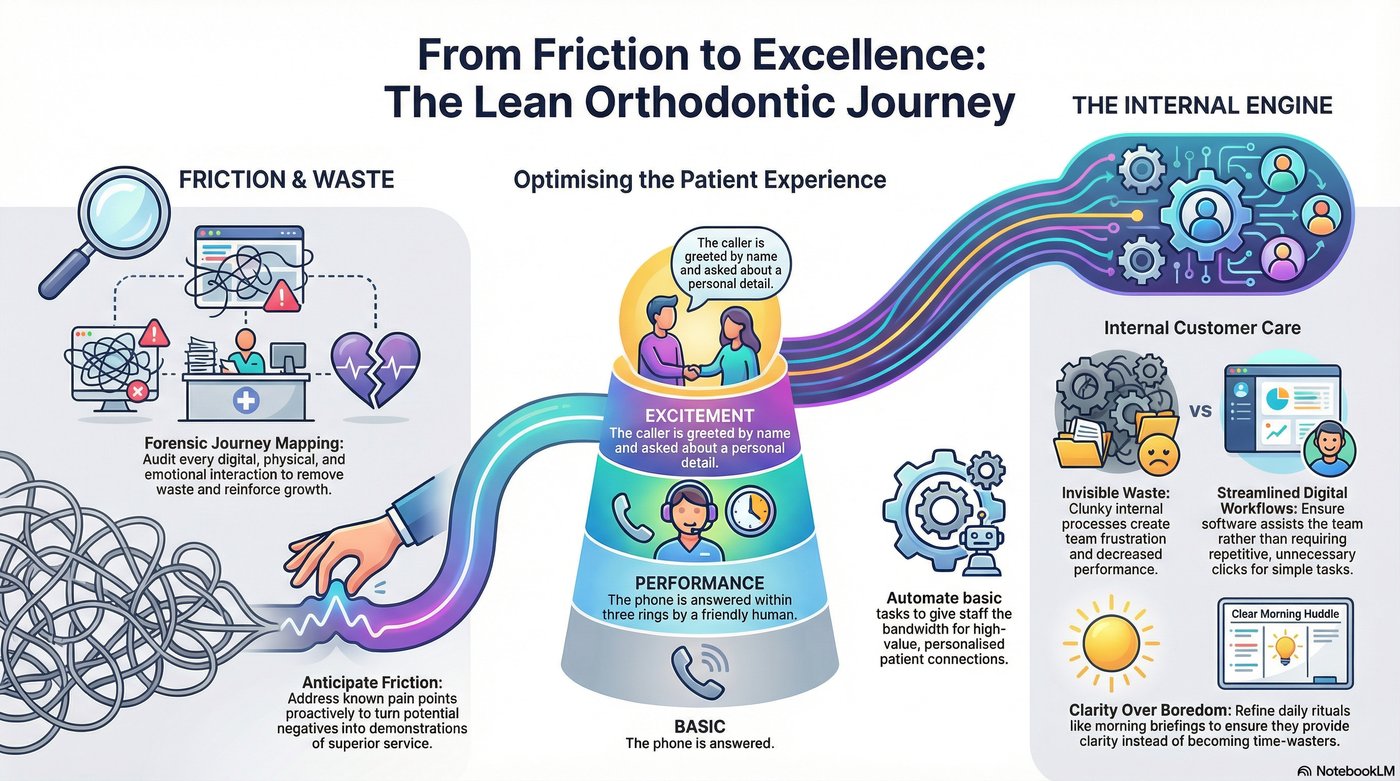
In the Lean Orthodontics philosophy, “waste” is defined as anything that creates friction or fails to add value. When we analyze the patient journey in orthodontics through this lens, we often find that the biggest drains on practice efficiency are poorly managed touchpoints. These hidden bottlenecks often occur during transitions, such as the handoff from the front desk to the clinical assistant or the gap between a consultation and the signing of a financial contract.
A “touchpoint” is any interaction—digital, physical, or emotional—between the practice and the customer. To achieve operational excellence, we must perform a “forensic” audit of these moments, removing those that cause waste and reinforcing those that drive growth. This means looking beyond the surface-level clinical procedure and examining the emotional state of the patient at every stage, from the first Google search to the final debonding appointment.
Anticipating Friction: The “Honesty” Touchpoint
Every practice has pain points. Perhaps your office is in a historic building with difficult parking, or perhaps certain treatment phases, like the initial placement of spacers or a bulky appliance, are inherently uncomfortable. Many practice owners try to hide these negatives or gloss over them during the consultation, but a lean leader does the opposite: they anticipate them and address them with radical transparency.
If parking is a known issue, turn it into a proactive touchpoint. Mention it on your website; tell patients on the phone to allow an extra ten minutes; or even better, send a text with a map of the best local spots. By addressing the friction before the patient experiences it, you turn a potential negative into a demonstration of superior service. This is “expectation management” as a tool for practice efficiency, ensuring that patients arrive relaxed rather than frustrated, which keeps your schedule running on time.
Engineering Excitement: Beyond the Basic Need
Using the Kano model, we can categorize touchpoints into basic, performance, and excitement levels. This framework allows us to prioritize our operational improvements by distinguishing between what is simply expected and what truly delights. In a competitive market, relying solely on clinical skill is no longer enough; we must engineer the experience as meticulously as we engineer a smile.
Basic: The phone is answered.
Performance: The phone is answered within three rings by a friendly human.
Excitement: The caller is greeted by name (using caller ID) and asked about a detail from their last visit.
Operational excellence is achieved when the “basic” and “performance” levels are so automated and standardized that the team has the mental bandwidth to focus on “excitement.” This is where true differentiation happens. When you use your practice management software to trigger personalized touchpoints, such as a “happy birthday” video from the doctor or an automated check-in after a difficult procedure, you are using technology to scale human connection. This reduces the cognitive load on your staff while maximizing the patient’s perceived value.
The Two-Way Street: Internal and External Customers
We must never forget that your staff members are also experiencing touchpoints with your practice systems. If your internal processes are clunky, frustrating, or repetitive, your dental team’s performance will suffer. A team that is battling outdated software or searching for misplaced instruments cannot provide high-level care. They are too busy navigating internal friction to focus on the external customer.
Lean management in dentistry requires looking at internal touchpoints:
The Morning Briefing: Is it a source of clarity or a source of boredom?
The Digital Workflow: Does the software help the assistant, or does it require ten extra clicks?
By optimizing these internal touchpoints, you remove the “invisible waste” that leads to team burnout and high turnover. A happy, efficient team is the prerequisite for a happy, satisfied patient. When the internal workflow is seamless, the team radiates a sense of calm and competence that the patient can feel. This internal excellence becomes the foundation for your external reputation.
Conclusion: The Architect of Experience
Mastering touchpoints is not a marketing gimmick; it is a fundamental shift in how you run your business. It requires you to step out of the clinician’s role and view the practice through the eyes of the patient and the employee. Every detail, from the scent of the lobby to the clarity of the billing statement, contributes to the overall narrative of your brand.
Map your journey. Identify the gaps where patients feel lost or overwhelmed. Anticipate the points of friction and design them out of existence. By consciously designing every interaction, you create a resilient, high-performing clinic that delivers value at every turn. You are no longer just an orthodontist or a dentist; you are the architect of a world-class experience that builds lifelong loyalty and drives sustainable growth.
In conclusion, forensic journey mapping is about the relentless pursuit of perfection in the ordinary. It transforms the mundane daily operations of a dental office into a strategic asset. By applying these lean principles, you ensure that your practice remains efficient, profitable, and, most importantly, patient-centered in an evolving healthcare landscape.