

Fire Prevention: The Lean Strategy for Operational Excellence
Published on: Jun 10, 2026
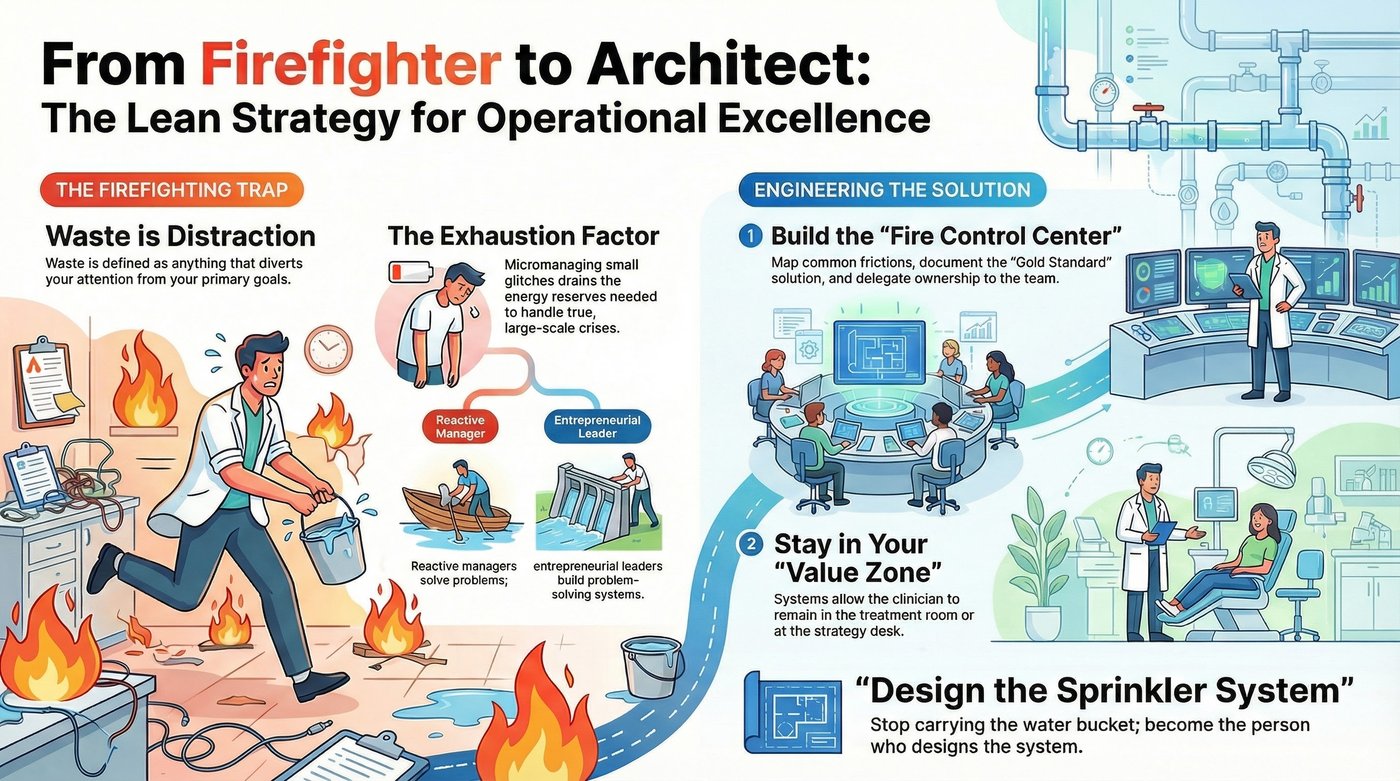
In the world of Lean Orthodontics, waste is defined as anything that diverts your attention from your primary goals. There is no greater waste of a clinician’s talent than that spent on “firefighting”—the ad hoc handling of minor administrative or clinical glitches. This reactive approach consumes valuable chair time, delays scheduled procedures, and fractures team confidence, directly impacting patient flow and profitability.
To achieve operational excellence, a practice owner must move beyond fixing problems and focus on engineering them out of the system. This shift transforms the practice from a collection of individual heroes into a resilient, self-managing machine, where standard work is the default setting.
A high-performing practice is not one where the boss is the best problem solver; it is one where the boss has built the best problem-solving systems. This is the difference between being a reactive manager and an entrepreneurial leader. The entrepreneurial leader designs the system to prevent common errors from ever reaching the doctor’s desk.
This systemic approach ensures that the highest-paid person in the room—the clinician—is exclusively focused on high-value tasks: patient care and strategic growth. Every minute spent searching for a chart or rebooking a missed appointment is a direct financial loss to the practice.
Building a “Fire Control Center”
A lean practice operates with a “fire control center” mindset. This isn’t a physical room but a comprehensive set of protocols and ready-made solutions that your team can access instantly. This digital library of standard operating procedures (SOPs) is the institutional memory of your practice, ensuring consistency regardless of staff turnover.
When a team member encounters a problem, their first instinct should be to check the protocol, not to look for the doctor. For example, a broken bracket, a late patient, or an insurance verification error should trigger an immediate, pre-approved action sequence from the front- or back-office team.
The implementation of a “Fire Control Center” requires a dedicated, structured effort:
Map the Common Frictions: Identify the top five issues that currently pull you away from your work. This often involves collecting data on administrative interruptions, failed equipment procedures, or patient communication breakdowns. For a dental practice, this might include recurrent issues like late lab cases or inaccurate insurance pre-authorizations.
Create the Standard: Document the “Gold Standard” solution for each. The documented solution must be simple, repeatable, and easily accessible, perhaps integrated into your practice management software or a quick-reference guide. This standardization is the key to consistent, high-quality patient experiences and reduces variation in service delivery.
Delegate the Role: Train specific team members to own these solutions. Accountability for process maintenance must be clearly assigned. For example, one clinical assistant might own the “Broken Appliance Protocol,” including all necessary forms, inventory checks, and patient communication scripts.
By providing the team with the “rules and the tools,” you move the firefighter role down the organizational chart. This allows you to stay in your “value zone” (the treatment room or the strategy desk) while the practice continues to run smoothly around you. This delegation is a powerful lever for scaling the practice without multiplying the owner’s workload.
The Perfectionism Trap in Crisis Management
When a true, extraordinary crisis occurs—such as a major power outage, a key staff member’s unexpected resignation, or a server crash—many leaders are paralyzed by perfectionism. They want to find a solution that has zero negative consequences. This pursuit of the ideal often leads to delayed, ineffective action when speed is essential.
However, in a real fire, damage is inevitable. The goal shifts from flawless execution to minimizing harm and maintaining business continuity. Waiting for 100% certainty or the “perfect” communication strategy wastes precious time and exacerbates the situation with staff and patients.
Leadership during a crisis is about mitigation, not perfection. You must make the best possible decision with the information available at that moment. This requires a mindset shift: accept the necessary trade-offs and focus on rapid recovery speed.
By focusing on fire prevention for the 90% of predictable issues, you ensure that you have the “energy reserves” required to handle the 10% of truly unforeseen events with clarity and poise. This strategic conservation of mental and emotional capacity is crucial for long-term practice health. A leader who is already exhausted from micromanaging the small things will inevitably fail when a large-scale crisis hits. A clear, rested mind makes better, faster decisions under pressure.
Moving Toward Sustainable Leadership
The goal of lean management is to create a predictable, high-quality environment. This predictability is the foundation of patient trust and team performance. Patients appreciate knowing what to expect, and this consistency reduces anxiety and boosts positive word-of-mouth referrals, driving practice growth.
When a team knows exactly how to handle a “fire,” they work with more confidence and less stress. They transition from asking permission to taking ownership, which is the definition of an empowered, high-maturity team. This culture of empowerment is far more sustainable than dependence on a single heroic leader.
To solidify this culture of continuous improvement (Kaizen), embed these behaviors into your weekly practice huddles:
Audit your “Emergencies”: How many of today’s fires were actually preventable through better protocols? Analyze the root cause of every interruption to identify the systemic weakness, not the individual error.
Pause and Reflect: Use the four-second rule to maintain your composure. Before reacting to an issue, take four seconds to consider the optimal response, ensuring your action addresses the process, not just the symptom.
Empower your Team: Shift from solving problems to coaching your team to solve them. Ask guiding questions like, “What does the protocol say?” or “What solution would you document for this issue?” This reinforces their capability.
Sustainable leadership involves designing your exit from daily operational chaos. By standardizing problem-solving, the owner can step back from tactical execution and dedicate time to strategic thinking, such as integrating new technology or planning facility expansion.
Conclusion: The Architect of the Future
If you want to grow your practice, you must stop being the person who carries the water bucket. You must become the person who designs the sprinkler system. Operational excellence is a journey of continuous improvement (Kaizen) where you slowly replace chaotic reactions with standardized actions.
Take a fresh look at your daily schedule. Where can you subtract complexity? Where can you add a checklist? These small, consistent improvements are the engine of lean transformation in any dental office. The elimination of “firefighting” frees up capacity for true value creation.
By investing in fire prevention today, you create the space for the strategic growth that will define your success tomorrow. The true measure of a practice leader is not their ability to handle chaos, but their success in eliminating the need to do so. This is the foundation of true, scalable operational excellence, securing both your peace of mind and the practice’s future profitability.