

Finding the Eighteenth Camel: The Art of Win-Win Negotiations in Dentistry
Published on: Jul 4, 2026
Beyond the Surface of the Conflict
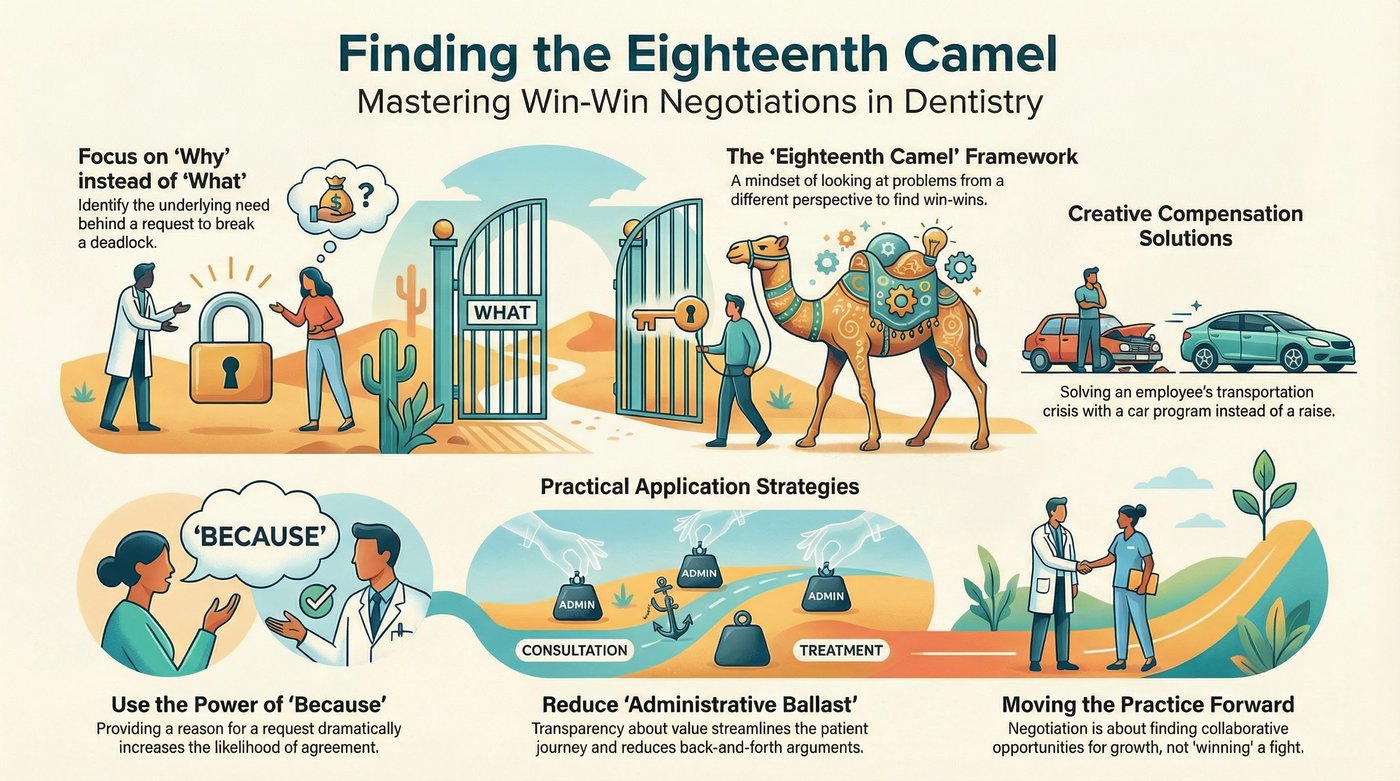
Most negotiations in an orthodontic practice fail because the parties involved focus on the “what” rather than the “why.” Whether you are discussing a salary increase with a team member or a treatment plan with a parent, it is easy to get stuck in a deadlock over numbers or specific demands. In lean orthodontics, we use a mental framework called “finding the eighteenth camel”—a concept derived from a classic story about looking at a problem from a different perspective to find a solution that benefits everyone.
As a leader and entrepreneur, your goal is to identify the underlying need that the other person is trying to fulfill. When you move past the initial request and look at the broader context, you often find creative solutions that resolve the friction while actually improving your practice efficiency.
The essence of “the eighteenth camel” lies in understanding the difference between a position and an interest. A team member’s position might be “I need a $10,000 raise,” but their interest might be financial security, better work-life balance, or a feeling of being valued. A savvy negotiator addresses the interest, not just the position.
Applying this to a vendor negotiation, if a supplier is rigid on the cost of clear aligners, their true interest may be consistent volume and predictable cash flow. Instead of arguing price, a practice leader can offer an exclusive 24-month commitment in exchange for a modest per-unit discount, securing long-term savings and simplifying inventory management. This minimizes administrative overhead for both parties and stabilizes the relationship, transforming the negotiation from a zero-sum game to value creation.
Solving the Real Problem: A Leadership Example
Consider a common scenario: an employee asks for a significant raise because they are facing an unexpected personal expense, such as a major car repair. From a traditional management perspective, this is a binary choice—yes or no. However, a lean leader looks for the “eighteenth camel.”
A small monthly raise is heavily taxed and might not even solve the employee’s immediate liquidity crisis. If the practice was already considering a company car program, providing a reliable vehicle could solve the employee’s transportation problem more effectively than a salary bump. This is a win-win: the employee receives a high-value benefit that solves their problem, and the practice gains a motivated team member and a tax-efficient business expense.
This principle extends far beyond payroll. Imagine a high-performing hygienist who requests to transition from a full-time, five-day schedule to a four-day work week. The traditional response is often denial, fearing a drop in chair time utilization and revenue. The leader, however, investigates the underlying interest: the hygienist wants more quality time with family.
The “eighteenth camel” solution could involve restructuring their schedule to four 10-hour shifts, maintaining their total weekly hours, or offering a schedule that allows them to start one hour earlier to better accommodate patient demand while also leaving earlier one day a week. Furthermore, the practice could invest in advanced training for the hygienist in a high-value service, like laser debridement, and tie a bonus structure to the productivity of those specific procedures.
This alternative compensation structure transforms the request from a resource drain into a revenue driver. The employee gains the desired flexibility and career development, and the clinic leverages a new, profitable service line. It is a testament to value-based negotiation, where success is measured by mutual gain rather than concession.
The Power of “Because” in Patient Consultations
Human psychology plays a massive role in negotiation. Studies have shown that simply providing a reason for a request—using the word “because”—dramatically increases the likelihood of a positive outcome. This is a vital tool for dental leadership during patient consultations.
When presenting a treatment plan or a specific service, don’t just state the price or the procedure. Explain the why. By providing context, you help the patient understand the value, making the negotiation about health and long-term stability rather than just cost. This transparency reduces the “administrative ballast” of back-and-forth arguments and streamlines the patient journey in orthodontics.
The “because” framework shifts the conversation’s focus from transaction to transformation. For instance, instead of saying, “The fee for this custom appliance is $4,000,” a dental professional should frame it: “We utilize this custom-milled appliance because it ensures maximum biological compatibility and minimizes treatment time by 20%, leading to greater long-term stability for your child’s bite.”
For complex procedures, linking the cost directly to patient-specific benefits is crucial. If a parent balks at the cost of an early interceptive phase 1 treatment, the leader should explain: “We recommend Phase 1 treatment now because it allows us to guide jaw growth while the bone is still pliable, preventing the need for more invasive and costly jaw surgery later in adolescence.”
This psychological approach builds trust and professionalism. It positions the practice not as a vendor of services, but as a long-term clinical partner committed to optimal outcomes. This authoritative communication style is a hallmark of strong dental leadership, improving treatment acceptance rates, which are key metrics for practice health.
Conclusion: Broadening the Perspective
Effective negotiation is not about “winning” a fight; it is about finding a way to move the practice forward together. By seeking the “eighteenth camel” in every professional interaction, you turn obstacles into opportunities for growth. This mindset is what allows a clinic to remain high-performing while maintaining a positive, collaborative culture.
A negotiation should be viewed as a mutual discovery process rather than a confrontational event. For the leader and entrepreneur in a dental setting, mastering this art means developing the skill of active listening—listening to understand the emotion, the unstated fear, or the aspiration behind the stated position.
Ultimately, the ability to consistently find the “eighteenth camel” is a direct reflection of a practice’s commitment to its people and its patients. It is a strategic advantage that fosters long-term loyalty among staff and cultivates evangelists among patient families, reinforcing the practice’s market position and its reputation for ethical, solution-driven care.