

Filling the Vacuum: Why Your Team’s Acceptance Starts with Your Job Description
Published on: Jun 7, 2026
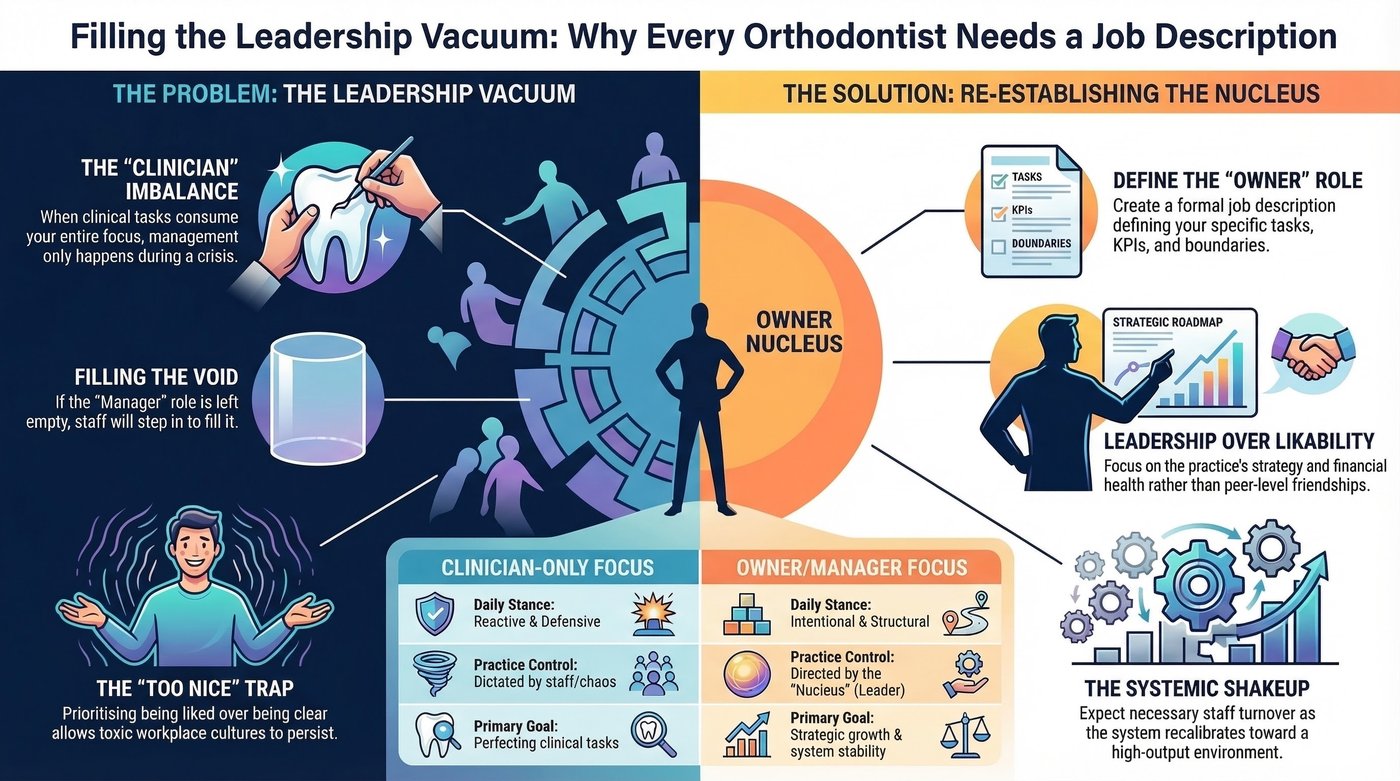
In many orthodontic practices, a subtle but destructive power struggle is at play. The doctor, despite being the owner, feels like a passenger in their own clinic. They are reactive, constantly put on the defensive by staff requests, and frequently overwhelmed by a schedule they didn’t design. When a team lacks “acceptance” of their leader, it is rarely because of a personality conflict; it is usually because of a leadership vacuum. This vacuum occurs when the boundaries of authority are blurred, and the operational steering wheel is left unattended. Without a captain at the helm, the crew begins to steer the ship in conflicting directions, leading to inefficiency and resentment on both sides. The doctor may feel they are being “too kind,” but in reality, they are failing to provide the safety of a structured environment.
As Dr. Martin Baxmann emphasizes, if you do not define your role as the boss, the team—or the daily chaos—will define it for you. Establishing authority isn’t about being authoritarian or unfriendly; it is about providing the structural “nucleus” that a high-performing system requires to stay stable. A team that knows exactly where the doctor stands is a team that can perform with confidence. Clarity is the greatest gift a leader can give their staff, as it removes the guesswork from their daily interactions and allows them to focus on clinical excellence rather than navigating political ambiguity within the office.
The Role of the “Owner” Job Description
We spend thousands of euros and hundreds of hours perfecting job descriptions for clinical assistants and front-desk coordinators. We define their tasks, their KPIs, and their boundaries. Yet, most orthodontists have never written a job description for themselves. They assume that being the “Doctor” is a description enough. However, the technical skill of moving teeth is entirely separate from the skill of running a business entity. By failing to document your specific responsibilities as the head of the organization, you leave your staff wondering who is responsible for the vision, the culture, and the ultimate financial outcomes of the practice.
Without a clear definition of what you do as the Owner and Manager, you default entirely to the role of Clinician. When the “clinician” slice of your professional life consumes the entire pie, management becomes a tiny sliver addressed only during a crisis. This imbalance creates a vacuum. In a lean system, every role must be filled. If the “Manager” role is empty, the staff will step in to fill it, leading to a situation where the team effectively dictates the doctor’s next move. This often manifests as staff members making promises to patients that the doctor cannot keep, or changing the schedule without consulting the clinical flow requirements. To fix this, you must explicitly list your duties: setting the strategy, monitoring the overhead, leading the morning huddle, and conducting performance reviews. When these tasks are owned by the doctor, the team no longer feels the need to self-govern in a chaotic way.
The “Too Nice” Trap: Choosing Leadership over Likability
One of the most significant hurdles for specialists is the desire to be the team’s friend. While a social and integrative style is valuable, the role of the boss is fundamentally different from that of a peer. A leader is the one with their hands on the wheel, responsible for the strategy and the financial health of the business. Friendships in the workplace are wonderful, but they cannot come at the expense of professional standards. If the lines become too blurred, the doctor loses the ability to provide objective feedback, and the staff loses the respect necessary to follow a directive during high-stress clinical moments.
When you prioritize being “liked” over being “clear,” you allow “smoldering fires” to persist. For example, if a likable staff member is consistently late or toxic to the culture, failing to take disciplinary action is a failure of leadership. You aren’t being “nice” to the team; you are being unfair to the high-performers who have to pick up the slack. Filling the vacuum means having the courage to make tough decisions for the health of the entire system. It means understanding that your primary responsibility is to the survival and flourishing of the practice as a whole, which sometimes requires removing elements that are holding the team back. True acceptance from a team comes from their belief in your competence and fairness, not your popularity.
The Systemic Shakeup: Re-establishing Equilibrium
Think of your practice as a molecule where every person is a particle with a specific “charge.” When the nucleus (the leader) stops fulfilling its role, the entire molecule shifts. The particles (staff) move out of their intended orbits to try to stabilize the structure. This leads to a messy, high-energy state where everyone is exhausted. Re-establishing the nucleus requires a period of re-orientation. You must announce the new standards, explain the “why” behind the changes, and then consistently model the behavior you expect to see.
When you decide to re-establish order by introducing clear rules and structures, the system will react. This is often referred to as a “shakeup.” Some employees who thrived in the lack of accountability may choose to leave. In a lean practice, this is not a failure—it is a necessary recalibration. By acting with intentionality rather than reacting with emotion, you attract the right talent that values a professional, high-output environment. Those who stay will feel a renewed sense of purpose because they are finally being led by someone who knows where they are going. This transition phase is uncomfortable, but it is the only path toward a sustainable, low-stress practice where the doctor is truly in control.
Conclusion: The Path to True Team Acceptance
Ultimately, your team’s acceptance of your leadership is a reflection of the clarity you provide. By creating and adhering to an “Owner” job description, you fill the leadership vacuum that invites chaos and insubordination. When you step fully into the roles of Owner and Manager, you liberate your team to excel in their own positions. You transition from a reactive passenger to an intentional pilot, ensuring that the practice moves toward its goals with precision. Leadership is not a title; it is a set of defined actions. Start defining yours today, and watch your team transform into the cohesive, respectful unit your practice deserves.