

Engineering “Wow” Moments: Applying the Kano Model to Orthodontic Satisfaction
Published on: Jun 15, 2026
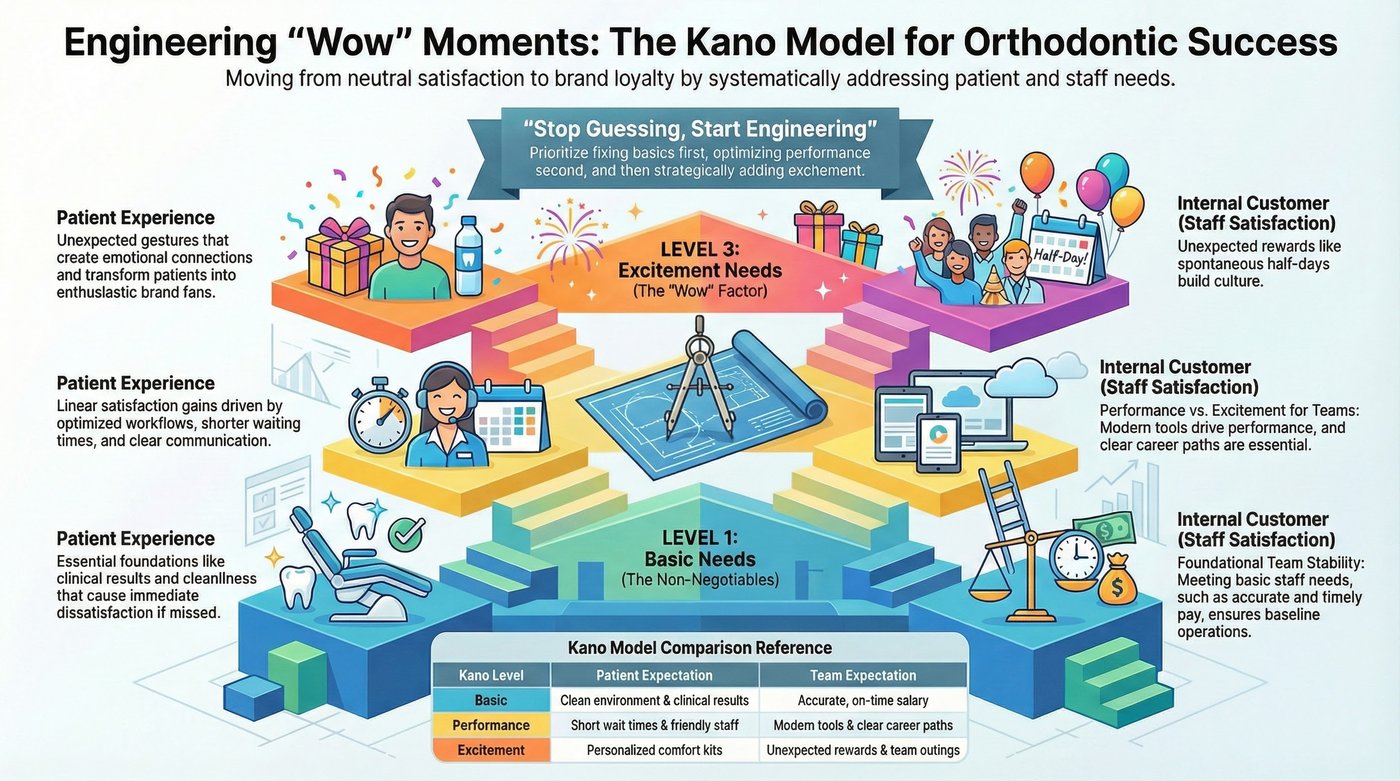
Many practice owners attempt to improve patient satisfaction through random acts of kindness—a new coffee machine here or a slightly friendlier greeting there. While well-intentioned, this “shotgun” approach to service often fails to produce consistent results. To truly dominate the market and turn patients into raving fans, we need a systematic framework for exceeding expectations.
The Kano Model, a tool originally developed for product development, provides a powerful roadmap for orthodontic practice management. By categorizing needs into three distinct levels, we can move from “guessing” to “engineering” a five-star patient experience.
Level 1: Basic Needs (The Non-Negotiables)
Basic needs are the “must-haves” of your practice. In orthodontics, this means achieving a good clinical result in a clean, professional environment. Interestingly, meeting these needs does not make a patient “happy”—it simply leaves them neutral. They expect the train to arrive at the station on time.
However, the risk here is immense. If you fail to meet a basic need—if the office is untidy or the clinical outcome is poor—satisfaction drops to zero immediately. You get no “extra credit” for being clean, but you are penalized heavily for being dirty. As a leader, your first task is to ensure these foundations are bulletproof.
Level 2: Performance Needs (The Competitive Edge)
Performance needs are linear: the better you perform, the higher the satisfaction. These are the benchmarks by which patients compare you to the clinic down the street.
Common performance needs in a dental practice include:
Waiting Times: How quickly is the patient seen?
Friendliness: How welcoming is the front desk staff?
Communication: How clear are the instructions and follow-ups?
Investing in these areas moves your practice from a “neutral” three-star rating to a solid four or five stars. This is where lean management in dentistry pays off; by optimizing your workflows and scheduling, you directly increase your “performance” score in the eyes of the patient.
Level 3: Excitement Needs (The “Wow” Factor)
Excitement needs are the game-changers. These are unexpected features that the patient didn’t even know they wanted. Because they are unexpected, their absence doesn’t cause dissatisfaction, but their presence creates enthusiastic “fans” who will actively promote your practice.
An excitement factor might be a staff member greeting a patient by name before they even reach the desk, or offering a personalized comfort kit after a long appointment. These moments create an emotional connection that transcends the clinical procedure. To deliver these consistently, you must train your team to anticipate needs before they are voiced.
The Internal Customer: Applying Kano to Your Team
A visionary leader understands that the Kano Model applies just as strongly to dental team performance. Your employees are your “internal customers,” and their satisfaction directly dictates the patient experience.
Basic Need: Salary paid accurately and on time.
Performance Need: A safe workplace, modern tools, and clear career paths.
Excitement Need: Unexpected rewards, team outings, or a spontaneous half-day off.
When you treat your team with the same “excitement” mindset you apply to patients, you build a culture of loyalty. A team that feels valued will naturally go the extra mile to create “wow” moments for your patients.
Conclusion: Stop Guessing, Start Engineering
The Kano Model teaches us that not all service improvements are equal. By systematically mapping your patient journey against these three levels, you can prioritize your resources effectively. Fix the basics first, optimize your performance, and then strategically sprinkle in the excitement. This structured approach is the secret to building a practice that doesn’t just treat patients but creates a movement of loyal ambassadors.