

Engineering the Schedule: How Guardrails and Blocking Eliminate Practice Chaos
Published on: Jun 24, 2026
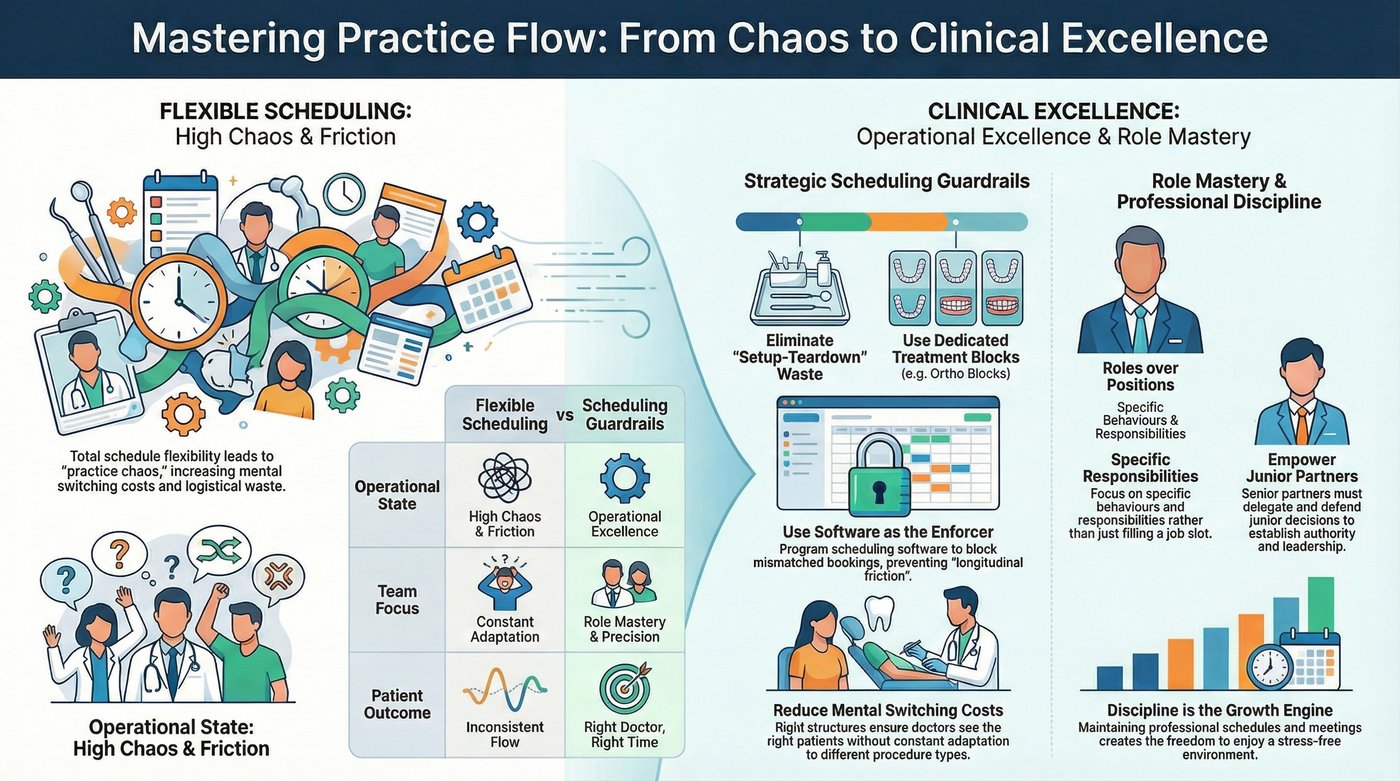
Many clinicians believe that a flexible schedule is a benefit to the patient. They operate under the assumption that accommodating every request builds loyalty, but this perspective overlooks the severe internal cost.
From a lean management perspective, however, total flexibility is a profound source of operational chaos. When you “wing it” by mixing complex orthodontic adjustments with routine fillings or implant check-ups in consecutive slots, you dramatically increase your mental switching costs.
This rapid context-switching is an invisible drain on the lead doctor’s cognitive resources, leading to fatigue and an elevated risk of clinical error. Furthermore, this chaotic scheduling disrupts the logistical flow of your assistants.
The constant need to reorganize instruments, restock trays, and sanitize different operatories slows the entire clinic down. To achieve operational excellence, especially in a multidisciplinary or family-run practice, you must implement “Scheduling Guardrails”.
This is not about being rigid with patients but about optimizing your capacity as a clinical leader. By utilizing your practice management software to enforce a rigid structure, you ensure that the right doctor sees the right patient at the right time.
Maximizing your revenue per hour and minimizing human error is the ultimate goal. This strategic use of time blocks shifts the practice from reactive scheduling to proactive operational design, creating a more sustainable environment for everyone.
The Power of the “Ortho Block”
A multidisciplinary practice often struggles most acutely with the “setup-teardown” waste inherent in switching between general dentistry and specialized services like orthodontics or endodontics. This waste is quantifiable and highly disruptive.
Every minute spent locating a specific wire or sterilization cassette that should have been pre-staged is a minute of lost production. The essential solution is the implementation of dedicated treatment blocks. This approach is fundamental to lean methodology.
For example, designating Tuesday afternoons strictly for orthodontics allows the entire team to prepare all necessary instruments and materials in advance, often staging multiple trays simultaneously. This batch processing drastically cuts down on the sterilization backlog.
In a high-performance family practice, the scheduling software acts as the enforcer and the accountability partner. If a slot is designated for a wire change, the system will not allow a routine hygiene check to be booked there.
These guardrails prevent the chronic “longitudinal friction” that occurs when a team is constantly rushing to adapt to different procedure types, burning out key staff in the process. It forces the practice to manage capacity effectively.
This ensures that complex, high-value procedures are not squeezed into sub-optimal windows, preserving both clinical quality and team morale. By batching similar tasks, you reduce the physical and mental drag of constant reconfiguration.
Role Mastery over Position Filling
In a lean environment, effective leadership means focusing on “Roles” rather than simply “Positions”. A position is merely a title and a list of tasks; a role implies a specific set of behaviors and ownership.
Roles must be mastered and executed with consistent excellence. This distinction is absolutely vital for leadership succession, particularly for the junior partner entering a multi-generational practice who needs to establish credibility quickly.
Joining a father’s or mother’s practice requires the junior partner to move quickly into a role of defined authority. This critical transition is significantly facilitated by the senior partner’s willingness to delegate genuine authority.
The senior partner must publicly defend the junior’s clinical or management decisions. When roles are clearly defined—for instance, who is the lead for all implant surgery protocols—the practice operates with the precision of a specialized clinic.
Whether it is the new patient journey intake or team training and compliance, Role Mastery provides the junior partner with a clear domain of ownership. This accelerates their development into a reliable, accountable co-leader.
This domain-specific ownership allows for focused growth and reduces internal friction during the succession process. By empowering the junior partner in specific areas, the practice benefits from fresh oversight and modern clinical perspectives.
Professional Discipline as a Growth Engine
Ultimately, the sustained success of a structured family practice is not achieved through genius, but through unwavering discipline. This discipline is the engine that converts well-designed systems into predictable outcomes for every patient visit.
It is the discipline to keep a mandated professional management meeting even when the day is overflowing with emergencies. It is the discipline to follow the optimized schedule even when a patient asks for a “quick favor.”
Deviating from the schedule, even once, signals to the team that the systems are optional, immediately undermining accountability. Crucially, it is the discipline to consistently support your partners’ leadership in front of the entire team.
This public support solidifies the defined roles and prevents staff from attempting to circumvent new systems by appealing to the senior partner. When you transform your practice from a loose family arrangement into a structured clinical machine.
You don’t lose the essential “family feel”—you gain the freedom to enjoy it without the pressure of constant firefighting. By removing the chronic stress of chaos, you create an environment where three generations can work in harmony.
This predictable, disciplined operation allows you to deliver a level of high-performance care that an undisciplined practice can never achieve. Harmony and precision become the hallmarks of the practice, ensuring longevity and professional satisfaction for all.