

Engineering Team Buy-In: How to Solve Resistance Using Process Logic
Published on: Jun 18, 2026
Leadership in a dental practice is a continuous “tennis match” of ideas. You propose a new workflow—perhaps reducing chair changeover time to twenty minutes—and your team responds with “it”s impossible.” How you handle this resistance determines whether your practice achieves operational excellence or stays stuck in a cycle of “we”ve always done it this way.”
This friction point is critical in high-performance dentistry. Practices aiming for premier status cannot afford the revenue leakage and schedule drag caused by inefficient operations. Overcoming resistance to change is therefore a core leadership competency, requiring objective analysis over emotional debate.
Just as with patients, team resistance is often a mix of valid objections and emotional pretexts. As a leader, your job is to strip away the excuses until you find the real process bottleneck. This is not about winning an argument; it is about using data to build a more efficient clinic. When you apply engineering logic to administrative or clinical processes, you replace subjective opinions with quantifiable metrics.
From “Impossible” to “Inquiry”
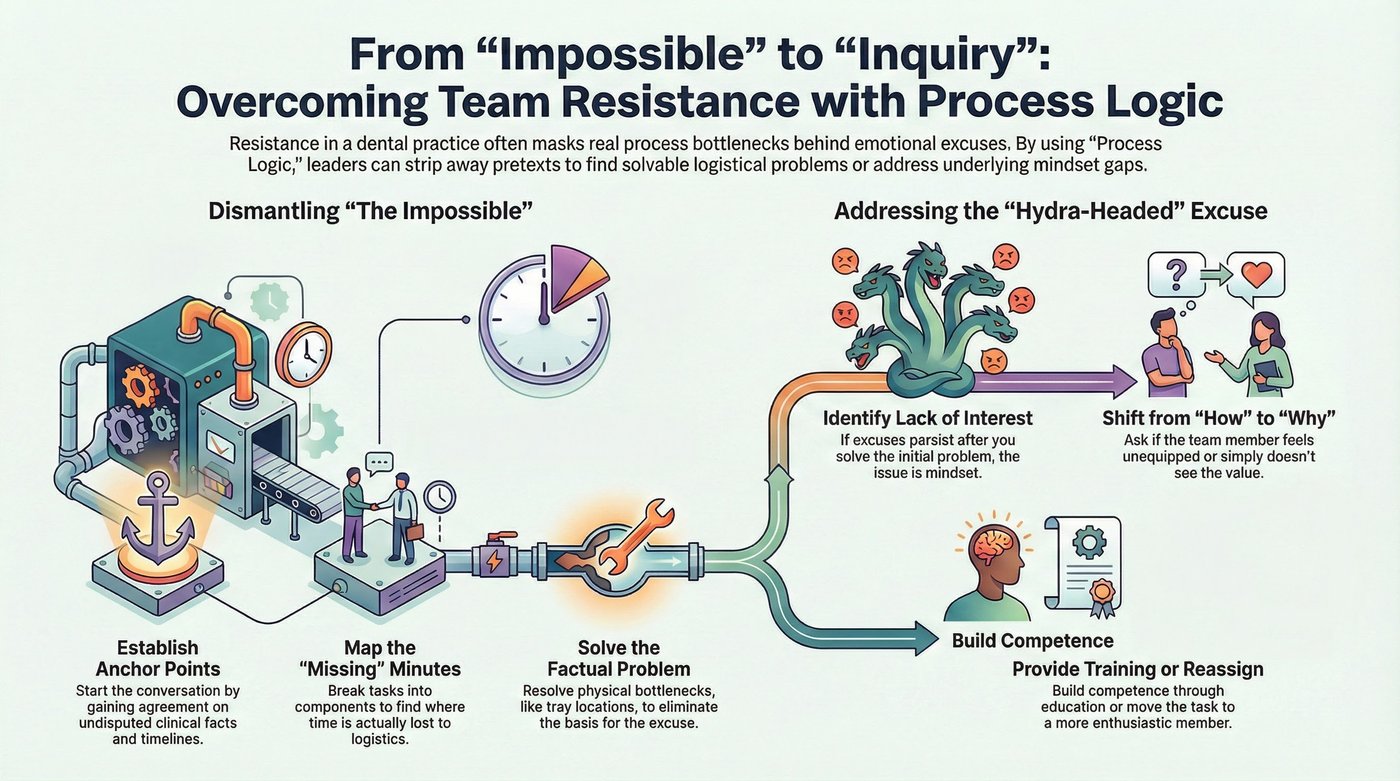
When an employee says a task is impossible, do not argue with their feelings. Instead, ask for facts. Start with your anchor points: “We agree the actual clinical work takes five minutes, right?” These anchor points establish a baseline of agreed-upon, undeniable metrics. When they agree, move to the next step. “If the task is five minutes and seating the patient is two minutes, where are the other thirteen minutes going?”
This is the essence of time-motion analysis in a clinic setting. We are deconstructing the entire procedure, often revealing hidden waste or necessary re-sequencing. Consider, for example, a struggle to reduce sterilization cycle time. If the team anchors on the fact that the autoclave run time is fixed at 45 minutes, the inquiry shifts to pre- and post-cycle bottlenecks.
By breaking the process down into its component parts, you stop fighting the “excuse” and start investigating the “process.” You might discover a real objection: “I have to walk to the other side of the building for a specific tray.” This logistical issue, once hidden by frustration, becomes a clear target for process improvement. Now you have a solvable, factual problem. By fixing the logistics—perhaps through mobile carts or relocating high-use instruments—you dissolve the excuse. This analytical approach transforms perceived failure into system design opportunity.
The Hydra-Headed Excuse: Identifying Lack of Interest
In team management, pretexts often show up as “time wasters.” If an employee says, “I don”t have time to do the marketing flyers,” and you free up their schedule, but they find another reason not to do it, you are dealing with a lack of interest. A key responsibility of leadership is discerning between genuine capacity issues and attitudinal roadblocks.
A lean leader doesn”t keep chasing the “next” excuse. This constant shift is the “Hydra-headed excuse,” where cutting off one objection only allows two new ones to sprout. Instead, you address the mindset. “It seems that this task is not a priority for you. Is that because you feel unequipped, or do you not see the value in it?”
A common real-world example is the staff member who resists following up on large case presentations. Their excuse may be a technical glitch in the CRM, but once fixed, they complain about call script length. By shifting the conversation to the “why,” you stop wasting time on the “how.” You either provide the necessary training to build competence (solving a real objection, such as sales reluctance) or you reassign the task to a more enthusiastic team member. Leadership must swiftly reallocate responsibilities when a task fundamentally conflicts with a team member’s priorities or cultural alignment.
Communication as a Collaborative Sport
View communication in your practice not as a battle to be won, but as a collaborative sport. You are exploring the court together. By using process logic, you depersonalize the conflict, making it a problem to be solved rather than an argument to be won. This framework fosters psychological safety, encouraging staff to raise genuine flaws in the process without fear of judgment.
Sometimes a long rally where you gently uncover the truth through listening and questioning is the most satisfying win. This same method applies when discussing complex treatment plans with patients. If a patient resists an essential procedure, a logical breakdown of the risks and benefits, using agreed-upon facts (anchor points), dissolves emotional or financial pretexts.
By distinguishing between the solvable facts of a valid objection and the emotional evasion of a pretext, you become a more effective leader and a more persuasive communicator. Whether you are talking to a patient at the chairside or a staff member at the front desk, lead with logic, identify the anchor points, and never be afraid to dig beneath the surface of a “no.” This commitment to objective inquiry is the hallmark of practices that achieve and sustain peak performance.
Conclusion:
Solving resistance is the essential step toward operational mastery in a dental or orthodontic clinic. By adopting process logic—breaking down complex workflows into measurable, data-driven anchor points—leaders can effectively bypass emotional resistance and pinpoint tangible bottlenecks. This engineering mindset shifts the focus from managing people”s feelings to optimizing systems. When you consistently apply this framework, you not only improve efficiency but also cultivate a high-trust, high-accountability team culture ready to embrace change and drive the practice forward.