

Engineering Predictability: Why Systems-Thinking is the Ultimate Competitive Advantage
Published on: Jun 9, 2026
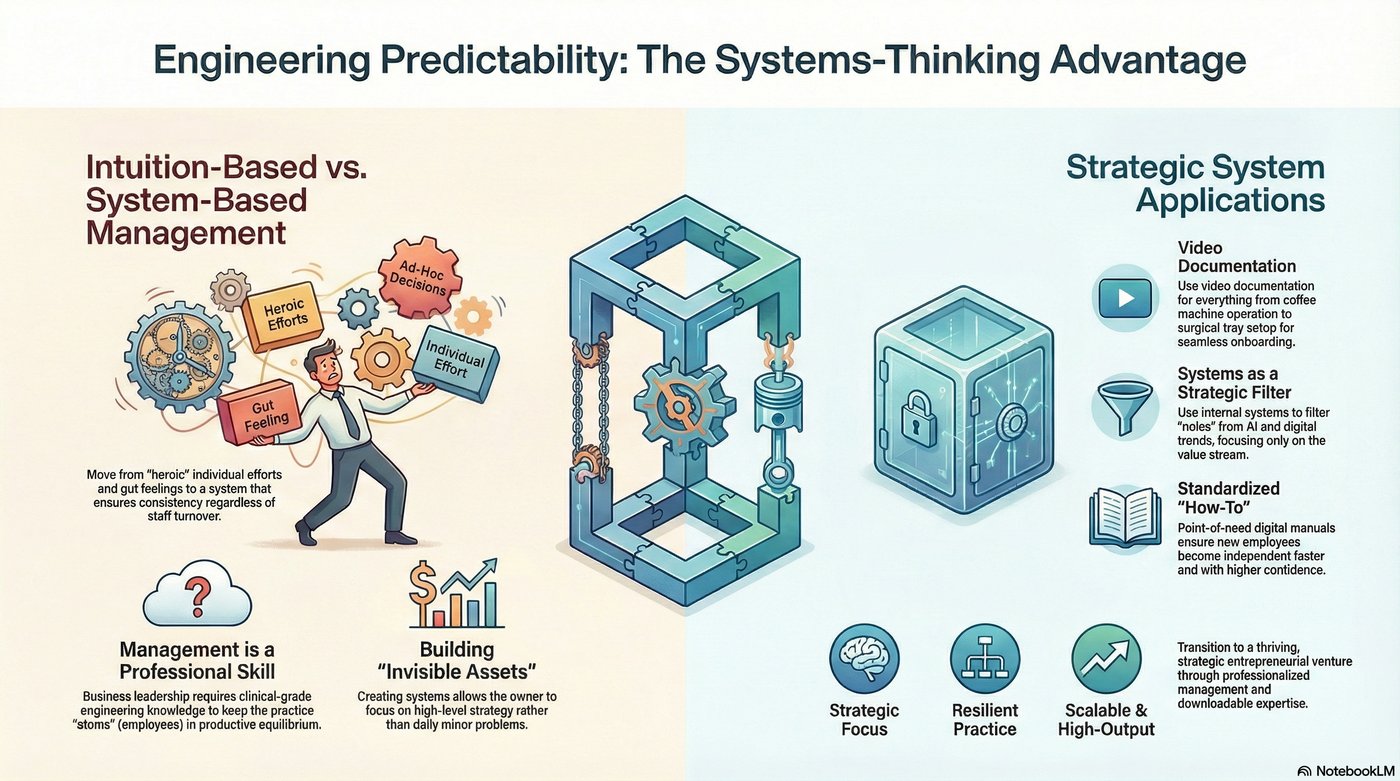
In the philosophy of Lean Orthodontics, operational excellence is defined by predictability. A practice that relies on the “heroic” efforts of a few talented individuals is fundamentally fragile. If your clinic’s success depends on one specific receptionist or a single lead assistant, you haven’t built a business; you’ve built a dependency.
To build a truly valuable asset, a leader must move beyond instinct and embrace systems-thinking. This approach ensures that high-quality treatment, leadership, and patient interactions happen consistently, regardless of which staff member is on duty. It is the transition from individual brilliance to organizational reliability.
The most successful practices are those that have successfully “downloaded” the owner’s expertise into a system that the entire team can execute. Think of this as creating a clinical operating system (OS) for your office. When the doctor is the only one who knows “how we do things here,” growth is capped by the doctor’s physical and mental bandwidth.
This transition from “intuition-based” to “system-based” management is what separates a struggling clinic from a thriving entrepreneurial venture. It allows the clinician to step back from micro-management and step into the role of a strategic visionary, confident that the standards are being met at every chair.
The Skill of Management: Moving Beyond Instinct
Many dentists attempt to manage their practices by gut feeling, assuming that their clinical degrees automatically qualify them as business leaders. This is a dangerous misconception. While you spent years mastering occlusion and biomechanics, management is a distinct professional skill that requires its own set of “clinical” tools and diagnostic protocols.
Relying on instinct leads to “management by crisis,” where the leader is constantly putting out fires instead of preventing them. Professional management involves understanding workflow bottlenecks, overhead ratios, and team psychology with the same precision used to diagnose a complex malocclusion.
Just as you wouldn’t calculate the structural integrity of a building without engineering knowledge, you shouldn’t attempt to scale a practice without mastering leadership mechanics. This involves setting clear KPIs and establishing a culture of accountability where every team member knows exactly what “winning” looks like for their specific role.
Acquiring these skills allows you to treat your practice as a living system where every “atom” (employee) and “molecule” (team) is in a state of productive equilibrium. When the system is balanced, the practice runs with a sense of calm efficiency that patients can feel the moment they walk through the door.
Creating a “Knowledge Vault” for Seamless Onboarding
One of the most efficient applications of systems-thinking is in the area of onboarding. Traditionally, training a new hire is a massive drain on the senior team’s time, often leading to “tribal knowledge” where shortcuts are passed down as standard protocol. In a lean practice, we solve this by creating a digital “knowledge vault”—a centralized repository of truth.
This vault ensures that training is proactive rather than reactive. Instead of a new assistant shadowing a busy colleague and hoping they catch the right details, they follow a structured curriculum that guarantees a baseline of competency before they ever touch a patient.
Video Documentation: Don’t just write a manual; record a video. From using the coffee machine to setting up a surgical tray, video provides a clear, repeatable standard that eliminates the “I thought you meant…” conversations.
Accessibility: Ensure that this information is available at the point of need. QR codes on equipment that link directly to instructional videos can transform a confusing moment into a learning opportunity without interrupting a senior staff member.
Consistency: When the “how-to” is standardized, new employees become independent faster and with more confidence. This creates a uniform patient experience where the quality of care doesn’t fluctuate based on who is in the building.
This approach protects your practice from the “brain drain” that occurs during staff turnover. When a key employee leaves, the system remains. This documentation ensures that your unique clinical and service standards are upheld at all times, preserving the hard-earned reputation of your brand.
Systems as an Information Filter in the AI Era
We are currently bombarded with data—from AI-driven treatment planning and remote monitoring to endless digital marketing trends. Without a strong internal system, this “noise” can lead to a fragmented practice identity, where the team is constantly chasing the latest “shiny object” at the expense of core clinical results.
The danger of the AI era is not the technology itself, but the lack of a framework to implement it. If you introduce a new tool without a system to support it, you aren’t innovating; you are merely adding complexity and cost to an already stressed environment.
A well-designed system acts as a strategic filter. It takes the overwhelming flow of external data and curates it to match your specific practice philosophy. If a new AI tool doesn’t improve your specific value stream, the system rejects it, keeping your focus where it belongs.
This ensures that your team isn’t just “busy” with the latest trend, but is focused on the specific actions that drive your value stream: a perfect smile, an optimal bite, and a satisfied patient who refers their friends and family.
Conclusion: The Balanced Life of the Strategic Leader
Ultimately, building these invisible assets—knowledge, skills, and systems—is what allows the practice owner to achieve a balanced life. Many doctors find themselves “married” to the office, unable to take a vacation without checking their email or worrying about clinical errors. Systems break that cycle of anxiety.
When the practice doesn’t depend on your constant physical presence to solve every minor problem, you are free to focus on the high-level strategy that only you can provide. You transition from being a technician who owns a job to a CEO who owns a self-sustaining business.
Invest in your systems today to secure your success tomorrow. By professionalizing your management and documenting your expertise, you turn your practice into a resilient, high-output organization that delivers a world-class patient journey with effortless precision. The ultimate competitive advantage isn’t just what you do; it’s how predictably you do it.
In conclusion, systems-thinking is the bridge between a chaotic clinical existence and a streamlined, profitable legacy. By committing to the engineering of predictability, you empower your team, delight your patients, and finally reclaim the freedom that entrepreneurship promised. Start building your knowledge vault today, and watch your practice transform into the ultimate competitive asset.