

Engineering Innovation: Why Psychological Safety is the Foundation of Practice Growth
Published on: Jun 18, 2026
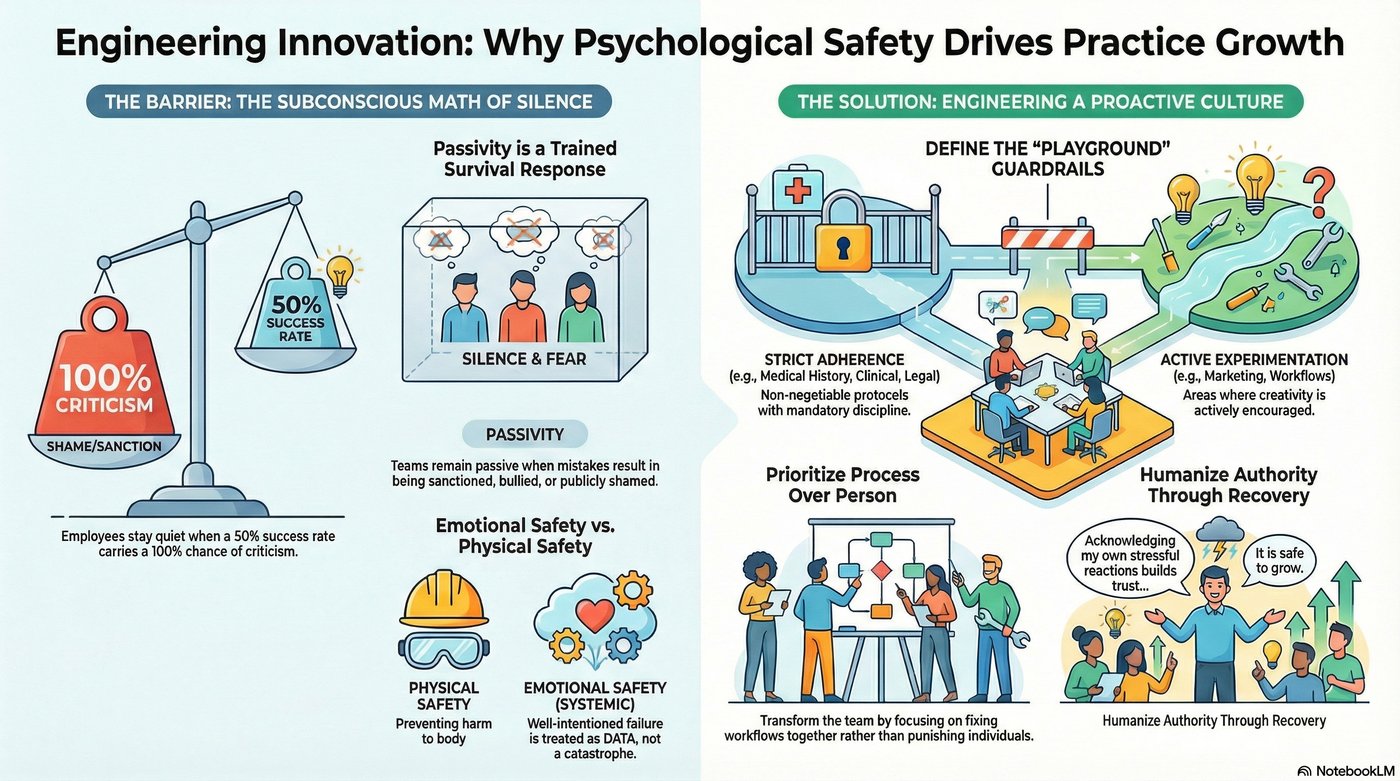
In the high-stakes world of orthodontics, we often wonder why our team members simply do what they are told but rarely step up to solve problems or suggest new ideas. We complain about a lack of “ownership,” but the uncomfortable truth is that if your team is not innovative, it is usually because the environment in your practice has trained them that it is safer to be passive than to be proactive.
This lack of proactive engagement directly impacts practice efficiency and patient experience. When staff members feel unsafe sharing concerns, small procedural cracks become chronic systemic failures, resulting in lost production time and increased stress for everyone.
I am Dr. Martin Baxmann, and to achieve operational excellence, we must reverse engineer the process of responsibility. You cannot simply command a person to “be innovative.” Innovation is an output that only occurs when specific inputs are present. The primary input is psychological safety—the belief that one will not be punished or humiliated for speaking up with ideas, questions, concerns, or mistakes.
To unlock this potential, we must build a three-level structural hierarchy of culture, moving from the foundational layer of trust to the peak of a healthy error culture. This structure shifts the focus from individual blame to continuous system improvement, which is essential for scaling a successful practice.
The Cost-Benefit Analysis of the Employee Mindset
Every time an employee considers suggesting a new workflow or a change in the sterilization process, they perform a subconscious calculation. If a new idea has a 50% chance of success but a 100% chance of resulting in the boss yelling at them if it fails, the math is simple: they will stay quiet. This “silent quitting” of proactive thought is one of the biggest hidden costs in a dental practice.
Consider a front office coordinator who notices that new patient forms are often missing critical insurance data. They want to suggest moving the data-entry step earlier in the process. If a previous suggestion was met with skepticism or punitive inquiry—”Why did you let this happen?”—they will learn to simply process the flawed forms. Their emotional safety outweighs the perceived benefit of fixing the system.
In lean management, we define “Safety” not just as physical protection but as systemic emotional safety. This is about establishing a high-trust environment where interpersonal risk-taking is encouraged. Emotional safety assures the team that their standing within the practice is not immediately threatened by a failed experiment or a disclosed error.
If an employee knows that a mistake will result in being sanctioned, bullied, or publicly shamed, they will never take a risk. They will do exactly what is written in the manual and nothing more. This rigidity stifles the organic, on-the-ground improvements that only front-line staff can identify.
As a leader, your job is to create an environment where a well-intentioned failure is treated as data, not as a catastrophe for their career. This requires shifting the conversation from “Who made the mistake?” to “What in our system allowed this mistake to occur?” It’s a profound operational shift from accountability to collective process mastery.
Defining the Playground: Innovation vs. Disorder
A common fear among practice owners is that “innovation” means a lack of discipline. This is a crucial distinction: total freedom without boundaries is not innovation; it is chaos. Uncontrolled experimentation can indeed compromise clinical standards or legal compliance, which is why structure is paramount.
In a lean practice, leadership must clearly define the “playground”—the boundaries within which experimentation is permitted and even expected. This involves making explicit which workflows are sacred and which are malleable. Failure to articulate these boundaries leads to fear and paralysis, as employees assume all areas are off-limits.
There are areas where strict adherence is mandatory—such as medical history scripts, HIPAA compliance protocols, or legal documentation. These are non-negotiable protocols where deviation is unacceptable. In these zones, the focus is on rigorous training and perfect execution of established standards.
However, there are other areas—such as the patient recall system, inventory management, or marketing workflows—where creativity is actively encouraged. A hygienist, for instance, might suggest a new way to integrate oral hygiene instructions during treatment, or a scheduler might propose a different way to batch appointments for efficiency.
By defining where creativity is welcome and where discipline is mandatory, you provide the guardrails that allow your team to experiment without compromising the clinical or legal integrity of the practice. This structured approach to innovation protects the practice while maximizing the team’s creative input into non-clinical, workflow-related areas.
The Leader’s Recovery: Humanizing Authority
We are all human. There will be days when things go wrong and you, as the doctor, react with annoyance or stress. Perhaps a critical appliance was ordered incorrectly, or a patient’s chart was misplaced just before a procedure. A spontaneous, frustrated reaction is natural, but it can destroy weeks of trust-building instantly.
However, the key to building a culture of trust is the recovery. This is where professional leadership truly shows its strength. The goal is not to be perfect, but to model the behavior you expect from your team when they inevitably make a mistake.
True leadership is the ability to return to the team and say, “I was stressed; that reaction was not okay. I appreciate that you took the risk [or brought this error to my attention]. Let’s look at how we can fix the process together.” This act of vulnerability is a massive signal that reinforces psychological safety. It demonstrates that learning supersedes defensiveness.
When you prioritize the process over the person, you signal to your team that it is safe to try, safe to fail, and safe to grow. This is how you transform a group of employees who simply follow instructions into a unified force of problem-solvers. This collective intelligence, driven by safety and trust, is the only sustainable pathway to true practice growth and innovation in the competitive dental landscape.
Conclusion:
Psychological safety is not a soft human resources concept; it is a hard operational prerequisite for sustained growth in a modern orthodontic or dental practice. By consciously addressing the employee’s cost-benefit calculation, clearly defining the boundaries of their “playground,” and mastering the art of the leader’s recovery, you move beyond simply managing staff. You build an empowered, resilient team that is willing to take the calculated risks necessary to evolve your practice and ensure its long-term excellence.