

Engineering Freedom: How to Build a Practice That Outlasts You
Published on: Jun 3, 2026
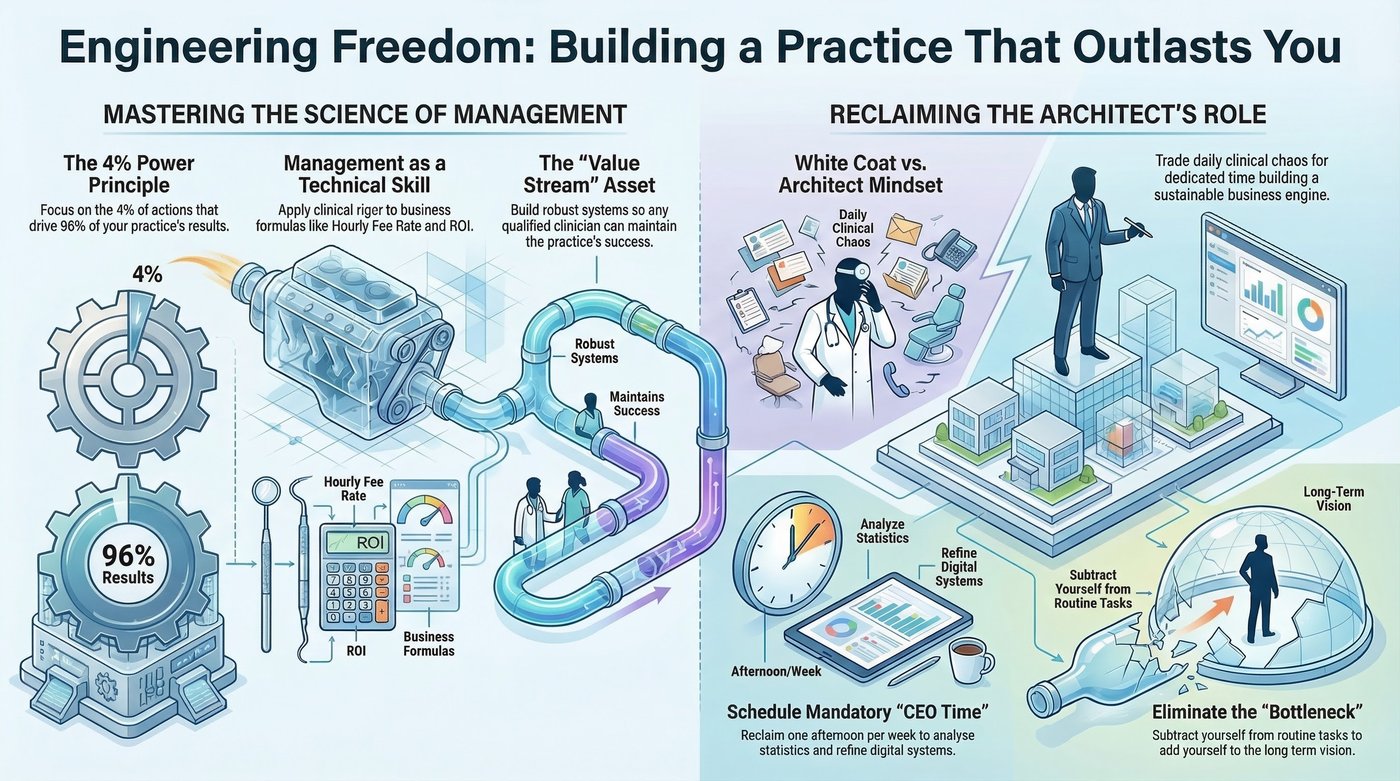
The true measure of a successful orthodontic entrepreneur is not how many patients they see in a day, but how well the practice functions when they are absent. This distinction separates a high-value asset from a high-stress job. A practice that depends entirely on the owner’s constant presence, clinical speed, and personal reputation is merely a “house of cards”. Its fundamental weakness is its sole reliance on one individual’s energy. When you decide to shift your focus to work on your business, you are essentially building a sustainable legacy—an enduring asset that maintains and grows its intrinsic value even after you walk away. This strategic evolution from clinician to CEO is the most crucial step toward financial independence and true professional freedom.
Management as a Technical Skill
We often treat “business” as an intuitive gut feeling, yet we rigorously treat “orthodontics” as an empirical science built on data and predictable outcomes. To transition effectively into a leadership role, you must apply the exact same clinical rigor to your practice management. Management is not abstract; it is a technical skill involving established formulas, repeatable systems, and measurable data that must be tracked daily. This shift necessitates moving beyond patient-centric metrics to encompass business-centric diagnostics.
To work on your business, you must master the “Clinical Data” of entrepreneurship:
Hourly Fee Rate: Understanding the true value of every chair minute is foundational, extending beyond simply dividing daily production by hours worked. This rate must factor in the total cost of overhead, amortization of expensive technology like CBCT units, and the efficiency of highly-paid support staff. A precise calculation allows you to identify and eliminate procedures that are “time-hogs” but low-value, thereby maximizing chair time utilization and production per hour.
Return on Investment (ROI): Calculating if a new purchase—such as a $50,000 3D scanner or the renovation of an additional treatment room—actually generates substantial profit or merely creates more complex work. Effective ROI analysis means measuring the true patient lifetime value generated by that asset, rather than just its sporadic usage. For instance, a new hire in a non-clinical role, like a dedicated treatment coordinator, often yields a higher ROI through increased case acceptance than a piece of hardware that is underutilized.
The Power Principle: This concept, rooted in the 80/20 rule, involves identifying the 4% of your actions, services, or patient demographics that drive 96% of your results. For a clinic leader, this means ruthlessly prioritizing high-leverage activities, such as refining the new patient conversion script or auditing key performance indicators (KPIs), over low-leverage tasks like ordering supplies or troubleshooting IT issues. This focus ensures that limited management time is spent on systemic improvements, not routine tasks.
The Calendar: Your Most Important Instrument
The operational transformation happens on your calendar before it can ever be realized in your clinic. If you fail to carve out dedicated “CEO Time” and defend it fiercely, the urgent, daily chaos of clinical work will inevitably consume every available second. This constant reactionary mode prevents strategic thinking and long-term asset development.
Start by aggressively reclaiming one half-day, or four consecutive hours, once a week. During this protected time, the white coat is functionally off, and you shift your identity. You are no longer a doctor delivering care; you are an architect designing the operational flow. Activities here include analyzing monthly financial statistics, drafting and refining digital onboarding videos for new staff, or documenting the standard operating procedures (SOPs) for key front-desk roles. Crucially, this time also includes meeting with your “Kitchen Cabinet” of specialized advisors—the CPA, legal counsel for transfer planning, and business coach—who guide your long-term wealth strategy. Viewing this time as a high-leverage investment, rather than a waste of clinical revenue, is essential, as this dedicated planning is the engine that makes your future revenue streams scalable and sustainable.
Building a Transferable Asset
When the inevitable time comes to sell or hand over your dental or orthodontic practice, a sophisticated buyer is not looking at your personal reputation; they are scrutinizing your Value Stream. They need to see a “package tour” experience where every step of the patient journey is documented, standardized, and repeatable. The systems must be so robust, standardized, and proprietary that any qualified clinician can step into the operatory and continue the established standard of success with minimal disruption to patient experience or cash flow.
By investing heavily in your team’s systematic development and refining your standardized operational protocols, you are accomplishing far more than simply reducing your daily clinical stress. You are creating proprietary intellectual property—a high-value asset that commands a premium valuation. This requires creating detailed training modules and checklists for every role, from scheduling to insurance verification, ensuring operational consistency regardless of personnel changes. A practice that runs entirely on established, auditable systems and documented procedures is worth significantly more than a practice whose value is based solely on an exhausted doctor’s personal charisma or relentless work ethic. Systemization guarantees continuity, which is the ultimate currency for a potential buyer valuing the asset.
Conclusion: The Path to Strategic Growth
The crucial transition to working on your business is fundamentally a journey of strategic subtraction. You intentionally subtract yourself from the tactical, routine daily operations so that you can add yourself back into the elevated role of visionary and architect. This shift requires cultivating a high tolerance for the temporary discomfort and perceived inefficiency of change as you empower your team and delegate core responsibilities. The profound result, however, is a self-managing practice that consistently provides elite clinical care, ensuring patient loyalty, while simultaneously delivering deep personal and financial freedom for the owner.
Strategic growth is achieved not by treating more patients, but by designing and implementing better systems. Take a clear, objective look at your schedule for the next four weeks. Where, precisely, is your protected “CEO Time” documented and defended? If that dedicated time is not explicitly there, you must accept that you are not the leader; you are, by definition, the greatest operational bottleneck. Begin today by identifying that space and start building the robust foundation that will ensure your practice not only survives but thrives long after your final treatment is complete, guaranteeing your legacy.