

Engineering Flow: Why “Routine” is the Secret to Practice Efficiency
Published on: Jun 11, 2026
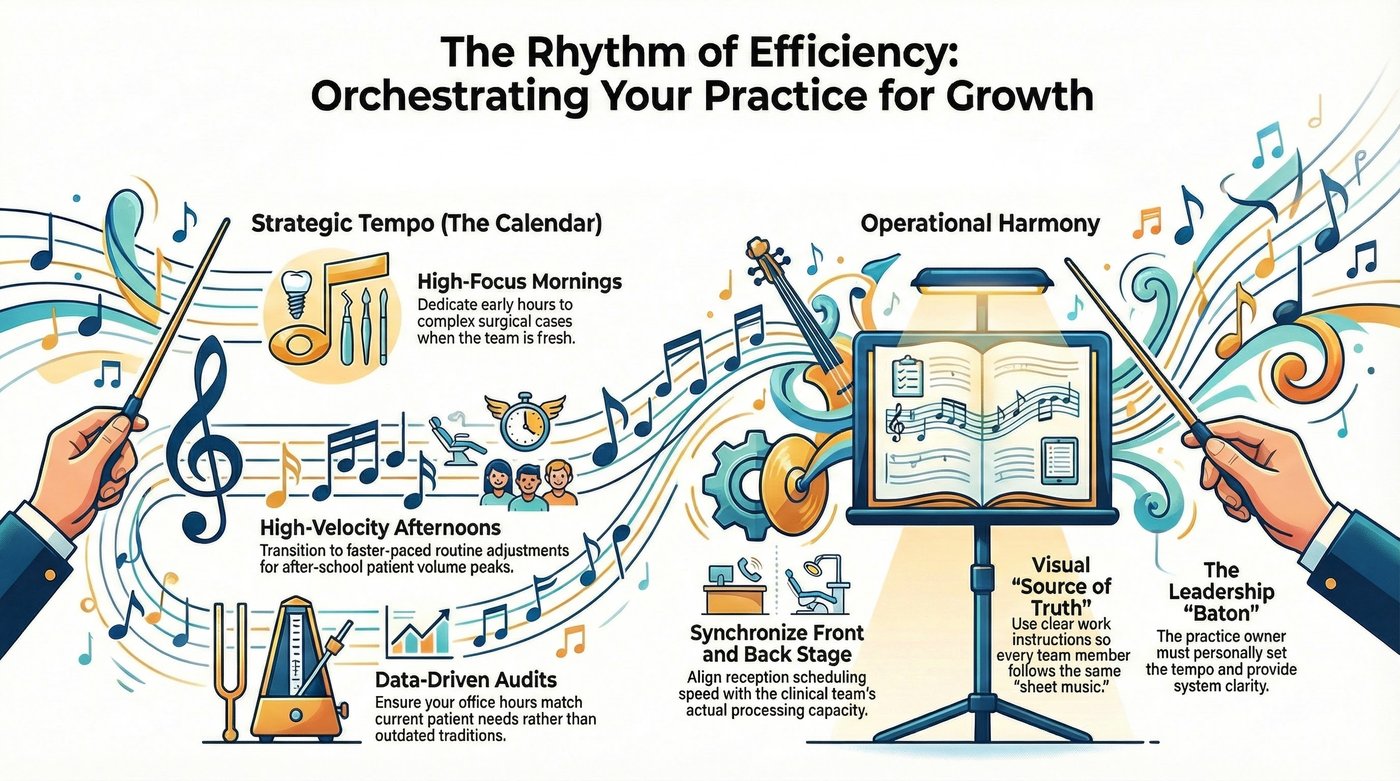
In the pursuit of practice efficiency, many orthodontists fear the word “routine.” They worry that standardization will stifle creativity or make the work feel stale. However, in the philosophy of lean management in dentistry, a well-engineered routine is not a cage; it is the foundation of freedom. It is the steady beat that allows your team to perform complex tasks with ease and predictability.
When systems are standardized, the cognitive load on your staff is significantly reduced. Instead of wondering where a specific instrument is located or which step comes next in a bonding sequence, the team moves with muscle memory. This mental bandwidth can then be redirected toward high-level patient interaction and clinical problem-solving.
Consider the difference between an amateur garage band and a professional orchestra. The orchestra follows a strict score, yet that precision allows for a more powerful and nuanced performance. In your clinic, the “score” is your standard operating procedure, ensuring every patient receives the same elite level of care regardless of which assistant is chairside.
Operational excellence is achieved when every member of the team knows exactly what is expected and when it should happen. By mastering the timing of your internal processes, you move away from a reactive state of “putting out fires” and into a proactive state of “synchronized performance.”
Synchronization requires a deep understanding of your “Takt time”—the rate at which you must complete a treatment step to meet patient demand. When the clinical flow is out of rhythm, bottlenecks occur. Patients wait in the reception area, and clinicians feel rushed, leading to an environment of high stress and potential error.
A proactive state means your team anticipates the doctor’s needs before they are even voiced. This level of synergy only happens when the routine is so deeply embedded that it becomes the practice’s natural state of being, allowing for a smooth transition from one patient to the next without friction.
The Dangers of Stale Habits
While rhythm is essential, we must distinguish between a productive rhythm and a stale habit. A lean leader constantly audits the “beat” of the practice to see if it still serves current goals. For example, many practices still close on Wednesday afternoons simply because it was a traditional norm decades ago.
Stale habits are often the result of “legacy thinking,” where processes remain unchanged despite shifts in technology or patient demographics. If your clinic still uses a paper-based check-in system or manual tracking for lab cases, you are likely clinging to a habit that is actively draining your team’s efficiency and profitability.
The danger lies in the comfort of the familiar. Habits are reflexive and require no thought, whereas a productive routine is intentional and regularly evaluated. A successful practice manager must have the courage to dismantle a habit that no longer contributes to the “Lean” objective of eliminating waste.
A modern practice manager looks at the data. Does our current rhythm match our patients’ school schedules? Does it accommodate the working hours of the parents? If your rhythm is based on “the way we’ve always done it” rather than current operational needs, it is time to rewrite the arrangement.
Data-driven decision-making removes the guesswork from scheduling. By analyzing your busiest hours and the types of procedures that cause the most delays, you can reconstruct your day to maximize throughput. This might mean shifting lunch hours or adjusting the start times of your morning huddles to better align with the reality of your local market.
Efficiency is not about working faster; it is about working smarter by aligning your resources with the actual needs of your community. When the practice rhythm harmonizes with the lives of your patients, you don’t just see more people—you provide a more convenient and valued service that naturally leads to increased referrals.
Strategic Tempo: The Appointment Calendar as a Tool
Your appointment calendar is the most powerful tool you have for setting the practice tempo. High-performing clinics use “time blocking” to create a specific flow. This involves categorizing procedures by their intensity and duration, ensuring that the schedule isn’t just full, but balanced.
A common mistake is “sprinkling” complex cases throughout the day, which causes constant shifts in the team’s mental focus. By grouping similar tasks together, you utilize the principle of batching, which is a cornerstone of industrial efficiency. This reduces the time lost to room turnover and mental reset between different types of appointments.
High-Focus Mornings: Dedicate the early hours to long, complex procedures (e.g., bondings or surgical cases) when the clinical team is fresh.
High-Velocity Afternoons: Transition to a faster beat for routine adjustments and checkups when the patient volume peaks after school hours.
This intentional shift in tempo prevents the team from burning out during the afternoon rush and ensures that complex cases receive the undivided attention they require. It synchronizes the practice’s energy with the patient’s journey, recognizing that the clinical team has different energy levels at 8:00 AM versus 4:00 PM.
Effective time blocking also creates “buffer zones” for emergency repairs or unexpected consultations. Without these intentional gaps, one late patient or a broken bracket can derail the entire afternoon, causing a domino effect of delays that frustrates both the staff and the families waiting in your lobby.
When the tempo is strategic, the office feels energetic rather than chaotic. The team knows when to push and when they have a moment to reset. This balance is vital for long-term retention of talented clinical staff and maintains a high level of morale throughout the work week.
Synchronizing the Internal and External Customer
Efficiency is lost when the “front stage” (the reception and consultation) is out of sync with the “back stage” (the clinical floor and lab). If your receptionists are scheduling appointments faster than the clinical team can process them, you create a bottleneck that compromises the quality of care and the patient experience.
The front and back offices must operate as a single unit. This requires frequent communication and shared performance metrics. For example, if the clinical team is running behind, the front desk should be notified immediately so they can manage patient expectations and perhaps offer a coffee or update on the wait time.
A lack of synchronization often stems from a lack of understanding of each other’s roles. Regular cross-training or department-bridging meetings can help front-office staff understand the technical complexities of the back, leading to more realistic scheduling and a more unified professional culture.
This is why clear work instructions and a visual “source of truth” are vital for dental team performance. Everyone must be looking at the same sheet music. When the communication at the front desk perfectly matches the feasible rhythm in the back, patient trust is solidified. They experience a practice that is calm, coordinated, and in total control.
Visual management tools, such as digital dashboards or huddle boards, provide this source of truth. They allow everyone to see the state of the practice at a glance: Are we on time? Are there open slots for new patients? Is the lab work for this afternoon ready? This transparency eliminates the need for constant, disruptive verbal check-ins.
When the internal customer—the clinical staff—is satisfied and well-supported by the front stage, the external customer—the patient—receives the best possible version of your practice. A synchronized office project an image of professionalism that justifies premium fees and fosters long-term loyalty from your patient base.
Leadership and the Art of the “Baton”
Ultimately, the rhythm of the practice is a reflection of the owner’s leadership. You cannot delegate the setting of the beat. You must be the one to step up and provide the clarity your “musicians” need to succeed, setting the standard through both your words and your consistent daily actions.
A leader’s role is to remove obstacles. If the team is struggling to maintain the routine, the leader must ask why. Is it a training issue? A lack of equipment? Or is the system itself flawed? Effective leaders don’t just demand efficiency; they engineer the environment to make efficiency the easiest path for the team to take.
Leadership also involves emotional intelligence. Recognizing when the rhythm is too fast and the team is nearing a breaking point is just as important as identifying when things are too slow. By being the “conductor,” you ensure that the practice remains sustainable and that the quality of clinical outcomes remains uncompromised.
If you find that your team is drifting or that “jazz-style” improvisation is causing errors, it is a signal to re-engage with your systems. Improvisation in a clinical setting is often a symptom of an undefined or poorly communicated standard. It leads to variations in care that can negatively impact the final orthodontic result.
Every “workaround” created by a staff member is a sign of a failing system. While well-intentioned, these individual variations create a lack of predictability. A leader must investigate these deviations to find the root cause and update the master routine so that the “best way” becomes the “standard way” for everyone.
Audit your processes: Where is the beat being dropped?
Retrain the team: Does everyone understand the current tempo?
Adjust the arrangement: Does the schedule need to be restructured to improve flow?
Conclusion: The Harmony of Predictability
A synchronized practice is a profitable practice. When you master rhythm and timing, you reduce the “invisible waste” of waiting times and confused hand-offs. You create an environment where your team feels secure because they know what is coming, and your patients feel cared for because the journey is predictable and smooth.
Predictability is the ultimate luxury for a busy healthcare provider. It allows you to focus on the artistry of orthodontics rather than the mechanics of office management. By embracing routine as a tool for efficiency, you elevate the entire standard of your practice, turning a collection of individuals into a high-performance team.
Look at your daily workflows today; if the music has turned to noise, it is time to pick up the baton and lead your team back into harmony. The secret to efficiency isn’t a new piece of technology or a faster handpiece; it is the discipline of the routine and the commitment to a shared rhythm of excellence.