

Engineering Flow: Rigid Roles and the “No Lane Changing” Rule
Published on: Jun 22, 2026
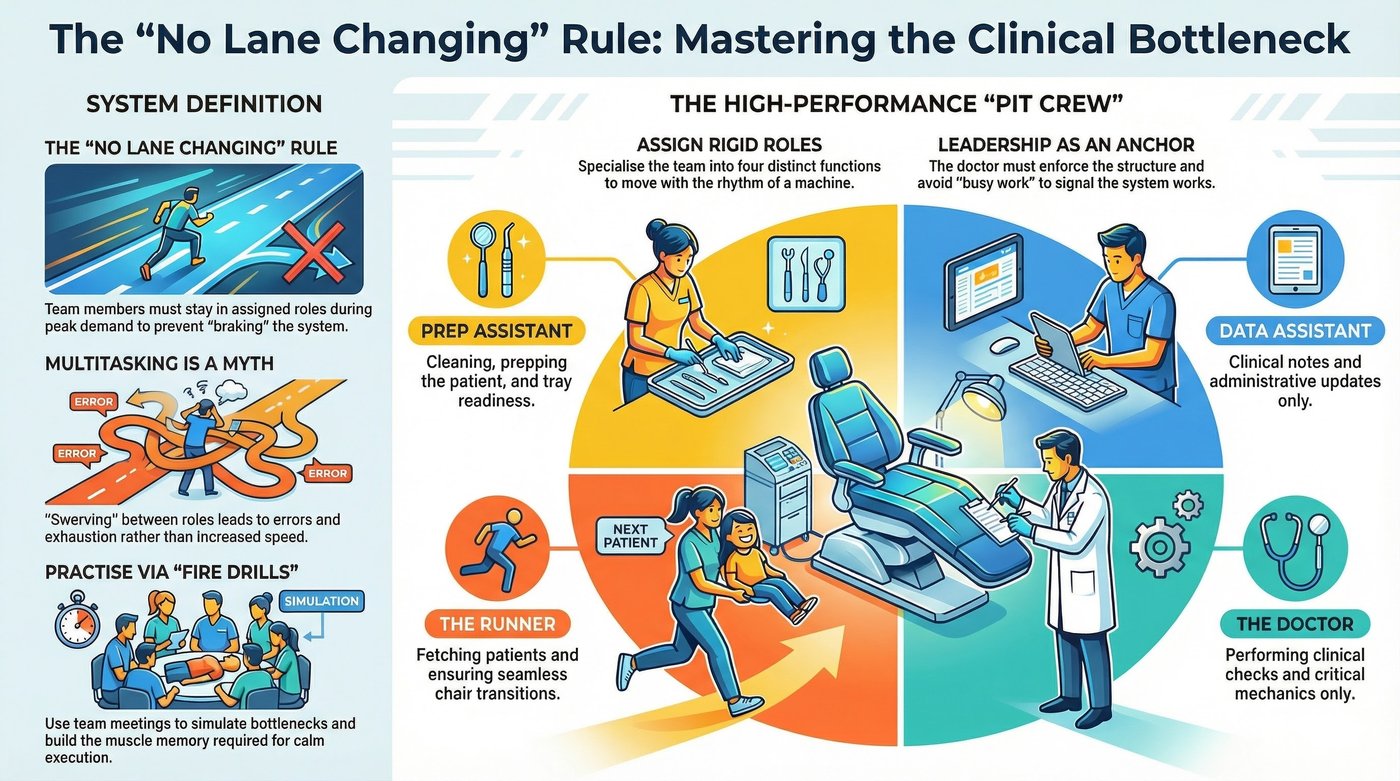
In orthodontic practice management, a bottleneck is often a symptom of a breakdown in the division of labor. This structural failure occurs during high patient volume, revealing cracks in an otherwise smooth operation. When the waiting room fills up, the temptation for team members to “jump out” of their defined roles to “quickly help” in another area is immense. An assistant might stop cleaning a tray to answer a ringing phone, or a receptionist might step into the clinic to help with a patient.
While this feels like teamwork, it is actually a fundamental disruption to efficiency. This is the clinical equivalent of a car swerving across three lanes of traffic. It forces everyone else to brake, resetting the hard-earned momentum of the entire system. To achieve operational excellence, your team must adhere to a strict “No Lane Changing” rule during peak demand periods. This ensures predictable, continuous flow, which is the hallmark of a lean clinical environment.
The Pit Crew Mentality: Specialization Over Multitasking
A high-performance team functions best when everyone stays in their assigned lane. The commitment to specialization, not versatility, is the foundational principle. During a bottleneck, you must assign rigid, singular roles to eliminate confusion and maximize throughput. These specific roles are non-negotiable for the duration of the rush.
For a smooth, optimized flow, these specialized functions are key:
The Prep Assistant: Solely responsible for cleaning, prepping the patient, and ensuring the correct, sterilized tray is ready. Their focus prevents delays from improperly set-up chairs and maintains strict sterility standards when speed is essential.
The Data Assistant: Focused entirely on real-time documentation: entering clinical notes and administrative updates. Separating documentation from chair-side care ensures the doctor’s attention and the flow of the patient visit are never interrupted by administrative delays.
The Runner: Responsible for fetching the next patient and ensuring the transition between chairs is seamless. They manage the physical flow of people, preventing “patient traffic jams” and minimizing chair downtime to maximize production hours.
The Doctor: Performs clinical checks and critical mechanics only—no “busy work” like inputting notes or fetching instruments. Delegating non-clinical tasks ensures the doctor’s most expensive and critical time is applied only where expertise is essential.
When each person focuses on a single, streamlined task, the speed and accuracy of the entire line increase. Multitasking is a myth that leads to errors, reduced quality of care, and staff exhaustion. By specializing, your team moves with the synchronized rhythm of a machine, clearing the backlog with significantly less collective effort than the “chaos” method. This disciplined approach fosters psychological safety and reduces the overall mental load.
The “Fire Drill”: Practicing the Emergency Protocol
You cannot simply hope your team knows how to react when the “bus arrives” and twenty patients walk in at once. In a lean, high-reliability practice, leadership doesn’t leave performance to chance; we practice the precise operational choreography. This proactive training turns potential confusion into predictable execution.
I recommend running “Fire Drills” during team meetings. Simulate a bottleneck by physically moving your staff between chairs and assigning the rigid roles mentioned above. The simulation should be a dry run, free from real patient stress, allowing for immediate feedback and coaching.
If your team hasn’t practiced the emergency protocol in a calm environment, they will revert to panic mode, confusion, and “lane changing” when the real stress hits. These repetitive simulations build the “muscle memory” required to stay calm and stay in their lanes when the waiting room is full. Consistent practice hardwires the correct, efficient response, making it second nature. Furthermore, these drills expose process weak points, allowing you to refine the system before a real crisis.
Leadership Under Pressure: Staying the Course
The leader’s role during a bottleneck is to remain the “anchor” of the system. The team’s operational temperature is directly correlated to the leader’s demeanor. If the doctor or manager starts panicking or rushing, the team will immediately follow, resulting in system failure.
Leadership provides necessary stability. By maintaining the structure, enforcing the “No Lane Changing” rule, and using precise communication, you signal to your team that the system works and is robust. The leader must be the embodiment of the process, moving deliberately and calmly, acting as a pace car for the crew. This controlled response ensures quality is not sacrificed for speed.
A lean clinic is defined not by a quiet morning but by how it handles the peak of the afternoon rush. By applying the “Traffic Jam” theory—eliminating unnecessary movements and enforcing role rigidity—you turn a potential crisis into a display of professional mastery. Stop braking. Stop swerving. Stay in your lane, accelerate through the bottleneck, and watch the chaos disappear.
Conclusion
Mastering clinical flow demands more than good intentions; it requires engineered discipline. The shift from reactive “heroics” to proactive system design defines the successful modern practice. By committing to specialized roles and instituting the “No Lane Changing” rule, leaders ensure higher patient throughput and a better experience for staff and patients. This structured approach reduces stress, improves clinical outcomes through fewer errors, and solidifies your practice’s reputation as a model of operational excellence. Capacity for growth is unlocked not by working harder, but by adhering strictly to the systems you design. Start drilling today to institutionalize this mastery tomorrow.