

Engineering Excellence: How to Build Your Practice “Manual”
Published on: Jun 30, 2026
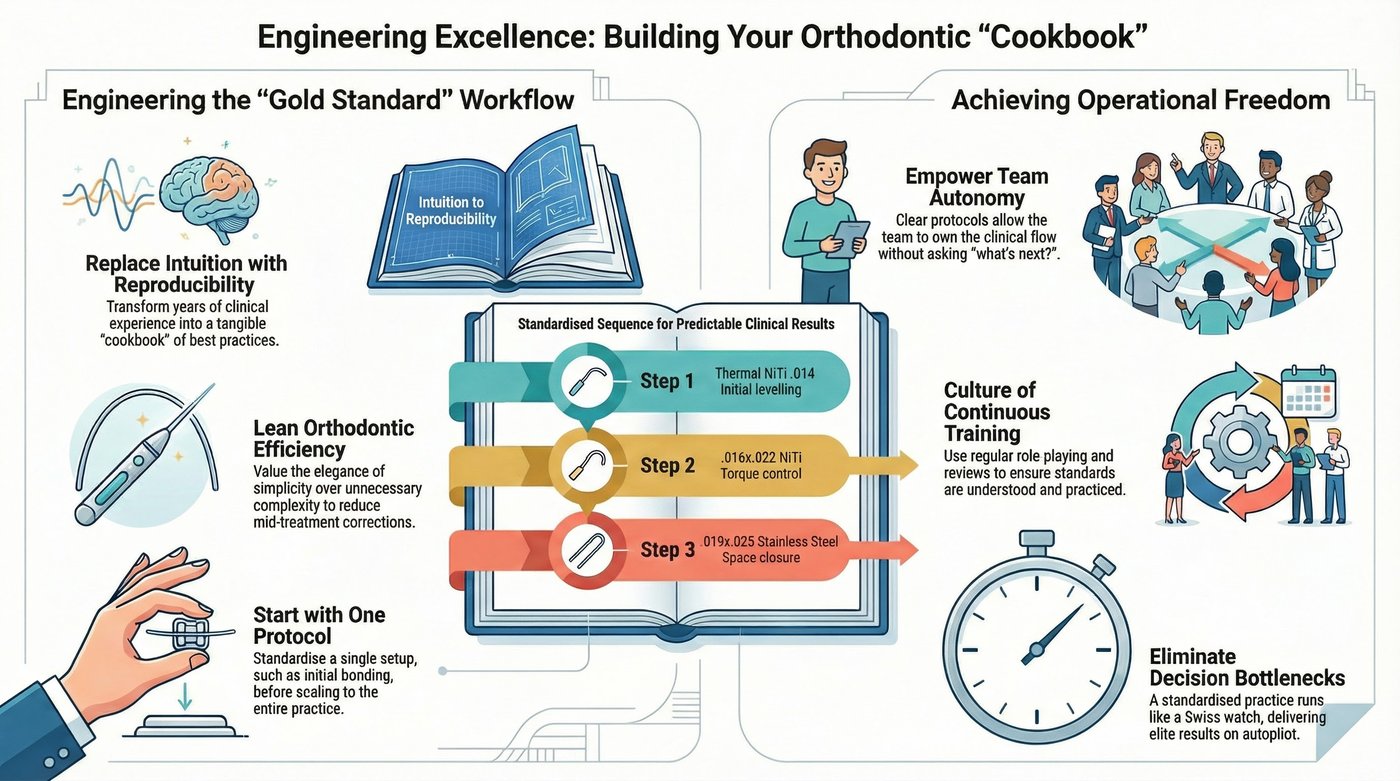
The Anatomy of a High-Performance Protocol
A “cookbook” is essentially a high-level quality management handbook. It contains the “best practices” that you have refined over years of clinical experience. To achieve operational excellence, you must transform your “gut feelings” into tangible, reproducible protocols. This transition is what separates a busy practitioner from a visionary leader and entrepreneur. Leaders understand that consistent results are not achieved by heroic, one-off clinical efforts, but by a reliable system that everyone follows. Documenting these processes creates scalable value beyond the doctor’s chair time.
The initial step in this strategic documentation is codifying your “Gold Standards”. These standards represent the ideal path for predictable outcomes, minimizing variance in technique and materials. For example, your archwire sequence in orthodontics should not be a suggestion; it must be a defined, mandatory path for every standard case. This level of detail removes clinical guesswork for associates and auxiliaries, ensuring every patient benefits from your highest level of expertise.
Step 1: Thermal NiTi .014 for initial leveling. This phase is purely dedicated to alignment with light, consistent forces, maximizing patient comfort and minimizing iatrogenic root resorption. The protocol dictates the specific time frame and the criteria for moving to the next stage.
Step 2: .016x.022 NiTi for torque control. By moving into a rectangular wire, we actively begin to express torque, a critical element often overlooked in non-standardized practices. The protocol should detail the required bracket prescription and specific tie-in mechanics.
Step 3: .019x.025 stainless steel for space closure. The transition to a heavy, rigid archwire ensures maximum anchorage control and prevents unwanted tipping during retraction. The manual should include specific instructions on loop mechanics or power chain application for this powerful closing phase.
The Efficiency of Intelligence and Elegance
In lean orthodontics, we value the elegance of simplicity over unnecessary complexity. An over-engineered treatment plan or a constantly changing protocol is often a sign of a lack of a standardized, vetted system. When your workflow is reproducible across all team members, your clinical results become inherently predictable. This predictability significantly reduces the “administrative ballast” of mid-treatment corrections, rescheduling due to technical errors, and managing unexpected emergencies.
True efficiency is the result of intelligent design, not simply working faster. By documenting precise protocols for procedures like composite placement, endodontic access, or clear aligner scanning, you embed quality into the system itself. This empowers auxiliary staff to execute complex procedures under supervision with high confidence and minimal variance, freeing the doctor to focus on diagnosis and high-value treatments.
By providing your team with these clear “recipes” for success, you empower them to take ownership of the clinical flow and become proactive partners. They no longer have to ask, “Doctor, what wire is next?” or “Which material do we use for this cementation?”—they already know and trust the defined standard. This synergy is the hallmark of high dental team performance, transforming the practice environment from a reactive series of demands into a proactive, autonomous system.
Moving to the Next Level: Training and Implementation
Implementing a cookbook approach requires more than just compiling documents; it requires a cultural and operational shift. It demands regular, protected training sessions where these protocols are not just read, but actively reviewed, debated, and practiced through role-playing. This continuous loop of training ensures compliance and identifies potential breakdowns in the workflow before they affect patient care.
The essence of this training is reminding the team why the standard exists—it connects the protocol to the final desired patient outcome. For example, when training on sterilization, the team must understand the “why” of preventing infection, not just the “how” of running the autoclave. This dedication to continuous quality improvement is what retains top talent and builds a lasting reputation for clinical excellence.
Whether you choose to use established, robust systems like the Baxmann Keys for practice management organization or decide to develop your own internal manuals tailored to your unique practice philosophy, the underlying goal remains the same: clarity, transparency, and definiteness in all clinical and administrative actions. When you let go of the ego of “bespoke” medicine—the idea that every single case requires ad hoc, unique decision-making—and wholeheartedly embrace the proven power of the protocol, your professional satisfaction as a practitioner will reach new heights. Protocols are not restrictive; they are the foundation for consistent, superior results.
Conclusion: The Path to Clinical Freedom
A practice that runs reliably and consistently on a structured “cookbook” is a practice that genuinely offers the doctor true clinical and personal freedom. When standardized procedures handle the majority of routine decisions, you are no longer the bottleneck of every single clinical and administrative decision. This shift allows the leader to transition from being an active operator to a system designer and visionary.
To begin this transformative journey, start today by identifying and documenting one single, high-impact protocol—perhaps your initial bonding setup, your perfect patient handoff between assistants, or your debonding checklist. Create a step-by-step document, test it with your team, and refine it until it is bulletproof. Once that single process is standardized and running smoothly, move immediately to the next one. Before long, you will look back and find that you have a practice that runs with the precision of a Swiss watch, delivering elite, world-class results effectively on autopilot. This systemic approach is the ultimate form of business mastery in dentistry.