

Engineering Efficiency: How Clinical Fundamentals Drive Orthodontic Practice Performance
Published on: Jun 24, 2026
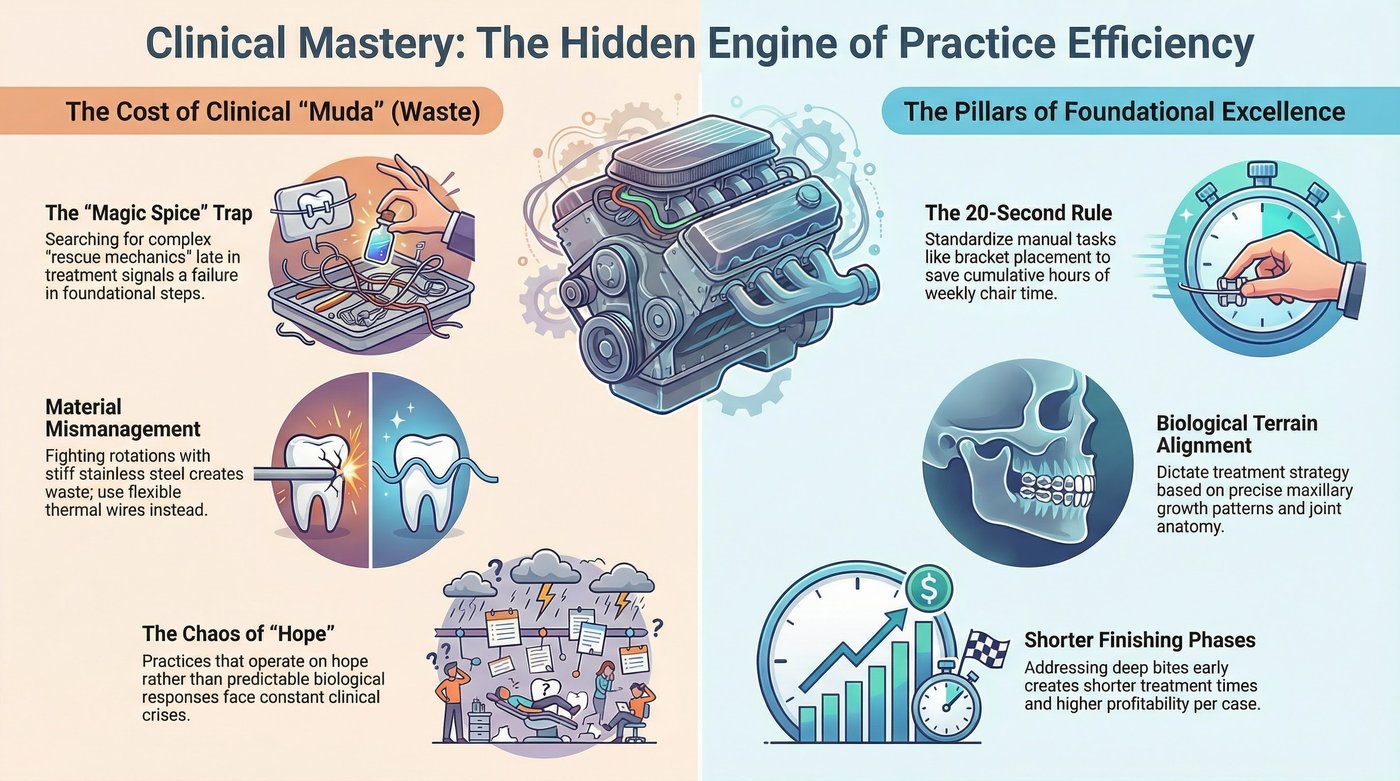
Operational excellence in an orthodontic practice is often discussed in terms of scheduling, marketing, and team leadership. While these are vital, there is a hidden driver of practice efficiency that many clinic owners overlook: the mastery of basic clinical mechanics. In a lean orthodontic environment, clinical proficiency is the engine of speed. When you master the fundamental basics, you eliminate the mechanical errors that cause treatment delays, unplanned appointments, and patient dissatisfaction.
The most successful orthodontic leaders are those who treat the “fundamentals” as an ongoing discipline. They understand that every clinical bottleneck is a symptom of a missed foundational step. By refining your team’s and your own grasp of biomechanics, you create a workflow that is not only faster but significantly more predictable.
The High Cost of the “Magic Spice” Mentality
In many mentoring sessions, I see a recurring theme: a clinician is struggling with a basic mechanical issue, such as a canine rotation, while the case is already in heavy finishing wires. They search for a “magic” solution—a specific wedge, a complex loop, or a double power chain—to force the movement. This is the definition of “muda” (waste) in lean management.
If you are fighting a rotation with a stiff stainless steel wire, the battle was lost months ago. Stainless steel is designed for stability, not for the flexible corrections required in the leveling phase. A lean clinician uses the right material for the right task. By utilizing super-elastic thermal wires during the initial phase to resolve rotations and tipping, you prevent the need for “rescue mechanics” later. Precision at the beginning eliminates chaos at the end.
Growth and Biology: The Roadmap for Leadership Decisions
Leadership in a clinical setting requires a profound understanding of the biological “terrain” we operate in. Whether you are treating a Class III patient or managing a deep bite, your strategy must align with the patient’s growth patterns.
Maxillary Growth: Understanding the timing and direction of the maxilla is essential for the effective use of face masks or headgear.
Joint Anatomy: Knowing the difference between hyaline and fibrocartilage on the condyle dictates the success of functional appliances.
Torque Control: Decisions like “flipping” a bracket to gain torque must be based on a precise knowledge of the bracket’s prescription values.
Without this foundational knowledge, you are simply “trying things” and hoping they work. A lean practice does not operate on hope; it operates on predictable biological responses. When the leader understands these principles, they can train their team to spot issues before they become crises, further streamlining the patient journey.
The 20-Second Rule: Standardizing Manual Excellence
In lean management, standardization is the key to quality. In orthodontics, this translates to manual dexterity and standardized protocols. You and your clinical team should be able to perform foundational tasks—like bending a trans-palatal arch or placing a bracket accurately—with almost subconscious ease.
If a simple mechanical task takes ten minutes instead of twenty seconds, you are losing cumulative hours of chair time every week. This manual mastery allows the clinician to focus their mental energy on the “big picture” of the case rather than being bogged down by the mechanics of the moment. By insisting on foundational excellence, you raise the bar for the entire team, leading to higher morale and better patient outcomes.
Clinical Mastery as a Competitive Advantage
The “basics” are the ultimate competitive advantage because they are the most difficult thing to fake. You can buy the same scanner or the same brackets as the practice down the street, but you cannot buy the clinical intuition that comes from mastering the fundamentals.
When you address the deep bite and the curve of Spee early and correctly, the “finishing” stage of treatment becomes a simple matter of refinement rather than a desperate attempt to fix underlying errors. This leads to shorter treatment times, fewer appointments, and higher profitability per case.
Summary: Building Your Professional Mastery
Mastery is not about knowing the most complex things; it is about knowing the foundational things better than anyone else. If you want to skyrocket your clinical success and reduce the stress of your daily practice, return to the basics. Refine your leveling protocols, master your biomechanics, and understand the biology of your patients.
When your foundation is solid, every advanced technology you add to your practice will perform at its highest potential. Stop chasing trends and start mastering the mechanics. Your practice, your team, and your patients will thank you for it.