

Engineering Clarity: The Science of Defeating Decision Fatigue in the Clinic
Published on: Jun 17, 2026
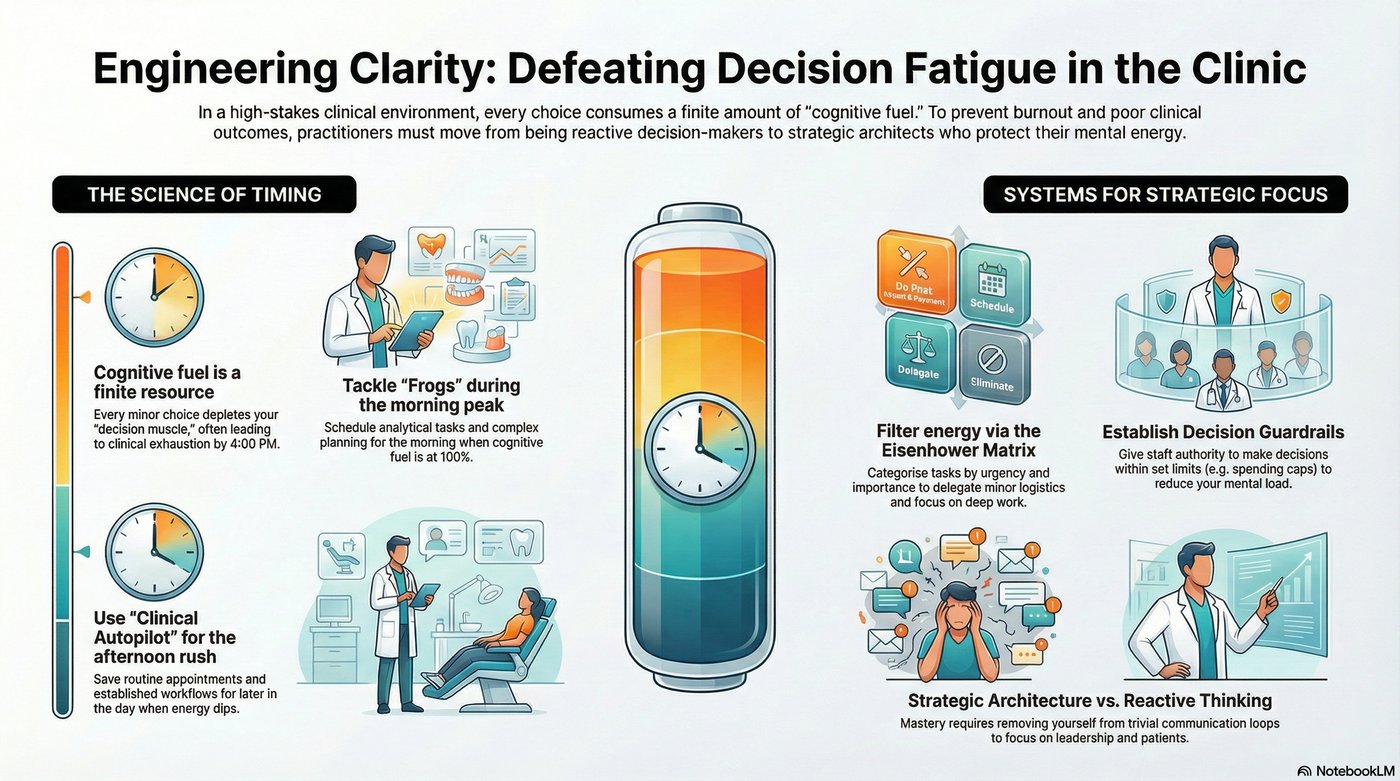
You are deep in your workflow—perhaps performing a complex indirect bonding procedure—when a team member interrupts you to demand a decision on a trivial matter. Suddenly, you feel a wave of aversion and exhaustion. This isn’t laziness; it is Decision Fatigue. In the high-stakes environment of an orthodontic practice, your brain acts like a muscle. Every choice, from the specific torque of a bracket to the wording of an email, consumes a finite amount of “cognitive fuel.” By 4:00 PM, if you haven’t managed this fuel, your “decision muscle” fails, leading to poor clinical choices, irritability, and burnout.
I am Dr. Martin Baxmann, and I believe that professional mastery requires you to move from being a reactive decision-maker to a strategic architect of your own day. By optimizing when and how you make choices, you preserve your mental energy for what truly matters: your patients and your leadership.
The Chronobiology of Choice: Why Timing is Everything
Scientific research into chronobiology—the study of internal biological clocks—suggests that our cognitive abilities are not static throughout the day. For most people, the morning is the absolute “peak” for analytical tasks and high-stakes decisions. Your brain is rested, and you have likely processed complex variables subconsciously during sleep.
In a Lean practice, we protect this peak. Never schedule critical business meetings, complex surgical planning, or difficult staff evaluations for the end of a long clinical day. Tackle these “frogs” first thing in the morning when your decision fuel is at 100%. By the time the afternoon rush of short appointments arrives, you can rely on your clinical “autopilot” and established routines.
The Eisenhower Matrix: Filtering the Mental Load
To protect your focus, you must categorize every decision that lands on your desk. Using the Eisenhower Matrix, you can visualize which choices require your unique expertise and which are simply “noise.”
Urgent & Important: Crisis management or complex clinical checks. These are the only decisions you must make immediately.
Important but Not Urgent: Strategic planning and X-ray analysis. Schedule these for your morning “Deep Work” blocks.
Urgent but Not Important: Most phone calls or minor logistical issues. Delegate these.
Neither: Delete immediately.
By ruthlessly filtering your daily intake, you ensure that you aren’t wasting your “Gold Tier” energy on “Bronze Tier” problems.
Delegating Authority, Not Just Tasks
The most common failure in practice management is delegating a task but retaining the decision-making authority. If you ask an assistant to manage the inventory but require them to ask for permission for every €20 purchase, you haven’t saved any energy; you’ve actually added a communication loop.
True delegation involves establishing Decision Guardrails. Tell your team: “You have the authority to approve any invoice from a standard supplier under €100.” If it’s a new vendor or over that limit, then bring it to me.” This reduces your mental load by hundreds of decisions every month, allowing your team to function autonomously while you focus on being the doctor.
Conclusion: From Reactive to Architect
Decision fatigue is not a personal failing but an engineering problem. By recognizing the finite nature of your cognitive fuel, you can move beyond being a reactive decision-maker. Strategic time management, such as protecting your morning peak for high-stakes clinical and planning tasks, is essential. Furthermore, implementing clear filters like the Eisenhower Matrix and establishing ‘Decision Guardrails’ empowers your team while safeguarding your mental energy. By architecting your practice to minimize trivial choices, you ensure that your focus remains sharp, leading to better patient outcomes, sustained professional mastery, and freedom from burnout.