

Energy Management: Conserving the Doctor’s Most Precious Resource
Published on: Jul 1, 2026
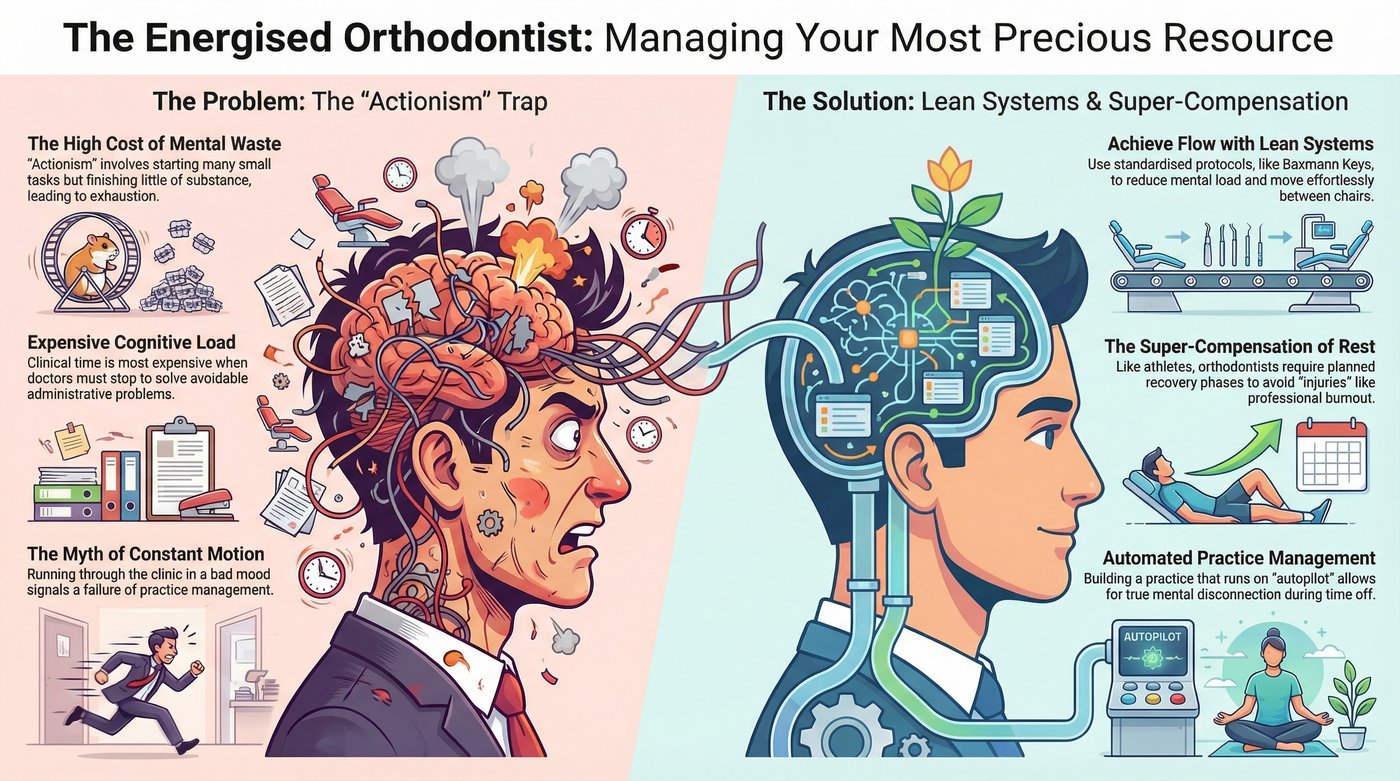
Avoiding the “Actionism” Trap
Personal energy is the most precious resource an orthodontist possesses. Too often, we fall into the trap of “actionism”—starting a thousand small tasks, running through the clinic in a bad mood, and finishing the day exhausted but having accomplished very little of substance. This “starting and stopping” is a primary source of mental waste.
Actionism is the illusion of productivity that substitutes motion for meaningful progress. It manifests as an endless cycle of checking low-priority emails or personally handling routine tasks that should be delegated. For a clinic owner, this creates an insidious cognitive drain and compromises high-stakes decision-making.
In orthodontic practice management, we conserve energy by being goal-oriented. A truly goal-oriented approach demands ruthlessly protecting scheduled “deep work” blocks. These times are designated for core clinical work, treatment planning, or strategic business development, shielded from administrative interruptions.
The most expensive time in a clinic is when the doctor has to stop and think about how to solve an avoidable administrative problem or navigate a chaotic schedule. When a doctor’s time is repeatedly fractured by low-value activities, the resulting cost is a diminished mental capacity for complex cases.
By implementing lean systems, you reduce the mental load of these daily fires, preserving your focus for high-level clinical strategy. Implementing lean systems requires creating comprehensive standard operating procedures (SOPs) for every repeatable administrative task. When staff follow these robust protocols, the doctor is shielded from having to personally intervene in “daily fires,” effectively outsourcing the cognitive burden of routine execution. This disciplined reduction of transactional overhead is the practical definition of conserving high-level clinical focus.
The Super-Compensation of Rest
We can learn much from competitive sports. An athlete’s improvement doesn’t happen during the high-intensity workout; it happens during the recovery phase—a process called super-compensation. A sustainable practice requires cycles of rest to avoid “injuries” like professional burnout.
The concept of super-compensation applies directly to clinical leadership. The brain’s executive function regenerates during true downtime, just as a muscle rebuilds stronger after intense exertion. Constantly checking in during time off is the professional equivalent of overtraining, which accelerates burnout and leads to diminishing returns on effort.
Long-term success comes from careful planning. True disconnection requires a management framework where the team is fully empowered and accountable for routine operations. This necessitates robust cross-training and clear escalation paths that do not solely rely on the doctor’s immediate availability. A successful practice leader deliberately designs the operational system to function flawlessly in their temporary absence.
By ensuring that your practice runs on autopilot during clinical hours, you can truly disconnect during your time off. Furthermore, consider scheduling a short “buffer day” upon returning from extended leave. This dedicated time allows for reviewing strategic items and urgent communication without immediately plunging into a full clinical schedule. This allows your mind and body to recover, ensuring you return to the clinic with the high energy required to lead and innovate. Prioritizing deliberate rest is a fundamental leadership strategy.
Flow States and the Baxmann Keys
When your practice has a lean system in place, you can move from chair to chair in a “flow state”. Achieving a clinical flow state means procedural friction has been meticulously eliminated from the practice. Every instrument, material, and patient record must be precisely located, allowing the doctor to focus exclusively on clinical execution.
You aren’t reinventing the wheel with every patient; you are checking that the Baxmann Keys (canine relationship, molar interdigitation, and midline) are met and that the anchorage is stable. The clinical team prepares the operatory environment so the doctor’s movement is seamless and predictable, concentrating energy on high-value patient interactions.
The Baxmann Keys serve as a high-level cognitive checklist—a systematic framework for evaluating treatment progress without engaging in exhaustive problem-solving at every visit. By standardizing decision-making around these core success metrics (canine relationship, molar interdigitation, and midline), you drastically reduce the mental overhead associated with complex, multi-year cases.
This structural way of working is much less taxing than a disorganized approach. This structural consistency prevents clinical errors and simultaneously builds psychological stamina. When the work is predictable, the doctor’s energy is preserved for genuine clinical challenges, such as managing complex biology or communicating difficult treatment paths to parents. It allows you to stay high-performing for years without the physical and mental fatigue that plagues many in our profession.
Sustainability is about celebrating small wins, protecting your energy, and building a practice that is designed to last a lifetime. The small win of an on-schedule appointment reinforces the efficacy of the underlying lean systems.
Conclusion: The Long-Term Vision
Sustainability in orthodontics is a marathon, not a sprint. By focusing on team retention, knowledge management, and your own personal energy, you ensure that your practice remains a source of pride and fulfillment. A practice designed for longevity provides consistent patient care and a predictable professional life. This long-term vision requires disciplined, incremental system building. Pick one area today—perhaps starting a training manual or scheduling a recovery day—and take the first step toward a more sustainable future.