

Empowering Your Team: How to Delegate Responsibility, Not Just Tasks
Published on: Jul 5, 2026
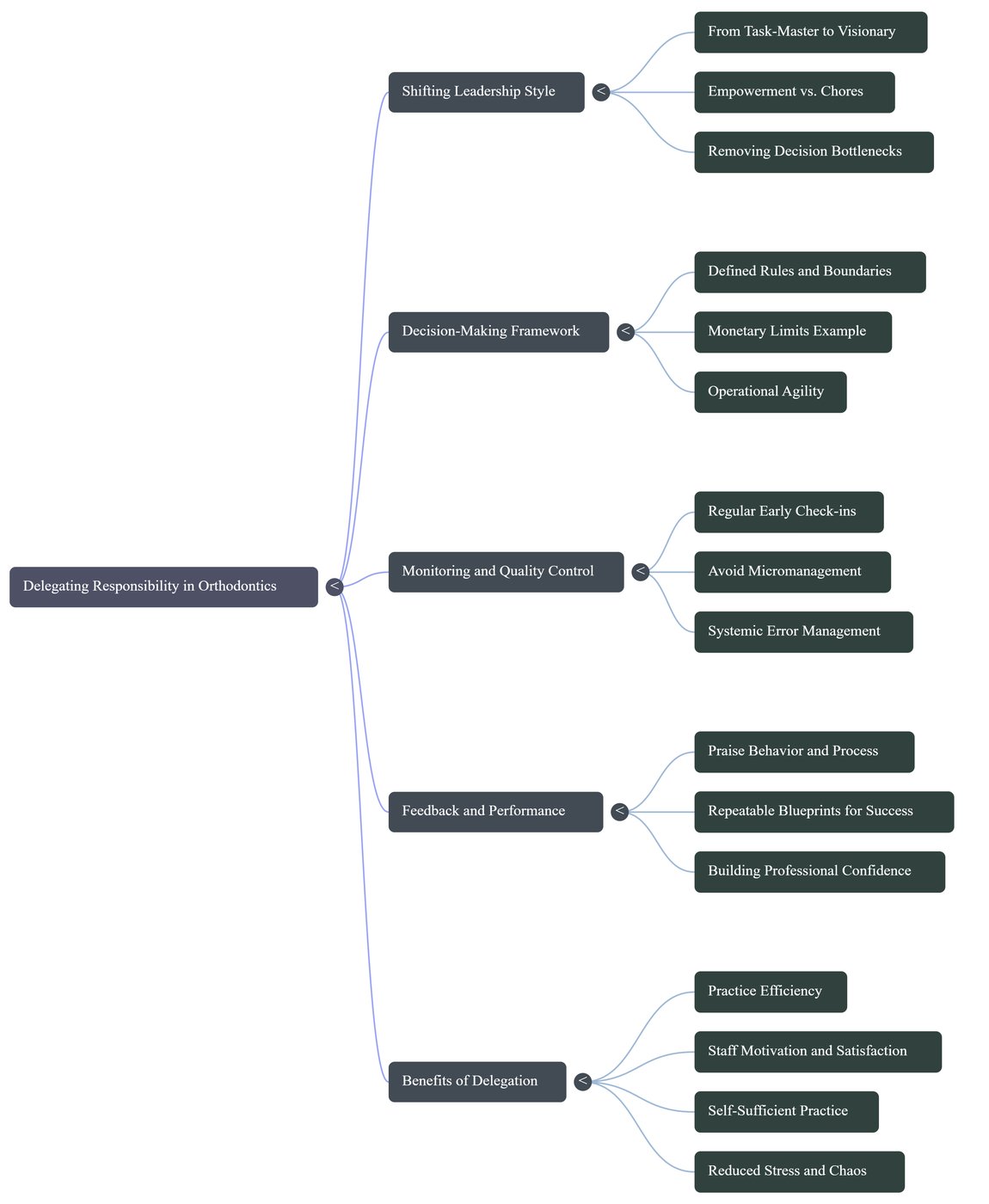
Shifting from Task-Master to Visionary Leader
Many orthodontists view delegation as simply giving someone else a chore to do—clearing a tray or filing a chart. However, there is a profound difference between delegating a task and delegating responsibility. When you only delegate tasks, you remain the bottleneck because every decision still has to cross your desk before it is finalized.
In a task-based model, your assistants and administrative staff act as extensions of your hands, but not your mind. This creates a reactive environment where the team waits for instructions rather than anticipating needs. To scale your practice, you must move beyond this linear way of working.
To achieve a high-performing clinic, you must shift your dental leadership style from micro-management to strategic oversight. You need to empower your team to make autonomous decisions within a structured framework. This transition is essential for long-term growth.
This cultural shift not only increases practice efficiency by reclaiming your clinical time but also significantly boosts staff motivation. When a treatment coordinator feels responsible for the conversion rate, rather than just the paperwork, their level of ownership and professional satisfaction skyrockets.
Eliminating the Decision Bottleneck
Consider a common scenario: an accounting employee who interrupts a complex bonding procedure to ask the doctor about a minor invoice discrepancy or a small discount request. This constant stream of micro-decisions drains the doctor’s mental energy and creates friction in the patient journey in orthodontics.
Every time you stop to answer a “quick question,” you lose focus on the patient in the chair. This “switching cost” is one of the hidden killers of productivity in a busy dental practice. It prevents the clinician from reaching a state of flow and often leads to an exhausted, overextended leadership team.
A lean solution is to implement “decision-making power” rules based on specific thresholds. For instance, in my practice, we empowered our billing specialist to handle any case involving less than fifty euros without consulting the doctor. If a refund or adjustment fell below that limit, the specialist had the authority to solve the problem immediately.
This simple rule instantly removed a major bottleneck and empowered the employee to provide faster service to patients. By delegating the authority to decide, you allow the practice to move with more agility. Your team becomes problem-solvers rather than just messengers, which is the hallmark of a truly efficient operational flow.
The Check-In: Ensuring Quality Without Micromanaging
Delegating responsibility does not mean “setting it and forgetting it” or abdicating leadership. To maintain operational excellence, you must perform regular, early checks to verify that the team is aligned with the practice’s standards. The key is to check the direction of the work, not the minute details of the execution.
In dental leadership, we often fall into the trap of waiting until the final deadline to review a project, only to find it has gone off the rails. This leads to frustration and the common refrain: “It’s just faster if I do it myself.” That mindset is a barrier to scaling and must be actively resisted through proactive coaching.
A quick check-in at the 10% mark of a project ensures the task was understood and the implementation is on track. These small adjustments are far more efficient than fixing major errors at the end of a deadline. It demonstrates that you value their progress and are there to support their success.
This builds a culture of error management where the focus is on systemic success rather than individual blame. When errors are caught early, they become teaching moments. This strengthens the team’s competence and ensures that quality remains consistent across all departments of the clinic.
Feedback: Praising Behavior Over Personality
When providing feedback on delegated responsibilities, focus on behavior and effort rather than inherent personality traits. If an employee handles a difficult patient negotiation or a complex scheduling conflict successfully, do not just call them “talented.” Instead, praise their specific preparation and their adherence to the “LATTE” method.
Specifically, tell them: “I noticed how you listened to the patient’s concern and followed our protocol to find a solution.” This makes the feedback actionable. When employees understand the exact behaviors that lead to a positive outcome, they are much more likely to repeat those behaviors in the future.
By praising the process rather than just calling them a “natural,” you give them a repeatable blueprint for success. This approach to dental team performance ensures that your team knows how to recreate their “A-grade” results consistently. It builds professional confidence and a sense of ownership over the practice’s outcomes.
When people feel their success is tied to a specific skill set they have mastered, they become more invested in their roles. This reduces turnover and creates a legacy of excellence within the clinic. It shifts the dynamic from a job they “have to do” to a career they are proud to lead.
Conclusion: Building a Self-Sufficient Practice
Mastering delegation is the key to transitioning from a busy clinician to a successful entrepreneur. When your team is empowered to make decisions and take responsibility for their areas of work, the practice begins to run on autopilot. This is how you significantly reduce stress and chaos in the clinic’s daily life.
By trusting your team and providing them with clear boundaries and tools, you create a sustainable, high-performing environment. This allows you to focus on high-level strategy and complex clinical cases. Ultimately, the goal is to build a practice that thrives with your leadership, but without requiring your direct supervision for every minor detail.