

Eliminating “Process Blindness”: How to Build a Self-Correcting Orthodontic Team
Published on: Jun 22, 2026
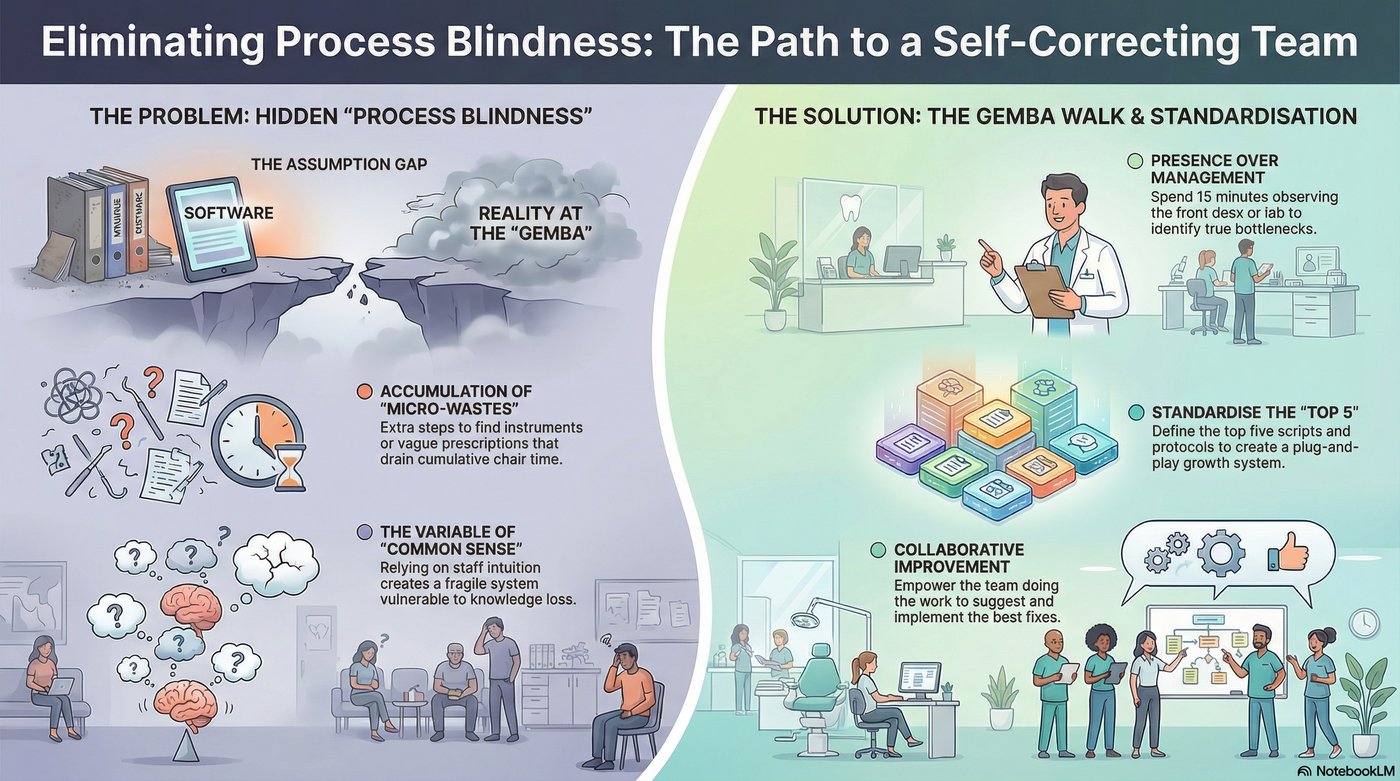
As a clinic owner, your “Process Blindness”—the inability to see operational friction—is the biggest threat to your profitability. We often assume efficiency because we bought the right software or wrote a manual three years ago. The reality at the “Gemba”—the actual place where work happens—is often very different, characterized by undocumented workarounds. The Gemba Walk is the cure for this blindness, transforming passive oversight into active engagement. It allows you to identify bottlenecks and standardize processes before they become patient or scheduling crises.
Operational excellence in orthodontics is not about making giant leaps; it is about the aggregation of small, consistent improvements. By stepping into the practice as an observer—from the financial coordinator’s desk to the bonding bay—you gain a granular workflow understanding. This process empowers your team to build a self-correcting system that runs with precision, with or without your constant supervision.
The Lab and Sterilization Gemba: Finding Hidden Waste
The Gemba Walk is just as critical in the back of the house as it is at the front desk, as this is where clinical efficiency is sustained or sabotaged. In the lab or the sterilization area, waste is often physical—the visible inefficiencies of motion, inventory, and time. It is the extra steps taken to locate a specific instrument or the repeated rework caused by a vague prescription or missing bracket. These tangible forms of waste directly drain profitability.
Conducting a Gemba here means observing the preparation of a single bonding tray. Is the instrument setup standardized and intuitive for every assistant? Does the clinical assistant have to physically leave the room and interrupt another colleague to find a specific adhesive or ligature wire? These subtle “micro-wastes” accumulate to cost you hours of cumulative chair time and thousands in lost productivity every month.
Identify the top five clinical errors or logistical hurdles in the back office and implement visual management solutions, such as shadow boards for instruments. When “we always do it this way” is replaced by a visually managed, lean standard, the chronic stress and panic associated with a busy afternoon disappears.
The Onboarding Advantage: Systems over “Common Sense”
A core driver of staff turnover is a frustrating and inconsistent onboarding experience. One of the most frequent complaints I hear from orthodontists is that new staff “just don’t get it”. This is rarely a lack of intelligence; it is a failure of leadership to provide a standardized, battle-tested Gemba manual. You cannot expect clarity if you have not standardized the process of execution.
Use your Gemba Walk to define the “Top 5” scripts for the front desk (e.g., handling insurance inquiries, scheduling first appointments) and the “Top 5” clinical protocols (e.g., wire changes, retainer delivery). This creates a plug-and-play system for rapid, predictable growth. These documented standards become the foundation of your training program.
You are no longer reliant on the unpredictable nature of an employee’s “common sense”—a variable you cannot control. Instead, you rely on the robust, documented process, which is a variable you can control, refine, and measure. This standardization makes your practice highly scalable and far less vulnerable to the disastrous “knowledge loss” that occurs when a senior staff member leaves.
Leadership is Presence
Effective leadership in operational excellence is fundamentally about humility and visibility. Taking off the blinders requires the leader to acknowledge that the frontline person doing the job possesses a better, more nuanced idea of how to fix a flawed process than the person reviewing reports in the private office. The Gemba Walk is the ultimate tool for breaking down organizational silos; it physically bridges the gap between strategic management and tactical execution.
Leaders must consciously resist the urge to dictate solutions from afar. Stop hiding in the treatment room. Instead, dedicate a focused 15 minutes today to sit near the reception desk and just listen to phone calls and patient interactions. This intentional presence demonstrates respect and validates your team’s daily experience.
Work with your team—not for them—to collaboratively identify and solve their most frustrating bottlenecks. This philosophy of empowering frontline workers creates a proactive, self-correcting culture, moving away from reactive chaos. Small, consistent steps and genuine engagement compound over time. This creates a high-performance machine that runs smoothly, efficiently, and, crucially, happily.
Conclusion:
Building a self-correcting orthodontic team is the ultimate competitive advantage, freeing the owner to focus on high-level clinical delivery and strategic growth, rather than routine firefighting. Process Blindness is not cured by expensive new technology, but by the leader’s consistent, humble presence at the Gemba. Commit to the walk today; formalize your standards, delegate the management of those standards, and watch your practice’s efficiency, profitability, and morale rapidly climb. The investment of time is minimal, but the return—a disciplined, high-performing team—is transformative.