

Doubling Capacity Without New Chairs: The Power of Lean Scheduling
Published on: Jul 6, 2026
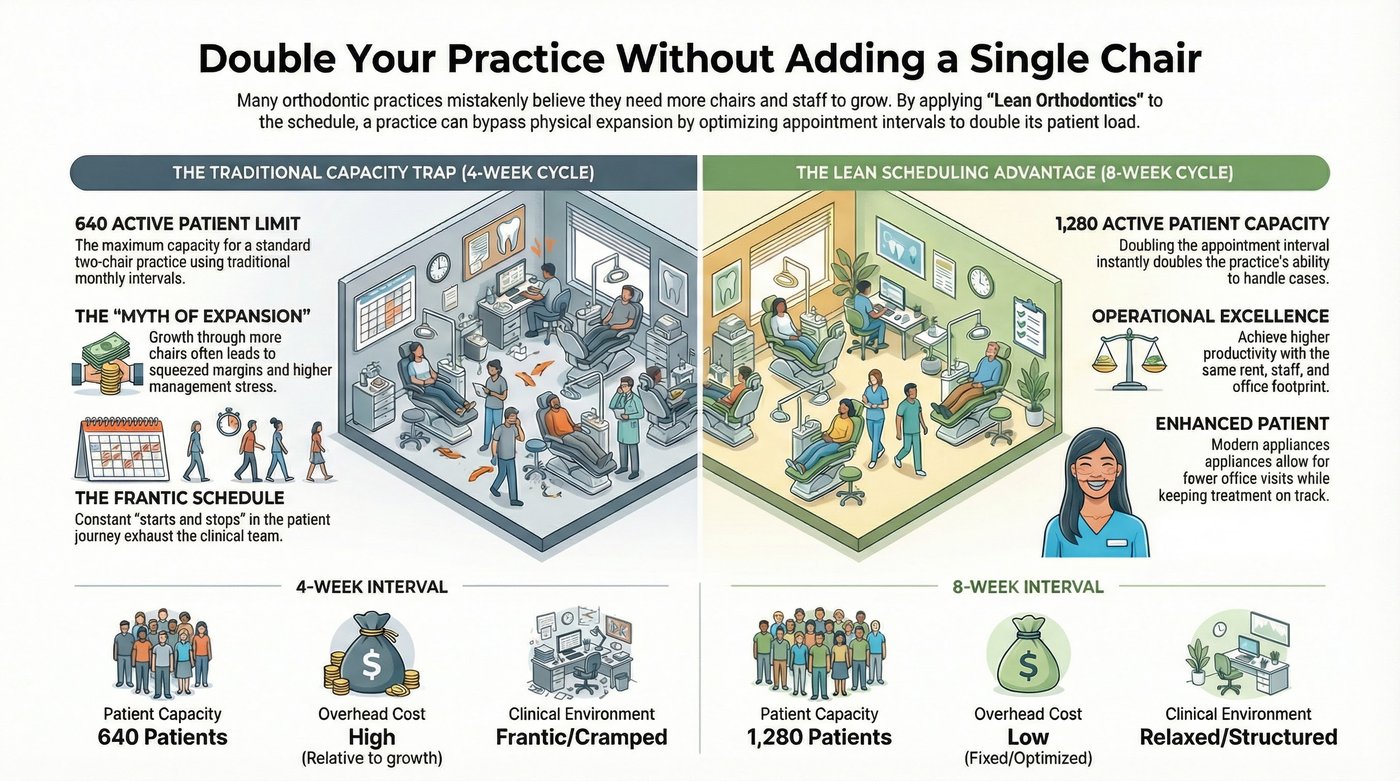
The Myth of Expansion
When an orthodontic practice reaches its capacity, the traditional response is to think “bigger.” Many practice owners believe that to grow, they need more treatment chairs, a larger office, and a bigger team. This reactive approach leads to a massive increase in rent, overhead, and management stress. The belief that capacity equals square footage is a trap that sacrifices margin for complexity.
You end up running between more rooms, managing more people, and seeing your profit margins squeezed by the very growth you sought. Beyond rent and utilities, the biggest hidden cost of physical expansion is the increase in human resources: recruitment, training, and managing additional staff who may only be partially utilized. This conventional thinking prioritizes adding resources over optimizing flow, which is unsustainable for long-term clinical and financial health.
In the world of Lean Orthodontics, we look for a different path. Lean methodology requires mapping the entire patient value stream to identify and eliminate waste, often found in unnecessary movement and waiting. Instead of increasing the size of the container, we optimize the flow within it. The most powerful tool for this transformation isn’t a new building or equipment—it’s the strategic re-engineering of your schedule.
The Math of the Four-Week Interval
Consider a standard two-chair practice operating on a traditional four-week appointment interval. If you see patients every fifteen minutes during a four-hour afternoon block, you have roughly 640 available slots per month. Once you hit 640 active patients, your practice is effectively “full” under this rigid, cycle-dependent model. The four-week cadence acts as an unyielding throughput ceiling.
This constant, short-cycle demand creates friction at every touchpoint, from sterilization to check-in and check-out. When practices operate at this self-imposed limit, every delayed patient, short-notice cancellation, or equipment hiccup instantly creates a bottleneck that compounds throughout the day. The team feels the stress of a perpetually full appointment book, leading to burnout and decreased quality of interaction.
At this point, most orthodontists feel the pressure to expand. They are exhausted, the schedule is cramped, and there is no room for new patients. However, this “limit” is an artificial one created by the four-week cycle, failing to account for modern technological and biological efficiencies.
The Eight-Week Shift: Instant Scalability
Modern orthodontic appliances—from advanced bracket systems and customized wires to high-tech aligners—are designed to work effectively over longer periods. These systems utilize low-force, continuous movement principles that perform optimally when given extended time to fully express the wire or aligner sequence. Interrupting this process too frequently with unnecessary check-ins is often biologically counterproductive.
By applying lean thinking and extending your standard appointment interval from four weeks to eight weeks, you achieve something remarkable: you instantly double your practice capacity without adding any new overhead. This strategic interval extension transforms the economics of your practice.
By making this one systemic change, your two-chair office can now handle 1,280 active cases instead of 640. Suddenly, the fixed costs of rent, utilities, and core team salaries are spread across twice the revenue-generating potential. You have the same rent, the same number of employees, and the same relaxed afternoon schedule, but your overall productivity has doubled. This is the essence of operational excellence—maximizing the output of existing resources before incurring the inevitable expense of new ones.
Enhancing Team Performance and Patient Experience
Lean scheduling doesn’t just improve the bottom line; it fundamentally transforms the daily life of the clinical team. A practice running at double capacity with a relaxed, structured eight-week cycle is far less stressful than a “full” practice running on a frantic four-week cycle. The team shifts from reacting to urgent demands to proactively planning and executing high-value, efficient appointments.
This proactive system reduces the total number of non-productive administrative “starts” and “stops” in the patient journey. Staff spend less time on check-in, check-out, and pre-appointment prep, allowing them to focus on clinical excellence. For the patient, this translates into the convenience of fewer office visits, which is highly valued, provided their treatment remains perfectly on track. The result is an improved patient experience characterized by individualized attention and a calmer office environment.
Practical Steps to a Lean Schedule
Transitioning to a lean schedule requires a deliberate shift in mindset and systems for both the doctor and the team. It is a system-wide change that must be meticulously implemented.
Trusting the Biology: Recognizing that longer intervals are often more biologically sound for tooth movement is critical for doctor buy-in. This trust must be supported by using modern, high-quality appliances designed for maximum efficiency over time, such as custom-arch wires or passive self-ligating brackets.
Standardizing Procedures: The key to a successful eight-week interval is ensuring that every appointment is highly productive. This requires comprehensive checklists and standardized processes for every procedure, eliminating non-value-added activities and ensuring the eight-week gap is utilized fully for tooth movement.
Strategic Monitoring: Leverage digital tools, like intraoral scanners and virtual check-in platforms, only where they truly save time and supplement the in-office visit. These tools should enhance, not replace, efficient scheduling and prevent patients from coming in for non-productive evaluations.
Conclusion: Leadership Through Mathematical Clarity
True leadership in dental practice management means moving beyond instinct and embracing operational mathematics. The most profitable and sustainable solution to a crowded practice is often better scheduling, not more software, more chairs, or more square footage. As a leader and entrepreneur, your goal is to build a high-performing system that supports not only financial growth but also the well-being of your team and yourself. By doing the math and embracing lean scheduling, you can grow your practice significantly while keeping your operations efficient, your overhead lean, and your stress levels low. The path to a more successful and less strenuous practice isn’t always through more; often, it is through “better” flow and operational intelligence.