

Discipline as Freedom: Sustaining Change in the High-Performance Clinic
Published on: Jun 30, 2026
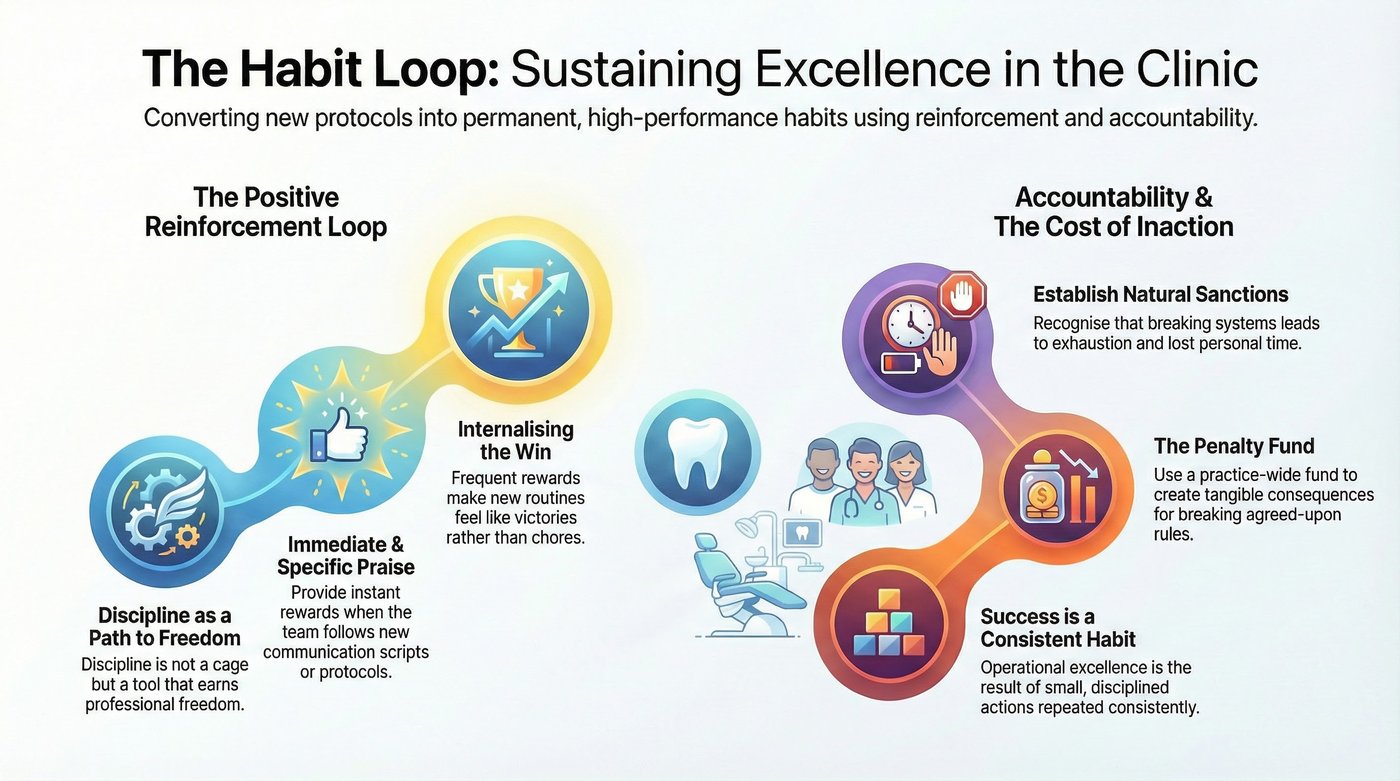
In lean orthodontics, change isn’t about willpower; it’s about system engineering. To keep your professional resolutions, you must move away from “hoping” for a better practice and start applying a structured framework to your behavior.
This framework shifts the focus from individual motivational failures to optimizing the environment and processes. High-performance clinics understand that inconsistent results are a symptom of a flawed system, not a lack of effort from the team. By hardwiring positive actions, we grant ourselves freedom from reactive chaos.
In our last video, we discussed “The 5-Step Resolution Protocol.” Now, let’s discuss the next steps for sustaining change in the high-performance clinic. This final phase focuses on embedding the new behavior into the practice culture.
Step 4: The Positive Reinforcement Loop
Discipline should not be a rigid, lifeless cage; it is the tool that earns you freedom. To turn a resolution into a habit, you must utilize the power of rewards. This is a fundamental principle of dental team performance.
For a new system to stick, the reward must be clear, immediate, and proportional to the effort involved. Delaying recognition dilutes the critical link between the new, desired behavior and the positive feeling it generates. For example, celebrating a successful implementation six months later is ineffective.
When your team follows a new communication script perfectly—perhaps a script designed to reduce last-minute cancellations—provide specific, immediate praise. This could be a shout-out in the morning huddle, a physical high-five, or an immediate entry into a weekly reward draw. The reward validates the difficulty of stepping outside of old, comfortable patterns.
Do the same for yourself as the clinic leader. If you stick to your new schedule, ensuring you leave the office on time for a full week, allow yourself a meaningful, non-work-related reward. This could be a new book, a weekend activity, or simply blocking two hours for focused, strategic planning without interruption.
If the goal is to consistently complete your “5-Second Model Analysis” habit for a week, the reward should reinforce the value of that focused work. Positive reinforcement internalizes the success, making the new routine feel like a win rather than a chore. This psychological conditioning is what transforms a temporary change into a permanent, self-sustaining habit for the entire practice. The key is to celebrate the process, not just the outcome.
Step 5: Establishing the Cost of Inaction
Finally, you must consider the consequences of “breaking the system.” In lean management, every deviation has a cost. This cost extends beyond missed revenue; it impacts team morale, doctor efficiency, and patient experience. When a new system is intentionally bypassed, the entire workflow suffers.
If you fail to fix your scheduling template and end up working late ten days in a row, the exhaustion and missed family time are the natural sanctions. These are the organic costs of inefficiency, and they accumulate quickly, leading to eventual burnout and high staff turnover. Recognizing these personal and professional tolls is a powerful deterrent.
To make the systemic cost tangible, practice leaders can implement transparent measures. For example, if the team fails to follow the instrument sterilization checklist, the cost is the potential risk to patient safety and the resulting administrative time sink. Quantify the time wasted when instruments must be re-sterilized.
Some practitioners find success by setting up a “penalty fund” for the practice if they break their own rules, such as using a non-standard tray setup. The collected funds can be donated to a professional charity or used for a non-work-related team activity, reinforcing that the system is more important than individual convenience. This creates a shared accountability structure.
The ultimate goal is to make the new routine so deep that it becomes a habit. When standardized work becomes the default, the thought of returning to the old, inefficient methods should be met with active resistance from the entire team. Eventually, it should feel more uncomfortable to skip your new, efficient routine than it does to perform it. This is the mark of true discipline and systemic maturity.
Conclusion: Success is a Habit
Professional growth in the dental sector is the direct result of many small, disciplined actions repeated consistently. These are not grand, unsustainable gestures but rather minute adjustments to the daily operational flow, such as standardizing the handoff between the assistant and the doctor. This accumulation of optimized micro-behaviors drives long-term success.
By moving from vague wishes to a structured five-step protocol, you move your practice toward operational excellence. This protocol transforms subjective desire into objective, measurable, and sustainable clinical practice. It turns high aspirations into reliable daily performance.
Don’t wait for a “perfect” time to start implementing a new framework. The time lost waiting for ideal conditions is itself a cost of inaction. Take one thought from today—perhaps refining one aspect of your inventory management—and put it into action immediately. This is how you lead your practice into the fast lane of success and secure your future professional freedom.