

Dimensional Accuracy and Material Safety: The Strategic Side of 3D Printing
Published on: Jul 2, 2026
Beyond the Surface Finish
When orthodontists first look at 3D-printed models, they are often seduced by the smooth, shiny finish of resin-based prints. However, in orthodontic practice management, aesthetics are secondary to dimensional accuracy. As a leader and entrepreneur, your primary concern is whether that model will result in a perfectly fitting appliance.
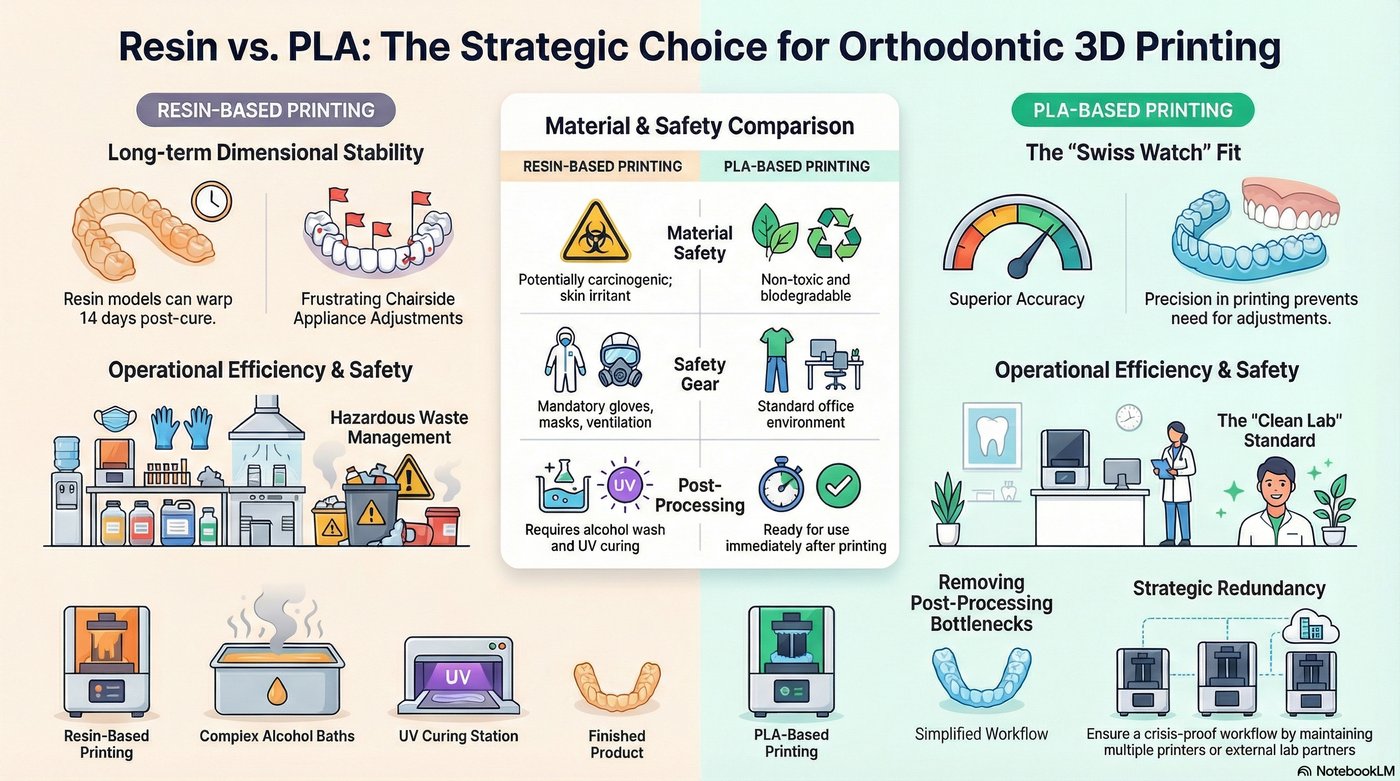
Interestingly, while resin models look “cleaner,” they can continue to warp slightly in the 14 days following their initial cure. In contrast, PLA (filament) models often maintain superior dimensional stability over time. For laboratory-made appliances like aligners or retainers, that fraction of a millimeter in accuracy is the difference between a “Swiss watch” fit and a frustrating chairside adjustment.
The “Clean Lab” Standard: Protecting Your Team
A core pillar of dental team performance is the safety of the work environment. Resin-based printing requires the handling of liquid resins that are potentially carcinogenic and can cause severe skin irritation. This adds layers of complexity to your safety protocols: mandatory gloves, specialized masks, and dedicated ventilation systems.
By contrast, a PLA-based system allows for a “cleaner” office environment. Because the material is non-toxic and biodegradable, it aligns with a lean philosophy that values both human health and environmental responsibility. Reducing the chemical footprint of your lab is a proactive leadership move that protects your staff and simplifies your waste management protocols.
Post-Processing: The Bottleneck of Digitalization
The “waste of waiting” is a major hurdle in many digital workflows. In a resin-based setup, the journey doesn’t end when the printer stops. The models must be washed in alcohol and then placed in a curing device. This alcohol cannot be poured down the drain; it is hazardous waste that requires professional disposal.
A lean practitioner evaluates the entire patient journey. If your lab workflow is so complex that only one specialized person can handle it, you have created a bottleneck. By choosing simpler, more robust printing methods like FDM for the majority of your models, you make the digital lab accessible to more team members, increasing the overall practice efficiency.
Strategic Outsourcing vs. In-House Production
As we have discussed in the “break-even” analysis of in-house production, you must remain rational. 3D printing allows for incredible agility, but it also requires maintenance. If your bank of printers stops and you have 50 models in the pipeline, you cannot simply revert to plaster.
This is why dental leadership involves building “redundancy” into your system. Whether that means having multiple printers or a reliable external digital lab partner for overflow, you must ensure your production is crisis-proof. The goal is a seamless flow from scan to physical model, ensuring your clinical work remains the focus.
Conclusion: Mastering the Clinical Workhorse
3D printing is the backbone of the modern orthodontic office. It turns your digital scans into physical solutions with unprecedented precision. By prioritizing material safety, long-term accuracy, and simplified post-processing, you create a lab that supports your clinical excellence rather than draining your administrative energy. Master the machinery, train your team, and lead your practice into the high-performing world of digital orthodontics.