

Digital Terminology: How to Command the Algorithm for Operational Excellence
Published on: Jun 27, 2026
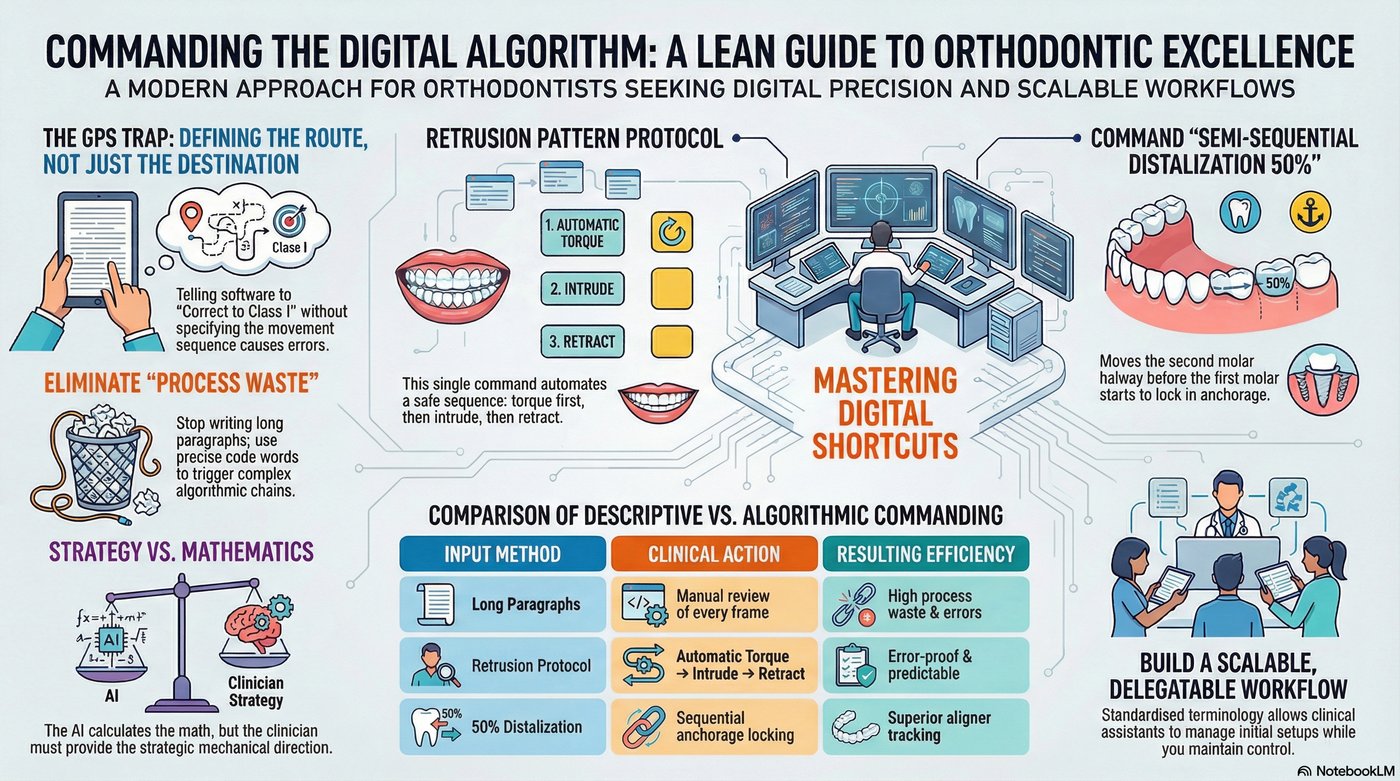
In the world of digital orthodontics, the biggest barrier to efficiency isn’t the software—it’s communication. Most practice owners spend far too much time writing long, descriptive paragraphs to technicians in distant design centers, only to receive a setup that completely misses the mark. This back-and-forth is a classic example of “process waste.”
To lead a lean, high-performance clinic, you must learn to speak the language of the machine. By mastering “Digital Terminology,” you can use specific protocols and code words that trigger complex algorithmic chains, ensuring that your clinical intent is translated into digital reality with zero misunderstanding.
The GPS Analogy: Defining the Route, Not Just the Destination
Think of digital treatment planning like a GPS navigation system. If you tell the system “Correct to Class I,” you have provided the destination, but you haven’t specified the route. Left to its own devices, the software might achieve that Class I by tilting teeth inappropriately or simulating a surgical move that isn’t realistic for the patient.
As the “driver,” you must select the route. Do you want to achieve the correction through distalization, IPR, or proclination? The AI can calculate the math, but you must provide the strategic direction. By being specific about the “route”—such as specifying the sequence of movements—you ensure the software creates a plan that is mechanically achievable in a clinical setting.
Using Staging Protocols to Guard Anchorage
One of the most powerful ways to command the algorithm is through “Staging Protocols.” For instance, in a Class II Division 2 case, moving teeth simultaneously often leads to root collisions with the cortical plate or a total loss of posterior anchorage.
Instead of writing a page of instructions on how to sequence the movements, you can use “lean terminology.” Using a command like “Retrusion Pattern Protocol” tells the system to execute the movements in a specific, safe sequence: torque first, then intrude, then retract. This single phrase eliminates the risk of human error in translation and ensures the software follows a biologically sound path. It is the ultimate shortcut to a predictable setup.
Mastering Distalization with Digital Shortcuts
Distalization is another area where “speaking the machine’s language” pays dividends. If you simply command the software to “distalize,” it may attempt to move the entire arch at once, leading to an immediate failure of the aligners to track.
By using precise commands like “Semi-sequential distalization 50%,” you are instructing the algorithm to move the second molar halfway before the first molar even begins to move. This “locks in” your anchorage and creates a realistic mechanical sequence. You are no longer manually adjusting every frame of the animation; you are using the software’s own power against it to create a superior result. This is the hallmark of a lean orthodontic leader: using technology to achieve more with less effort.
The Result: A Scalable, Error-Proof Workflow
When you master these digital protocols, you do more than just improve a single case; you create a scalable system for your practice. These code words and protocols can be standardized across your clinic, allowing you to delegate more of the initial setup review to trained clinical assistants while maintaining total control over the final outcome.
The objective of lean management in dentistry is to reduce stress and chaos while increasing quality. By taking command of the AI through precise terminology and strategic constraints, you build a practice that is truly at the forefront of the digital revolution. Stop being a passenger. Learn the language, define the route, and command the machine.
Conclusion
Operational excellence in digital orthodontics hinges on a paradigm shift: moving from ambiguous, descriptive communication to the use of precise Digital Terminology. By applying “lean terminology”—such as leveraging the GPS Analogy to define the treatment “route,” using Staging Protocols to guard anchorage, and specifying semi-sequential distalization commands—practitioners gain command over the algorithm. This mastery is the key to creating a scalable, error-proof workflow, enabling greater delegation, ensuring biologically sound movements, and ultimately positioning the practice at the forefront of the digital revolution. Embracing this machine-readable language transforms the clinician from a passive passenger into the commander of the treatment plan.