

Digital Sovereignty: Why In-House Aligner Production is a Leadership Milestone
Published on: Jul 2, 2026
Moving Beyond Hardware Dependency
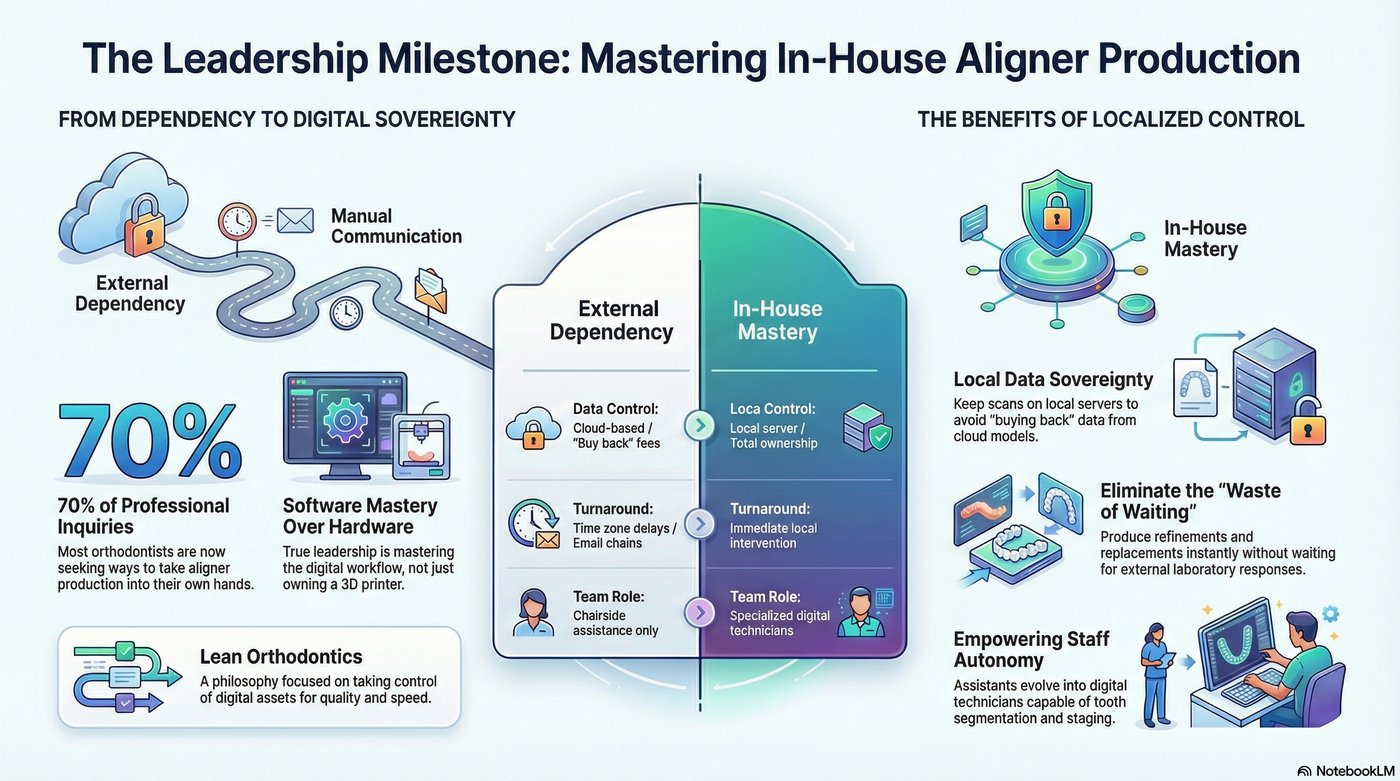
Many orthodontists invest in a high-end scanner and a 3D printer, only to find themselves stuck when it comes to the actual digital transition. The challenge is rarely the hardware; it is mastering the software and the workflow required to put your production on a reliable autopilot. In the world of lean orthodontics, true leadership means taking control of your digital assets to ensure quality, speed, and practice independence.
The physical machinery is a one-time capital investment; the sophisticated digital staging software represents the intellectual property of your treatment plan. Without deep mastery of the planning software, the practice remains a passive consumer, simply substituting one external lab for another. Leadership involves transitioning from a reactive ordering model to a proactive, continuous development cycle that you control.
Currently, nearly 70% of professional inquiries center on how to take aligner production into our own hands. This shift isn’t just about cost; it’s about becoming a proactive problem solver who controls the entire treatment journey from start to finish. When you produce in-house, you move from being a consumer of external services to a master of your own clinical outcomes.
A clear example is the precise protocol for root segmentation and attachment placement. While external labs offer a basic service, the truly efficient practice standardizes these micro-processes internally. This focus on workflow automation reduces variations in case setups, leading to fewer refinements and more predictable results. This efficiency ultimately translates to reduced chair time per patient, a critical metric in optimizing practice profitability.
The Security of Local Data Control
A significant advantage of in-house production is data security. In an era where cloud-based models often charge you to “buy back” your own data, keeping your scans and setups on a local server is a vital move for long-term orthodontic practice management.
Local data retention is essential for litigation preparedness and supporting longitudinal patient studies. Should a complex case require a detailed historical review or be challenged legally, having immediate and unfettered access to all planning files is non-negotiable. Reliance on external servers introduces layers of access complexity and dependency that compromise this control.
This local control allows for immediate intervention. You can monitor every tooth movement and make adjustments directly without the “waste of waiting” for external technicians in different time zones to respond to emails. This agility significantly improves the patient journey in orthodontics, as refinements and replacement aligners can be produced in a fraction of the time required by large commercial labs.
The operational difference is stark: a lost or broken aligner that takes two weeks to replace via a large lab can often be printed and delivered in under 48 hours in-house. This rapid response minimizes treatment regression, keeps the patient engaged, and elevates the practice’s reputation for superior service and efficiency. Digital sovereignty over data is the foundation of superior operational flow.
Building Team Autonomy Through Software Mastery
Effective dental leadership involves empowering your staff with high-level technical skills. Specialized orthodontic software is a powerful tool—much like Excel—where most people only use a fraction of its potential. By training your team to handle tooth segmentation and staging, you create a more capable and satisfied staff.
This investment in internal expertise transforms clinical assistants into invaluable digital technicians. They gain a comprehensive understanding of the mechanics of tooth movement and the biomechanical drivers behind each stage. This expanded role fosters greater job satisfaction and reduces team turnover, as staff feel invested in and essential to the practice’s intellectual capital.
Once a clear, step-by-step instruction is established, the workflow becomes a “plug-and-play” solution. This transition boosts dental team performance, as your assistants evolve from chairside help to digital technicians who understand the mechanics of tooth movement. This internal expertise is the backbone of a practice that functions with “Swiss watch” precision.
A “Swiss watch” operation is defined by established Key Performance Indicators (KPIs) for the digital workflow. These may include daily case capacity, error rates in segmentation, and turnaround time from scan to print. Empowering a dedicated team member to manage and optimize these metrics is the hallmark of leadership that scales.
Conclusion: Strategic Implementation
Mastering in-house aligner production is a strategic move that makes your practice more efficient and your team more autonomous. It requires a commitment to active learning—working through real cases on your own laptop rather than just watching lectures. By taking control of the software and the planning stages, you ensure your practice stays at the forefront of modern orthodontics, delivering professional results with maximum operational flow.
Implementing this shift is a phased, not immediate, process. Strategic leaders begin by identifying a core team member and dedicating time and resources to specialized training on one or two key software tools. This structured rollout minimizes clinical disruption while slowly building institutional knowledge.
The return on investment (ROI) is not only financial, derived from reduced lab costs, but also professional, through enhanced clinical confidence and control. This move is a paradigm shift, positioning the practice not just as a provider of orthodontic services but as an innovator in efficient, digitally-driven patient care. True digital sovereignty is attained when clinical excellence and operational efficiency are perfectly aligned.