

Digital Integration or Digital Ballast? Mastering the Scanning Workflow
Published on: Jul 2, 2026
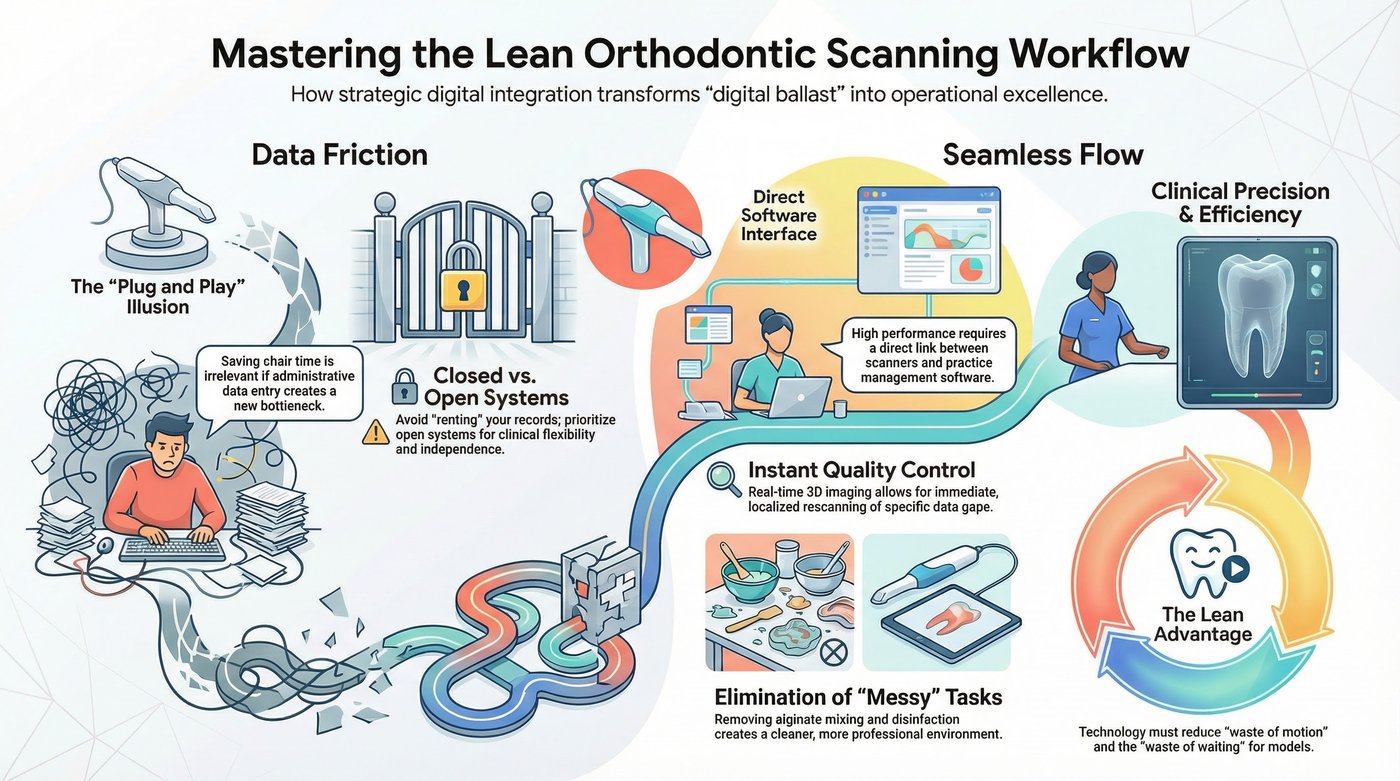
The Illusion of “Plug and Play”
In the modern orthodontic landscape, digital scanning is often marketed as a simple “plug and play” solution that instantly modernizes a clinic. However, many practice owners find that after the initial investment, the new technology actually creates more administrative “ballast” than it removes. If you save five minutes at the chair but spend ten minutes at the front desk manually entering data because your hardware and software don’t communicate, you haven’t improved practice efficiency—you’ve simply moved the bottleneck.
True integration demands more than just installing the scanner; it requires rigorous staff Standard Operating Procedures (SOPs) and comprehensive training. The initial time investment must be focused on mapping the entire patient intake, scanning, and data transfer process to identify and eliminate manual handoffs. Without this diligence, your team will default to old habits, and the scanner will remain an expensive, isolated tool rather than a systemic catalyst.
In lean orthodontics, technology must serve the system, not the other way around. To achieve true operational excellence, your digital scanning workflow must be strategically integrated into a seamless end-to-end process. This strategic view treats the scanner as a single node in a larger digital nervous system that connects the operatory, the front office, and the lab.
The Seamless Interface: Data Flow vs. Data Friction
The first rule of a lean digital workflow is software compatibility. Having to manually type patient details into a scanner’s standalone software for every session is a significant waste of motion and time. A high-performing practice requires a direct interface between the intraoral scanner and the practice management software. This essential step, often overlooked, is the difference between data flow and data friction, eliminating redundant administrative labor.
Practice leaders must also prioritize data security and regulatory compliance as part of this interface. A seamlessly integrated system should automate the secure transfer and storage of Protected Health Information (PHI), ensuring you meet standards like HIPAA or GDPR without requiring manual verification steps by staff. This reduces liability and frees up valuable clinical time.
Furthermore, you must consider the long-term cost of your data. Some providers use a “closed” cloud-based model where you are essentially renting your own patient records. A lean leader prioritizes an “open” system that offers clinical flexibility and independence, allowing you to control your digital assets and choose the best lab partners or aligner systems without restricted market pressure. An open architecture is key to future-proofing your investment, ensuring you can adopt the next generation of materials or software updates without being locked into a single vendor’s ecosystem.
Rescanning vs. Repeating: The Quality Control Advantage
While the clinical time of a scan is now comparable to a traditional impression, the lean advantage lies in the instant feedback loop. In the past, a flawed alginate impression required a total “do-over,” which was frustrating for the staff and uncomfortable for the patient. The delay in knowing an impression was defective often meant rescheduling the patient, resulting in a significant “waste of transportation” and wasted chair time.
With digital scanning, you see a 3D positive image in real-time. If the software identifies a “hole” in the data, the assistant can rescan that specific 2-millimeter area immediately. This instant quality control significantly reduces laboratory errors and eliminates the “waste of waiting” for a model that might ultimately be unusable. It also serves as an exceptional training tool; the doctor or senior assistant can provide immediate, point-of-care coaching to junior staff on proper technique, ensuring continuous workflow improvement.
The high-tech nature of this process also dramatically improves the patient journey in orthodontics. Patients appreciate the reduced gag reflex, the visual confirmation of their anatomy on a screen, and the speed of the procedure. This sophisticated presentation enhances case acceptance, as the technology subtly communicates competence and precision, directly supporting your practice’s premium value proposition.
Conclusion: Engineering a Cleaner Practice
The true benefit of a scanning workflow is the elimination of the “messy” tasks—mixing alginate, disinfecting impressions, and cleaning spittoons. By stripping away these non-value-adding steps, you create a cleaner, more professional environment. This shift transcends mere cleanliness; it reclaims valuable clinical minutes that were previously dedicated to ancillary supply management and disinfection protocols.
Adopting digital scanning is not just a hardware upgrade; it is a fundamental cultural shift in dental leadership. It requires discipline to follow the new, more efficient protocols and the foresight to choose systems that enable open data exchange. Digital scanning is a powerful tool for operational excellence, but only when it is backed by a disciplined, integrated system that prioritizes flow over friction. Ultimately, a well-engineered digital workflow converts potential administrative ballast into sustainable practice efficiency and a superior patient experience.