

Digital Indirect Bonding: Precision Planning for the High-Tech Clinic
Published on: Jul 2, 2026
Overcoming Chairside Visibility Challenges
One of the most physically demanding tasks in orthodontics is the accurate placement of brackets, particularly in the posterior region. Between limited visibility, patient movement, and the constant battle for saliva control, manual bonding is often a source of significant clinical stress.
Standard direct bonding requires the clinician to maintain a perfect ergonomic posture while peering into the back of a narrow oral cavity. Even with high-quality retractors and suction, the risk of a bracket slipping or a tooth being contaminated by moisture is ever-present.
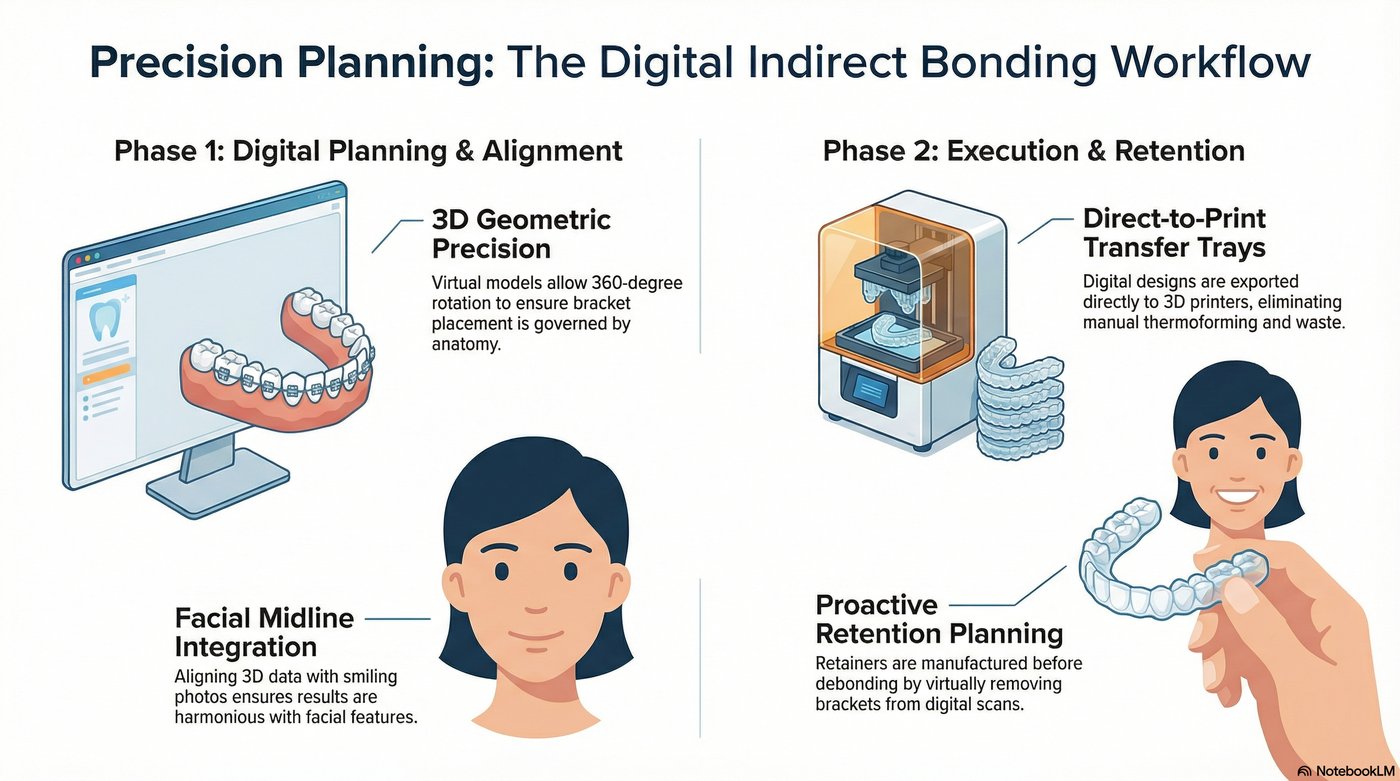
To improve dental team performance and clinical outcomes, the lean leader turns to digital indirect bonding (IDB). On a high-resolution screen, the traditional obstacles of the mouth disappear. You can rotate a 3D model 360 degrees to inspect the long axis of every tooth from angles impossible to achieve chairside.
This digital environment allows for “ideal” bracket placement governed by pure geometry. Instead of guessing the center of a molar while a patient fidgets, the clinician uses digital measuring tools to ensure every bracket is placed to within 0.1mm of the intended position.
The Synergy of 3D Models and Facial Photos
A digital model in a 3D environment has no natural center. If you plan solely on the teeth, you risk creating a perfectly straight smile that is canted relative to the patient’s face. This is why a high-quality, front-facing smiling photo is a non-negotiable standard in a modern workflow.
Clinicians often see “diagnostic drift” when they treat teeth as floating objects in a vacuum. By superimposing the 3D STL file onto a 2D facial photograph, you can verify that the dental midline matches the facial midline and that the smile arc follows the lower lip line naturally.
Aligning the 3D model with the patient’s actual anatomy ensures that treatment planning is face-driven. This integrated approach to orthodontic practice management allows the doctor to show the patient a preview of the final result, significantly increasing treatment acceptance and patient trust from day one.
In practice, this means checking for asymmetries in the jaw or lip levels before the first bracket is even glued. It moves the clinic away from reactive adjustments mid-treatment and toward a proactive, “finish-first” mentality that saves months of chair time.
The Direct-to-Print Transfer Tray
The evolution of the digital workflow has reached a new peak with the ability to design and print transfer trays directly. In the past, “digital” bonding was a bit of a misnomer; it still required printing a physical model, manually placing brackets on that model, and then thermoforming a tray over them.
That hybrid approach was riddled with “muda” (waste). Every manual step—from the glue used to hold brackets on the model to the plastic sheet heated in the vacuum former—introduced a margin for error. If the model chipped or the plastic warped, the tray’s accuracy was compromised.
Modern operational excellence utilizes biocompatible 3D printing resins to create the tray itself. The software generates a flexible, translucent appliance that holds the brackets in their virtual positions with extreme grip, releasing them only once the light-cure process is complete at the chairside.
This direct-to-print method reduces material costs and labor time by over 50%. More importantly, the trays are far more accurate because they bypass the physical model phase entirely. This ensures a faster, more comfortable bonding appointment for the patient and a stress-free experience for the staff.
Proactive Planning for Retention
The power of 3D data also extends to the end of treatment. Using digital tools, we can virtually “remove” brackets from a scan taken while the patient still has braces. This allows us to plan and manufacture retention devices before the debonding appointment even begins.
Consider the traditional bottleneck: removing braces, taking an impression, and having the patient wait hours or days for their retainer. During that window, relapse can begin. By using virtual debonding, the retainer is ready the moment the last bracket is polished off the tooth.
This proactive approach ensures that the patient leaves their visit with their retainers in hand, closing the loop in the patient journey. It eliminates the need for a “pick-up” appointment, freeing up the schedule for new starts and more complex procedures.
It is a hallmark of a practice that is truly running on a “Swiss watch” rhythm—where every step is calculated to minimize friction for both the team and the patient. This level of efficiency is what separates a standard clinic from a high-performance orthodontic business.
Conclusion: Leading the Digital Frontier
Efficiency in the digital age is about using data to solve clinical problems before they ever reach the chair. By mastering indirect bonding and virtual planning, you enhance your precision while drastically reducing chairside stress and variability.
This is the essence of dental leadership: using technology not as a novelty, but as a tool to elevate your craft. As you transition to these workflows, you aren’t just buying software; you are investing in a future where clinical excellence and operational efficiency exist in perfect harmony.