

Decoding the Message: The 3 Channels of Communication
Published on: Jun 28, 2026
Why We “Mis-hear” Each Other
Have you ever stood right in front of a patient or staff member, spoken clearly, and yet felt like you were speaking a different language? This is a common form of “Communication Waste” in orthodontics. This waste leads directly to scheduling inefficiencies, reduced case acceptance, and internal team conflict. The root reason for the disconnect is rarely the words themselves, but rather the channel through which the person receives and processes information.
In lean orthodontics, we recognize that every individual has a preferred sensory channel—Visual, Auditory, or Kinesthetic (V-A-K)—for processing the world. By quickly identifying and adapting your delivery method to these channels, you eliminate misunderstandings and move your practice toward operational excellence. Effective communication ensures your high-value message, whether it’s a treatment plan or a new office protocol, actually “lands” with impact and clarity.
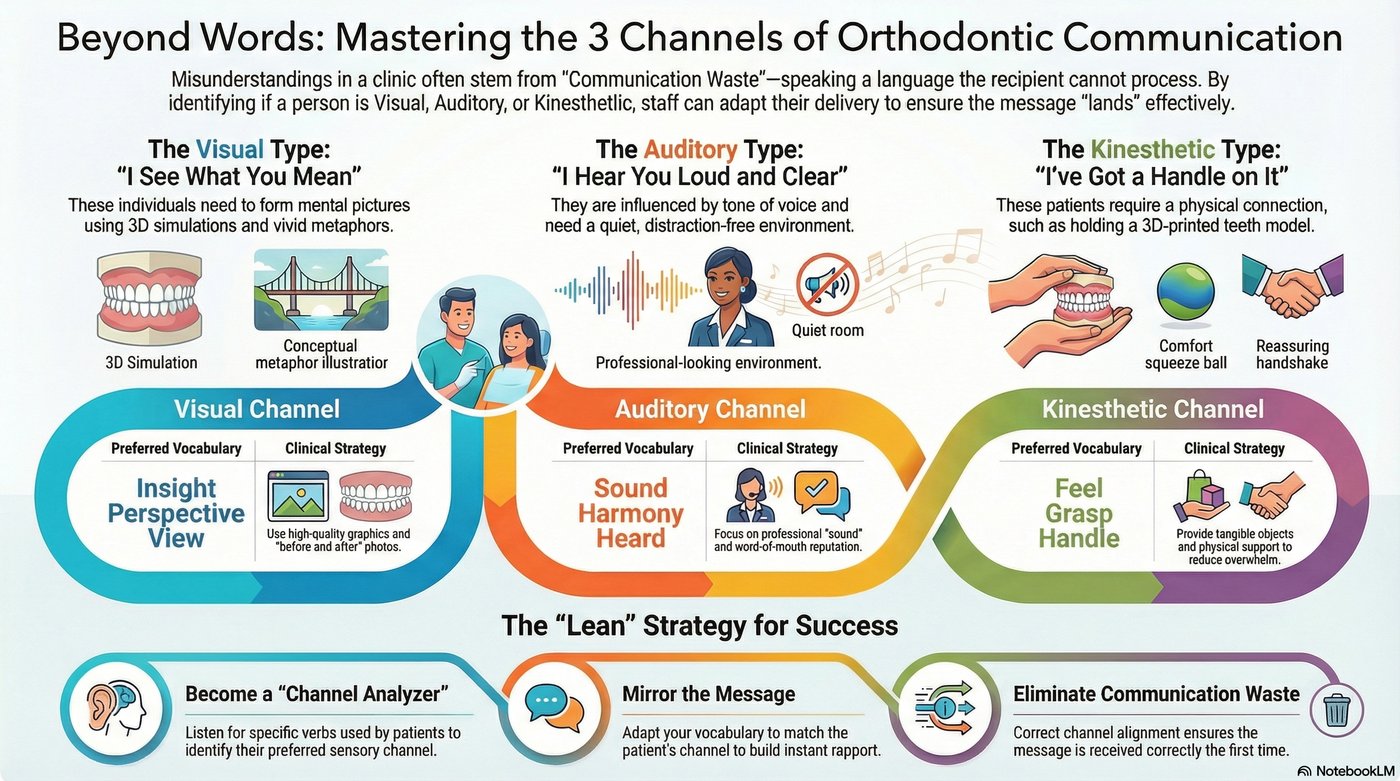
The Visual Type: “I See What You Mean”
Visual people process the world through their eyes. They require mental clarity and structure, often focusing on aesthetics, organization, and presentation. To lead them effectively, whether they are a prospective patient or a team manager, you must prioritize sight. They need to form a clear “picture” in their mind’s eye to feel confident in a decision or a directive.
A visual patient is often meticulous about the appearance of their records and the cleanliness of the clinic. A visual staff member responds best to checklists, workflow diagrams, and clearly formatted emails rather than verbal instructions. For them, a disorganized office signals a disorganized mind.
Vocabulary: They use words like insight, perspective, imagine, focus, view, show, and look.
The Strategy: Use vivid colors, striking metaphors, and high-quality graphics. In the consultation room, don’t just explain a Class II correction; show them a high-definition 3D simulation or a compelling “before and after” photo gallery. Implement digital case presentations with annotated images that highlight specific concerns and treatment milestones. If you fail to provide compelling visual evidence, they cannot “see” the value of the investment or the rationale behind your professional fee. Ensure all internal procedure manuals are graphically rich and color-coded for fast reference.
The Auditory Type: “I Hear You Loud and Clear”
Auditory individuals are “all ears”. They are deeply attuned to sounds, pitch, rhythm, and the actual content of spoken dialogue. They don’t necessarily need a screen full of data; they need information to go straight to their hearing, often enjoying detailed verbal briefings or lively discussions.
This type of individual, whether a patient or an employee, is highly sensitive to the spoken word and often remembers instructions based on the sequence in which they were spoken. For a new employee, a recorded, step-by-step audio guide may be more effective than a written manual. The emotional tone you use is as important as the message itself; a patient may forget your explanation but remember the calming sound of your voice during a difficult appointment.
Vocabulary: They talk about things sounding right, harmony, tuning in, making themselves heard, and listening.
The Strategy: Speak clearly and distinctly, using modulated tones to emphasize key points. Be mindful of background noise; a chaotic, loud clinic will cause an auditory person’s attention to drift, leading to poor retention of post-treatment instructions. They are heavily influenced by word of mouth—patient testimonials and internal team huddles are crucial for their buy-in. For them, your professional “sound,” which includes receptionist phone etiquette and the clarity of doctor-patient dialogue, is a critical part of your brand identity and perceived expertise.
The Kinesthetic Type: “I’ve Got a Handle on It”
The kinesthetic person needs to grasp things—literally and figuratively. They are grounded, highly sensitive to physical proximity, and respond best to tangible, hands-on experiences. This group values comfort, proximity, and the feeling of control.
In a clinical setting, this means they appreciate comfort items like blankets or neck pillows. When explaining complex mechanics, a kinesthetic team member learns fastest by performing the task while being guided. The office environment must feel welcoming and physically comfortable; hard, sterile surfaces can be highly off-putting to them.
Vocabulary: They use words like “feel,” “grasp,” “handle,” “solid,” “touching,” “flow,” and “connect.”
The Strategy: Give them something purposeful to hold. Handing a kinesthetic patient a high-quality 3D-printed model of their teeth or a sample of the retainer material can work wonders for case acceptance. They need a physical connection to the information to internalize the concept. If a patient feels overwhelmed, they don’t need a picture; they need a metaphorical “hand to hold”—a brief, reassuring touch on the shoulder or clear, supportive verbal pacing to feel grounded and supported. Incorporating physical movement, such as walking a staff member through a new instrument setup, solidifies their understanding.
Conclusion: Adapting for Efficiency
To be a high-performing leader and entrepreneur in modern dentistry, you must become a “channel analyzer.” Listen not just to the content but also to the verbs your patients and staff consistently use; these are the clues to their V-A-K preference. By mirroring their preferred channel—showing the visual, speaking clearly to the auditory, and providing something tangible to the kinesthetic—you build instant rapport and professional trust. This diagnostic approach to communication is the ultimate “lean” shortcut: it saves hours of frustration, reduces costly errors, and ensures your complex treatment plan or operational directive is received correctly and acted upon the first time. Mastering this skill elevates you from a clinician to a masterful business leader.