

Decoding the Decision-Maker: Precision Communication in Orthodontic Practice Management
Published on: Jun 12, 2026
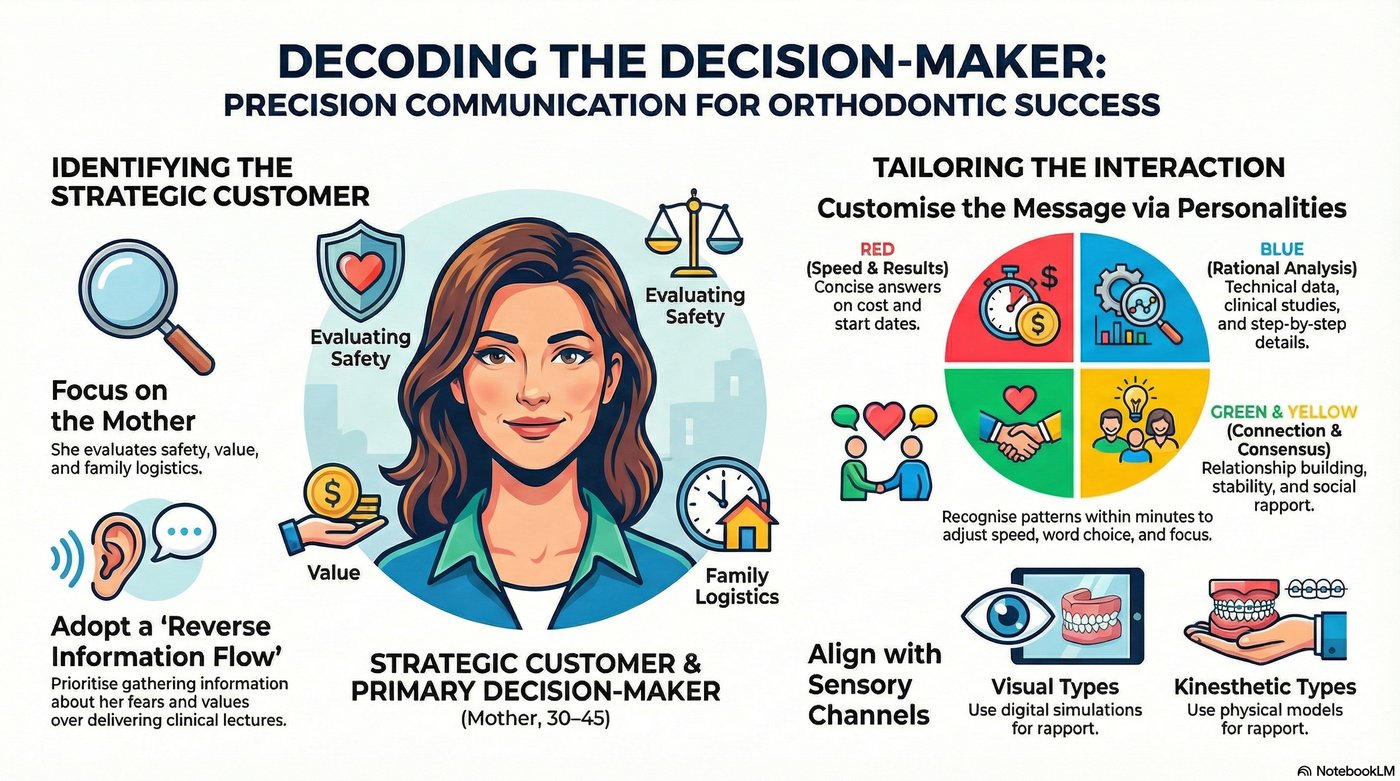
Many orthodontists operate under the fundamental misconception that their primary target audience is the child with crooked teeth. From a clinical perspective, this is true. However, from a leadership and practice management perspective, it is a strategic error. In reality, we are not communicating with thirteen-year-olds; we are communicating with their mothers—the primary decision-makers who navigate complex emotional and financial choices for their families.
Mastering the patient journey in orthodontics requires a shift in how we perceive our “customer.” To drive practice efficiency and increase treatment acceptance, we must move beyond medical education and embrace the psychology of the persona. By understanding exactly who is sitting in the consultation chair, we can tailor our communication to create an environment of trust and immediate clarity.
Identifying the Primary Demographic
If seventy percent of an orthodontic practice consists of children and adolescents, the demographic reality is that our most important “customer” is a woman between the ages of thirty and forty-five. She is the one browsing social media, reading reviews, and evaluating the atmosphere of your clinic. If your marketing and consultation scripts do not resonate with her specific concerns—safety, long-term value, and family logistics—your communication will never reach its full potential.
In a lean orthodontic system, we prioritize a “reverse flow of information.” Rather than the doctor delivering a one-way lecture on clinical mechanics, we must gather information. We need to understand her as a person: What are her fears? What does she value most in a healthcare provider? This shift from “expert-educator” to “expert-listener” is the first step in professionalizing your patient interactions.
The Color of Personality: Tailoring the Message
To achieve a high level of practice efficiency, we cannot use a one-size-fits-all approach to communication. Every person processes information differently, and high-level dental leadership involves recognizing these personality patterns within the first few minutes of an encounter. A common and effective method is the color-based personality system.
Red Personalities: The Impulsive Decision-Maker
The “Red” persona values speed and results. They are not interested in a deep dive into clinical studies or a thirty-minute explanation of biomechanics. They want to know three things: Can you fix it? How much does it cost? Can we start tomorrow? If you over-explain to a “Red” type, you create friction and delay the decision.
Blue Personalities: The Rational Analyst
Conversely, the “Blue” persona is detail-oriented and analytical. They might actually appreciate the clinical studies and a step-by-step breakdown of the process. For them, a lack of detail is a red flag. Meeting them on their wavelength requires providing the technical data they need to feel secure in their choice.
Green and Yellow Personalities: Consensus and Connection
“Green” types seek consensus and stability, while “Yellow” types are social and focus on the relationship. By adjusting your speed, word choice, and focus to match these colors, you create a sense of chemistry that is built on a deliberate, professional structure rather than mere luck.
Engaging the Sensory Channels
Beyond personality types, we must consider how a patient physically perceives our message. Some patients are visual; they need to see digital simulations or high-quality images. Others are auditory; they focus on the tone of your voice and how you describe the transformation. Then there are kinesthetic types, who may need to hold a model of an appliance to understand the journey ahead.
By paying close attention to the specific words a mother uses—”I see what you mean” versus “That sounds good”—you can identify her preferred sensory channel. Responding in kind is a powerful tool for building rapport quickly. This level of precision communication reduces the “noise” in the patient journey and ensures the decision-maker feels fully understood.
Conclusion: Engineering Chemistry for Practice Growth
Successful orthodontic practice management is not just about moving teeth; it is about moving people toward a decision that improves their lives. When we stop treating every consultation as a medical lecture and start treating it as a targeted interaction with a specific persona, our efficiency skyrockets.
By focusing your energy on the actual decision-maker—the mother—and adapting your communication to her personality and sensory preferences, you build a predictable, high-quality environment. True leadership is the ability to connect with anyone, at any time, by choosing to listen more than you speak.