

Decision vs. Outcome: The Architecture of a Resilient Practice
Published on: Jun 7, 2026
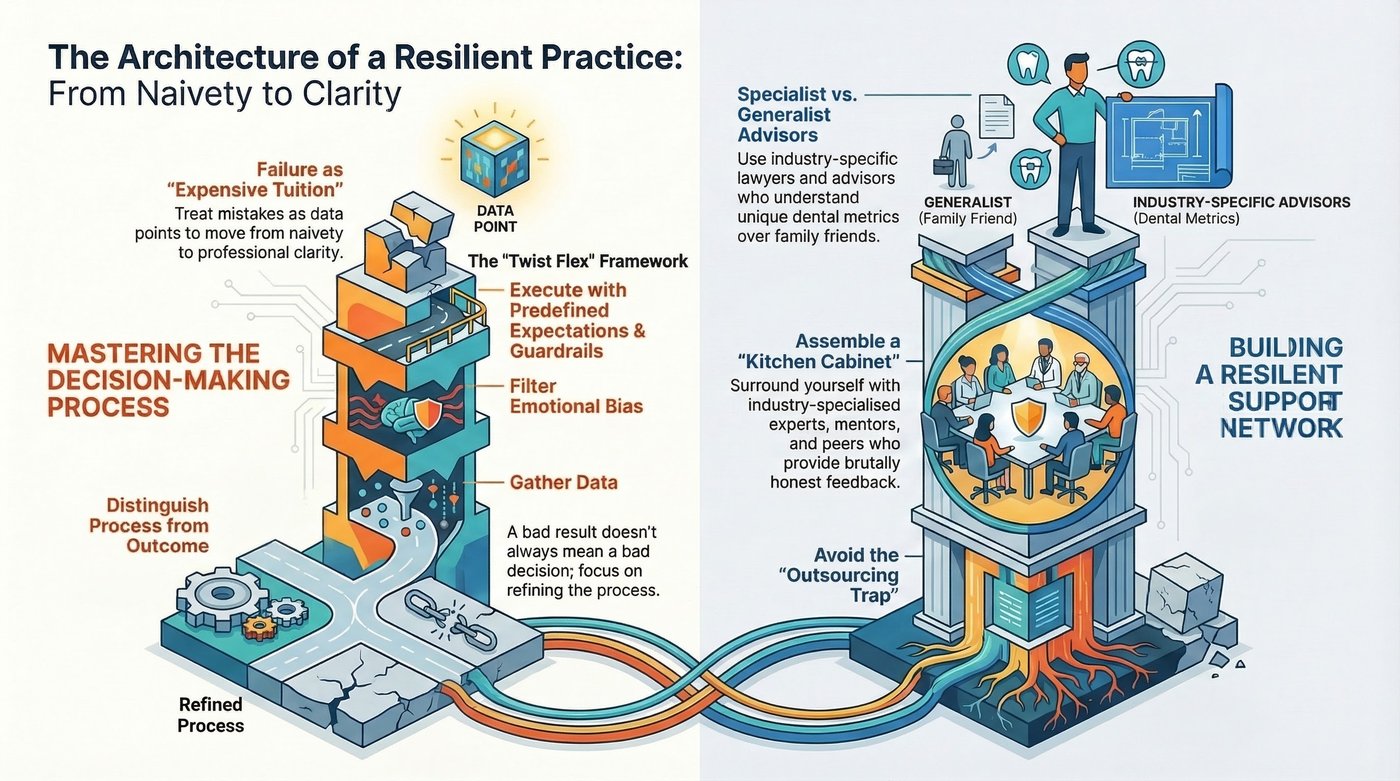
In the high-stakes world of orthodontics, we often conflate a “bad result” with a “bad decision.” If a capital investment fails to yield immediate returns or a secondary location struggles to gain traction, our first instinct is often to retreat into self-criticism. We question our intuition and fear that we lack the fundamental business acumen necessary to thrive in a competitive landscape.
However, true dental leadership requires a more sophisticated layer of analysis. As Dr. Martin Baxmann emphasizes, failure is frequently the most expensive tuition we pay in our professional lives. To ensure we are getting our money’s worth from these setbacks, we must learn to distinguish between the quality of our process and the luck of the outcome.
Consider a clinical scenario where you follow a perfect protocol, yet the biological response of the patient is suboptimal. You wouldn’t necessarily change a proven clinical technique based on one outlier. The same logic applies to practice management. External market fluctuations, sudden staffing changes, or global health crises can derail even the most brilliant strategic plans. Understanding that outcomes are probabilistic, not deterministic, allows a leader to remain steady when the storm hits.
Mastering this distinction is the key to transforming inevitable mistakes into long-term strategic success. It shifts the focus from emotional reaction to data-driven refinement. When we stop obsessing over the “what” happened and start scrutinizing the “how” we decided, we build a practice that is not just successful, but resilient to the core.
Standardizing the “Twist Flex” Decision Process
A bad result does not always mean you made a bad decision. For example, expanding your practice right before a global economic shift is a “bad result” driven by external variables that were impossible to predict with certainty. If the original decision was based on sound demographic data, a solid financial concept, and a clear community need, the process was fundamentally correct.
In these cases, the answer isn’t to abandon your long-term strategy or pivot in a panic. Instead, the correct leadership response is to apply more perseverance. When the process is sound, you must have the fortitude to see the plan through the temporary turbulence of a poor outcome. This is where many practitioners fail; they mistake a temporary dip for a systemic error and dismantle their progress just as it was about to stabilize.
Standardizing this process means creating a checklist for major decisions. Much like the “twist flex” wires we use in orthodontics to manage complex forces, your decision-making framework should be flexible enough to handle pressure but resilient enough to return to its original intent. Before signing a lease or hiring an associate, ask: Is this based on verified data? Does it align with our core values? Have we accounted for the worst-case scenario? If the answers are “yes,” you can proceed with confidence, regardless of the eventual result.
Conversely, a “bad decision” is one made without a standardized process—relying on gut feeling, hearsay, or “being too nice” to a struggling employee. These decisions are dangerous because even if they lead to a “good” outcome, the success is unrepeatable and based on pure luck. To achieve true operational excellence, you must treat every business decision with the same rigor as a complex clinical procedure.
Gather the Data: You must utilize your “twist flex” wires of information. This involves looking beyond surface-level numbers and diving into the patient acquisition costs, referral patterns, and chair-time utilization. If you aren’t tracking the metrics, you aren’t making a decision; you’re making a guess.
Filter the Noise: A leader must remove emotional bias from the equation. It is easy to get caught up in the excitement of a new technology or the fear of a local competitor. Effective filtering requires stepping back to evaluate the situation through an objective lens, ensuring that ego or anxiety isn’t steering the ship.
Execute with Clarity: Once the path is chosen, you must define the expectations and guardrails from day one. Communication is the bridge between a decision and its implementation. If the team doesn’t understand the “why” and the “how,” the execution will be fractured, leading to a “bad result” that was actually caused by a “bad implementation.”
The Outsourcing Trap: Why You Can’t Buy a Culture
One of the most common “bad decisions” in modern practice management is the attempt to outsource your core thinking. In an age of specialized agencies, many practitioners are eager to check a box and move on. They hire marketing firms to “build” their brand identity or HR consultants to “handle” the practice culture without any personal involvement from the leadership level.
This approach is a trap. While you can outsource tasks, you can never successfully outsource the soul of your business. When an external entity creates your values, they are often generic and lack the specific “flavor” that makes your practice unique. This leads to a disconnect between the marketing message and the actual patient experience, which is one of the fastest ways to erode trust and lose market share.
Dr. Baxmann shares a poignant personal lesson regarding this phenomenon. He once hired a company to produce a “finished” quality management manual in just two weeks. The result was a decade of organizational mess. Because the manual was built by outsiders who didn’t understand the internal workflow, it was a dead mass of paper that no one used or understood. It was a burden rather than an asset.
To be an asset, a system must be built from the inside out. You and your core team must be the ones to document the protocols, as you are the ones living them every day. You must understand the deep “why” behind your protocols, or they will eventually become a series of bureaucratic hoops that your team will find ways to ignore. True lean management requires that the leader remain the primary architect of the practice’s logic.
When you build your own systems, you create a living document that evolves with the practice. This internal authorship ensures that every team member feels a sense of ownership. Instead of following rules “because the manual says so,” they follow them because they understand how that specific step contributes to the overall excellence of the patient’s journey.
The Specialized “Kitchen Cabinet”
Many orthodontists fall into the habit of hiring tax advisors, lawyers, or contractors simply because they are “friends of the family” or convenient. This lack of specialization is a major, often invisible, source of waste and risk. A generalist lawyer, while competent in basic law, cannot navigate a complex dental partnership contract or a specialized equipment lease as effectively as a dental-specific legal expert.
The metrics of a dental practice—such as collections-to-production ratios, supplies-as-a-percentage-of-revenue, and specific labor laws for healthcare—are unique. Using a generalist means you are constantly paying for them to learn your industry on your dime. Specialized experts, however, come to the table with benchmarks and insights from hundreds of other practices, allowing you to bypass common pitfalls immediately.
To avoid these expensive and avoidable mistakes, you need to curate a “Kitchen Cabinet” of advisors. This is a small, trusted circle of people who don’t just work for you but partner with you in your success. They should be chosen specifically for their ability to challenge your assumptions and provide high-level, industry-specific guidance.
Specialized Experts: These are professionals who live and breathe dental economics. They know what a healthy overhead looks like for an orthodontic practice versus a general practice. They can spot red flags in your financial statements months before a generalist would even notice a trend.
Brutally Honest Peers: You need a network of colleagues who will give you data-driven feedback rather than polite praise. In many professional circles, there is a tendency to only share successes. You need a “safe harbor” group where you can share failures and receive the hard truths necessary for growth.
Mentors: These are the individuals who have already paid the “tuition” of failure several times over. A good mentor doesn’t just tell you what to do; they help you see the blind spots in your own thinking. By learning from their history, you can effectively “buy” years of experience without having to suffer the associated costs yourself.
Conclusion: Moving from Naivety to Clarity
In the journey of building a resilient practice, mistakes are unavoidable, but repeating them is entirely optional. The transition from a struggling practitioner to a true leader involves moving from a state of naivety—where we hope for good outcomes—to a state of professional clarity, where we trust our standardized processes.
Use your failures as invaluable data points. When a plan goes awry, resist the urge to panic and instead conduct a “post-mortem” on the decision-making process itself. Was the data accurate? Was the execution clear? If you find that your process was sound despite the result, stay the course. If you find the process was flawed, refine it immediately.
Ultimately, your practice is a reflection of the systems you build and the advisors you keep. By investing in your own leadership logic and surrounding yourself with specialized expertise, you ensure that every result—good or bad—provides the wisdom needed for your next great success. The architecture of a resilient practice isn’t built on luck; it is built on the unwavering commitment to a high-quality decision-making process.