

Decision Paralysis vs. Probability: Navigating the Grey Areas of Orthodontics
Published on: Jun 30, 2026
The Trap of the “Perfect” Choice
Many orthodontists carry the weight of their clinical decisions home, haunted by the lingering fear that choosing one treatment path—such as camouflage extraction—automatically makes the alternative path—like orthognathic surgery—the “right” one if complications arise. This binary mindset creates a heavy cognitive load that leads directly to clinical paralysis.
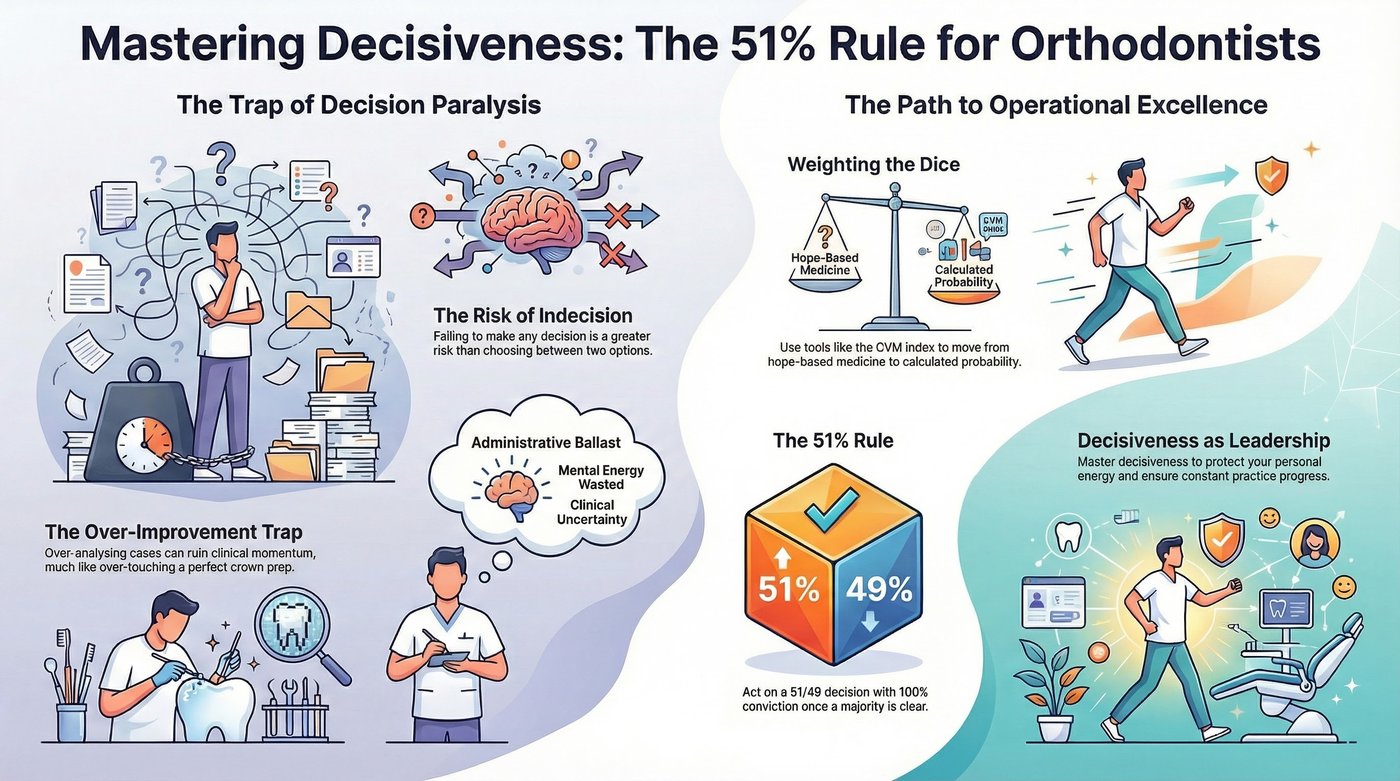
In lean orthodontics, we recognize that the greatest risk to your practice isn’t making a 51/49 choice; it is failing to make a decision at all. Stagnation in the diagnostic phase consumes chair time and mental bandwidth. When a clinician hesitates, the patient senses the lack of direction, which can erode the foundational trust required for complex, long-term treatments.
We often fall into the trap of “over-improving” a plan before it even begins. Just like a dental student who ruins a perfect crown preparation by touching it up “one last time” until the margins are compromised, we can over-analyze a case until we lose the momentum of the treatment. We seek a 100% guarantee that does not exist in biological systems.
If you have two viable options, having to choose between them is actually a clinical luxury. It means both paths lead toward a successful outcome. The only truly bad decision is remaining stuck in a state of “analysis paralysis” while the patient waits for a plan. Decisiveness at the start of treatment sets the tempo for the entire clinical team and ensures the practice continues to flow efficiently.
Weighting the Dice: Decision Making Under Uncertainty
In clinical practice, we are perpetually making decisions under conditions of uncertainty. We cannot predict with absolute certainty exactly how a specific patient’s biology will react to mechanical forces or how diligent their home-care compliance will be over eighteen months. However, we can “weight the dice” in our favor by gathering and prioritizing objective data over subjective intuition.
By using precise tools like the CVM index to identify peak growth spurts or assessing psychological markers for patient compliance, we move from a “blind roll” to a calculated probability. For example, if you use a functional appliance on a patient with no remaining skeletal growth, the statistical probability of success is extremely low. Understanding this allows you to pivot early.
Acknowledging these probabilities allows you to move away from “hope-based medicine”—where you simply wish for a good result—and toward operational excellence. This transition requires accepting that while you cannot control every variable, you can control the quality of the information used to make the initial call.
Implementing the 51% Rule
True dental leadership means having the courage to act on a “51 to 49” decision. You do not need to be 100% certain before you move forward; waiting for total certainty is an expensive waste of time. In reality, being 51% convinced is a clear majority in a complex clinical environment. It is the threshold where the evidence tips the scales.
The key to success is to make the decision based on probability but implement it with 100% conviction. Once the choice is made, the “49” must be discarded to prevent second-guessing. This mindset saves a massive amount of mental energy and prevents the “administrative ballast” of over-analysis that often bogs down the mid-treatment phase.
By leading with conviction, you provide your staff with a clear roadmap. They no longer have to navigate the clinician’s doubt, which allows the orthodontic assistants to focus on high-level execution rather than wondering if the plan will change at the next appointment.
Conclusion: Decisiveness as a Practice Standard
Decisiveness is not an innate trait; it is a clinical skill that can be mastered through practice and systems. By applying basic probability to your clinical and management dilemmas, you protect your personal energy and your practice’s momentum. This clarity reduces stress and prevents the burnout associated with constant ruminating over past cases.
When you stop fearing the “what ifs” and start acting on the data, you create a high-performing environment where progress is the only constant. A decisive practice is a profitable practice, but more importantly, it is a practice where the clinician can lead with confidence, and the patients can receive timely, effective care.