

Data Minimalism: Why “Less is More” in Orthodontic Diagnosis
Published on: Jul 6, 2026
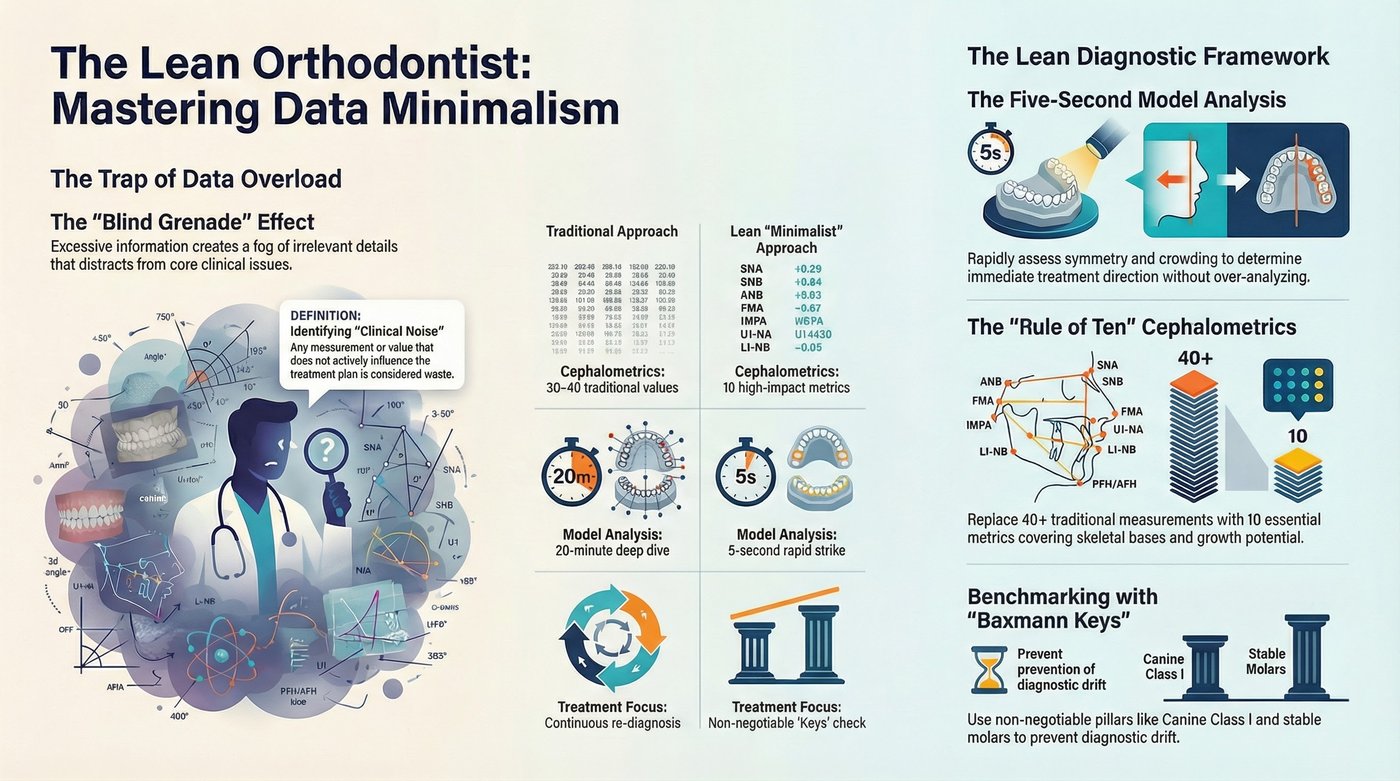
The Trap of Data Overload
In modern orthodontics, we are practically drowning in data. From high-resolution 3D scans to complex cephalometric tracings, the sheer volume of information available for a single patient is staggering. We are often trained under the assumption that more data inherently leads to better care. However, as many practice owners have experienced, excessive information often acts as a “blind grenade.” It creates a fog of irrelevant details that can actually distract us from the core clinical issues.
The challenge of practice management today isn’t just about gathering information—it’s about the disciplined filtering of that information. To maintain a high-performing clinic, we must transition from being data collectors to becoming master filters. This lean approach to diagnosis ensures that your valuable clinical energy is spent on decisions that move the needle for the patient.
The Power of Rapid Assessment: The Five-Second Model Analysis
One of the most effective ways to combat data waste is to implement structured, rapid assessment tools. Many clinicians spend far too long over-analyzing models before reaching a conclusion. A “lean” alternative is the five-second model analysis. This isn’t about rushing; it’s about focus.
By training yourself and your team to look specifically for symmetry, crowding, and basic spatial relationships in a five-second window, you answer the most decisive question immediately: Do we have enough space, and are the teeth in the right place? This rapid diagnostic strike guides you toward the solution far faster than a 20-minute deep dive into non-essential measurements. It sets the stage for a streamlined patient journey in orthodontics by establishing the treatment direction from the very first moment.
Lean Cephalometrics: The “Rule of Ten”
Perhaps no area is more prone to data waste than cephalometric analysis. Most of us remember dental school requirements involving dozens of angles and planes, many of which are never referenced again in private practice. If a value does not influence your treatment plan, it is clinical noise.
A lean cephalometric analysis focuses on the “ten values” that actually matter. These ten metrics should cover the skeletal bases, incisor position, vertical dimension, and growth potential. With just these ten numbers, you can identify if there is a risk of recession, if the lower incisors can be safely proclined, or if the bite is skeletal or dental. By stripping away the other thirty or forty “traditional” values, you gain clarity and speed without sacrificing clinical excellence.
Identifying the Non-Negotiable “Keys” to Success
To maintain efficiency during treatment, a leader needs non-negotiable benchmarks. These are what I call the “Baxmann Keys.” Instead of re-diagnosing the case at every appointment, you simply check the essential pillars: Are the canines in Class I? Is the midline centered? Are the molars stable?
If these keys are in place, the treatment is on track. This systematic way of working prevents “diagnostic drift” and keeps the clinical team aligned. It reduces the mental load on the doctor and ensures that every chairside minute is productive.
Conclusion: Clarity Over Complexity
The goal of lean thinking in diagnosis is to replace complexity with clarity. When we reduce the noise, we act with more confidence and less stress. This is not about cutting corners; it’s about sharpening our focus. By adopting a minimalist data strategy, you can treat more patients with more predictable results while keeping your practice running like a precise, efficient machine.