

Data-Driven Growth: Using Clinical Rigor in Your Marketing Strategy
Published on: Jul 2, 2026
The Marketing Science Mindset
One of the most common errors in orthodontic practice management is abandoning a marketing campaign too early because it didn’t produce “instant” results. In a lean practice, we treat marketing with the same scientific rigor we apply to a clinical diagnosis. This means we don’t guess; we test, measure, and refine.
We must approach marketing spend not as an expense, but as a clinical trial where every dollar is an investment in data collection. Just as a series of X-rays provides diagnostic insights, marketing campaigns provide metrics like Click-Through Rate (CTR) and Cost Per Acquisition (CPA). These numbers are the vital signs of your growth strategy.
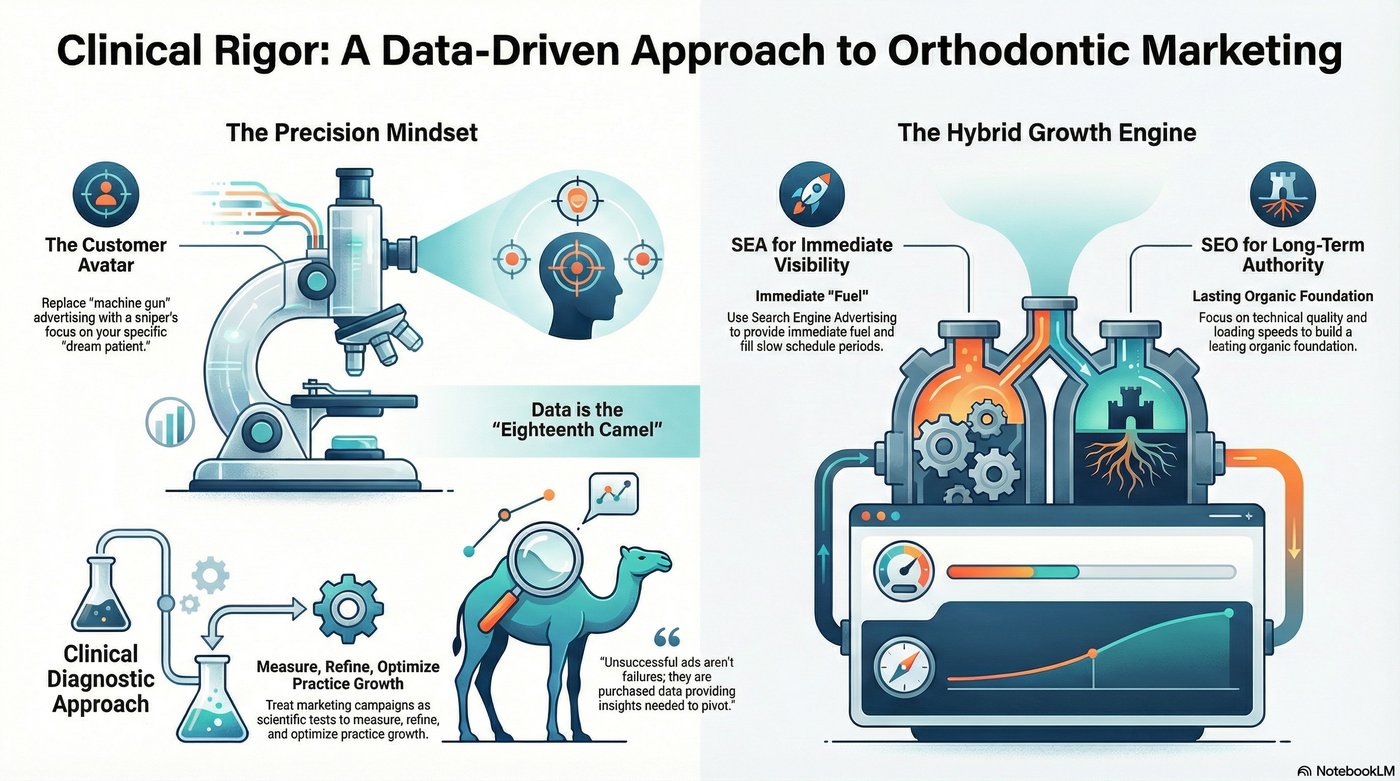
If a particular advertisement doesn’t result in a new patient inquiry, it isn’t a “failure.” Instead, you have successfully purchased valuable data that tells you what doesn’t work. This insight is crucial; it prevents the repetition of costly mistakes across all other digital channels.
This information is the “eighteenth camel” of marketing—it provides the insight needed to pivot and optimize your strategy. A real-world example is discovering that highly aesthetic stock imagery converts poorly compared to authentic, candid photos of your actual team and office environment.
This disciplined approach ensures that every marketing adjustment is evidence-based, moving away from subjective opinions within the management team. In dental team performance, this allows the practice to grow predictably rather than by accident. Clinical leaders understand that consistent patient flow must be a reliable, systemized process, not a fluctuating, chance variable.
Defining Your Customer Avatar: The Sniper’s Target
To maximize practice efficiency, you must define your “dream patient.” Look at your current successful cases: Are they mostly working professionals, or are they parents of young children? What are their primary concerns?
A superficial demographic analysis is insufficient for high-value growth; true rigor demands a psycho-graphic profile. Understand the patient’s anxieties about treatment cost, the pain points of their previous dental experiences, or their specific motivation for seeking alignment or restoration.
By creating a “Customer Avatar,” you can stop the “machine gun” approach of broad advertising and start aiming like a sniper. For instance, a specialty implantology practice must target pre-retirees primarily concerned with long-term chewing function, not general aesthetics.
You want to reach the specific group that fits your practice’s unique identity. This focused approach drastically reduces wasted ad spend on unqualified leads who will ultimately drain staff time with non-starter consultations.
This focus allows you to write advertising copy that speaks directly to their needs, increasing your conversion rate. When the copy is deeply resonant with the avatar’s concerns, the lead arrives already pre-qualified, having self-identified as a perfect fit for your specialized services.
Furthermore, a well-defined avatar ensures your internal patient journey is optimized for their specific expectations. The communication style, appointment times, and even the office decor should align perfectly with the target demographic to ensure stellar retention rates.
Hybrid Strategy: Balancing Paid Ads and SEO
To achieve operational excellence, a practice needs a hybrid strategy. Relying solely on one method creates vulnerability, either to budget cuts or to market stagnation, while waiting only for organic recognition.
The hybrid model is a risk-mitigation strategy, ensuring sustained visibility across both immediate and long-term horizons. This approach stabilizes the patient acquisition funnel, keeping new patient volume consistent throughout the year.
Search Engine Advertising (SEA): Allows you to “buy” immediate visibility for specific terms. This is critical for capitalizing on high-intent keywords like “emergency root canal” or for promoting limited-time offers to fill short-term schedule gaps.
Search Engine Optimization (SEO): Involves technical work to improve loading speeds and content quality for long-term organic growth. This is the digital equivalent of establishing your practice as the trusted, authoritative leader in your local market.
An effective SEA campaign requires constant A/B testing of ad copy and landing page design to optimize Quality Score and lower your Cost-Per-Click. This testing discipline mirrors the continuous improvement cycles essential in clinical quality assurance protocols.
A robust SEO strategy goes beyond basic keyword inclusion; it requires publishing high-value, comprehensive content that directly addresses complex patient queries. Long-form articles about procedures like “All-on-4” demonstrate professional depth and build credibility before the first phone call.
A lean leader understands that these two pillars support each other. High Quality Scores in SEA can be significantly boosted by having a fast, relevant landing page—a direct result of strong foundational SEO work.
While SEO builds a foundation of long-term authority, SEA provides the immediate “fuel” needed to fill the schedule during slower periods. Together, they create a balanced system that keeps new patient inquiries flowing on autopilot.
Conclusion: Investing in the Future
Online marketing is not rocket science, but it does require stamina and a testing mindset. Success is not determined by a single viral post or a high initial budget but by methodical, weekly iteration based on observable metrics.
By applying a structured investment approach to your digital presence, you move from a reactive state to a proactive state of growth. This structure allows clinic leadership to accurately predict ROI and allocate marketing resources efficiently, treating it like any other strategic capital expenditure.
Don’t let your professional ego dictate your ads; let the numbers and the data guide your path. Embrace the necessary failure rate inherent in testing, understanding that each unsuccessful test refines the eventual success formula. This is how you build a high-performing practice that flourishes regardless of the competition.
The commitment to data-driven marketing is the hallmark of a mature, scalable practice model. It allows a sophisticated dental organization to reliably dominate its local market year after year.