

Cracking the “Yes” Code: The 7 Buying Motives of Orthodontic Patients
Published on: Jun 28, 2026
Beyond the Clinical Need
In orthodontics, we often focus on the clinical necessity of a treatment—the overcrowding, the Class II correction, or the crossbite. However, in lean orthodontics, we recognize that patients do not buy “braces”; they buy the fulfillment of an internal psychological driver. To increase case acceptance and achieve operational excellence in your consultations, you must move beyond the diagnosis and identify which of the seven key motives is actually triggering the patient’s decision-making process. This psychological alignment is the cornerstone of leadership within the treatment room, allowing the clinician to act as a guide rather than a salesperson.
Understanding these motives allows you to adapt your communication with surgical precision. It transforms the consultation from a generic presentation into a tailored experience that speaks directly to the patient’s subconscious. By recognizing whether a patient is seeking security or social validation, you can eliminate friction in the “yes” process and build a practice known for its patient-centric approach.
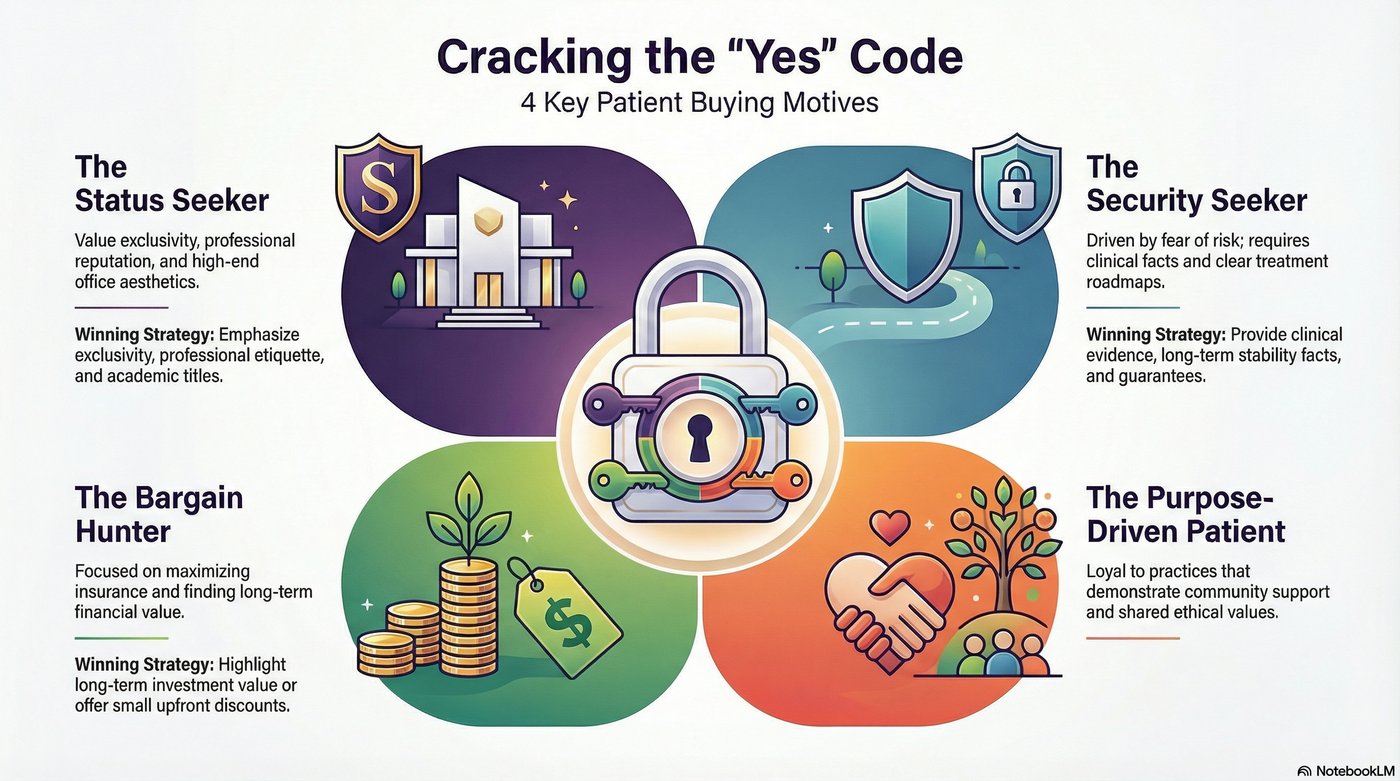
1. Status and Prestige: The “Rolex” Patient
These patients are brand-conscious and value exclusivity. They are impressed by your academic titles, your high-end office design, and your professional reputation.
The Strategy: Maintain a high level of professional etiquette. Use titles and emphasize the “exclusive” nature of your specialized techniques. For them, your practice is a reflection of their own status.
2. Safety and Risk Avoidance: The “Security” Patient
This group is driven by a fear of the unknown. They read every word of the consent form and worry about root resorption or unexpected costs.
The Strategy: Focus on clinical evidence, long-term stability, and guarantees. Provide a clear, step-by-step roadmap. If you address their fears with facts, you win their trust.
3. Profit and Frugality: The “Bargain” Patient
The “penny pinchers” are always looking for a deal or a way to maximize their insurance.
The Strategy: Highlight the long-term value of the investment. A small “bonus,” like a free professional cleaning or a minor discount for upfront payment, can turn a hesitant “maybe” into a joyful “yes.”
4. Social Conscience: The “Purpose” Patient
These patients want their money to go toward a business that gives back. They care about sustainability, community support, and the ethical footprint of the vendors you select. They aren’t just buying a smile; they are investing in your mission.
The Strategy: Share your practice’s values. If you plant a tree for every appliance used or support a local school, make it known. When your values align, they become your most loyal ambassadors.
5. The Social Contract: Belonging and Connection
For many, the motive is purely social. They want to feel like they belong to a tribe or a specific social group. This is particularly common in adolescent patients or adults in high-visibility professions who feel that their current dental state is a barrier to connection.
The Strategy: Use social proof. Show testimonials and photos of patients who share their background or lifestyle. Emphasize how the treatment will enhance their confidence in social settings, allowing them to engage more fully with their community.
6. Convenience and Time: The “Efficiency” Patient
In the modern world, time is the most valuable currency. These patients are less concerned with the price and more concerned with the number of visits, the proximity of your office, and the availability of digital monitoring solutions.
The Strategy: Highlight your lean workflows. Discuss remote monitoring, fewer in-office adjustments, and punctuality. If your practice respects their time, they will value your services above all competitors who lag in operational speed.
7. Health and Self-Actualization: The “Wellness” Patient
This patient views orthodontics as a vital component of their overall holistic health. They are interested in the airway, the longevity of their dentition, and the functional harmony of the masticatory system. Aesthetics are a secondary benefit to the pursuit of peak physical condition.
The Strategy: Provide deep clinical education. Use 3D scans to explain the relationship between tooth position and long-term health. Frame the treatment as a proactive health decision rather than a cosmetic elective.
Conclusion: Leading the Consultation
Mastering these seven motives requires active listening and emotional intelligence. When you stop pitching a product and start solving a psychological need, your conversion rates will naturally rise. True leadership in orthodontics is found at the intersection of clinical excellence and a deep understanding of human behavior.