

Communicative Efficiency: Shortening the Distance Between Idea and Action
Published on: Jun 30, 2026
The Organizational Chart as a Shortcut
As an orthodontic practice scales, the “communication path” naturally begins to stretch. If you find yourself constantly running from room to room to re-explain tasks or motivate individuals, your communication path is too long. This frantic pace signals a fundamental breakdown in systemic delegation, forcing the leader to become the central, often overworked, hub of all operational data.
In orthodontic practice management, a leader must build a structure that allows information to flow without their constant intervention. The initial growth phase often masks these structural flaws, but once a practice hits seven or more team members, reliance on verbal handoffs and informal chains of command introduces significant error rates and slows the pace of care.
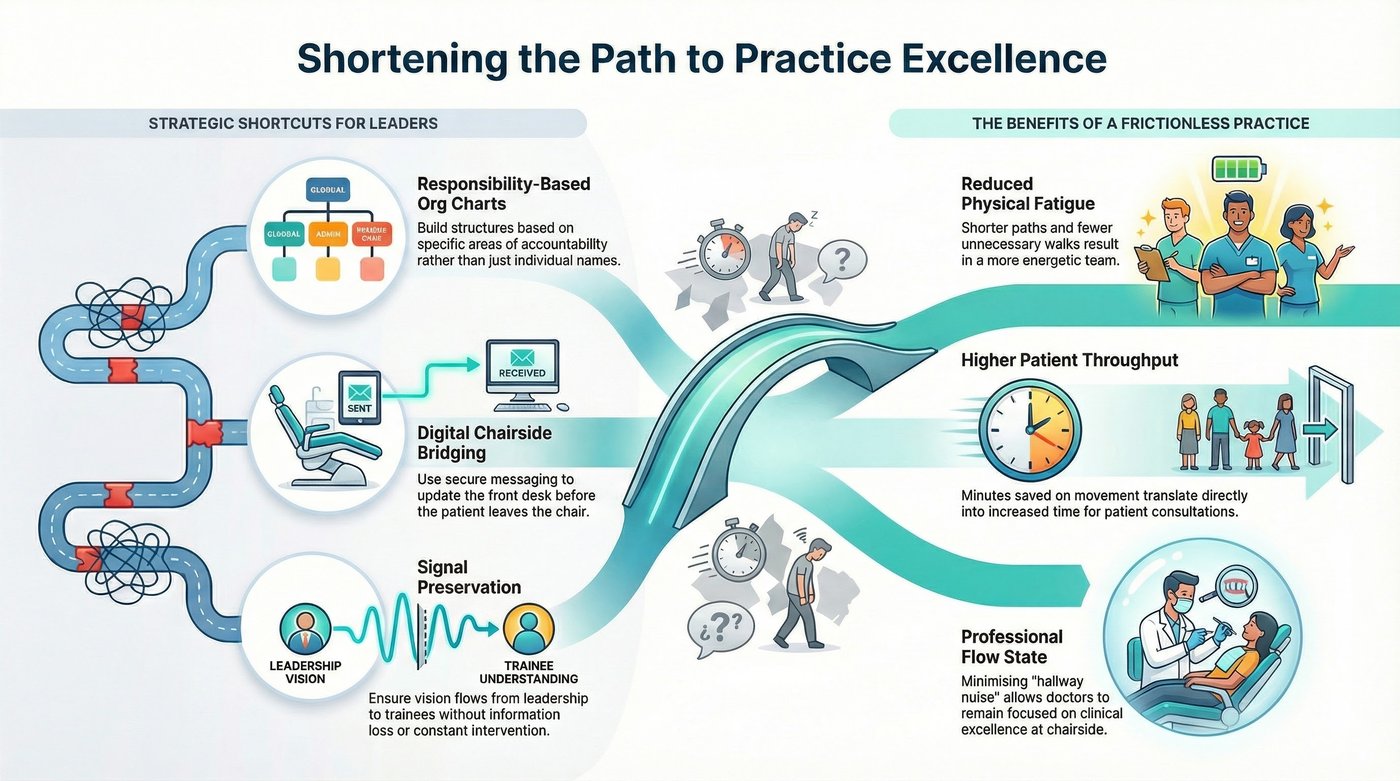
To shorten these paths, you need a clear organizational chart based on areas of responsibility rather than just names. This means defining roles like “Clinical Lead,” “Patient Care Coordinator,” or “Financial Manager” and assigning accountability for specific outcomes, not just daily tasks. This structural clarity allows a vision to flow from you to a department head and down to a trainee without a loss of signal. It is the essential framework for scaling predictable and repeatable results in specialized procedures.
It ensures that everyone knows who is accountable for hygiene, inventory, or billing, creating a direct line for every query. For instance, a broken instrument is immediately reported to the Inventory Manager, not the Doctor, who then initiates the reordering protocol without needing executive oversight, demonstrating true decentralized responsibility. This shift empowers team members, reduces decision latency, and ensures core operational functions never stall while the clinical team is focused on patient care.
Digital Shortcuts: Bridging the Clinic and the Front Desk
In many traditional offices, the “bridge” between the clinical bay and the reception is a physical one—the doctor or assistant walking to the front desk to hand over a file or explain a follow-up. This repeated physical movement, often for simple data transfer, is a classic form of waste, known as motion or transport in lean management principles.
Consider the cumulative time lost: even one minute of walking and explaining per patient, multiplied across twenty patients a day, translates to over 80 hours a year lost to inefficient data transfer. This friction is a silent killer of productivity and a constant source of stress for both the clinical and administrative teams.
By embracing digital communication, you can shorten this path to zero. The implementation of secure, HIPAA-compliant internal chat or workflow management software eliminates the need for physical interaction to convey routine patient status updates or scheduling notes. Using a secure messaging system allows you to send an update—such as “Patient needs a new cost plan” or “Schedule 4-week follow-up”—before the patient even leaves the chair. The assistant can enter the next step into the integrated practice management software immediately upon dismissal.
By the time the patient reaches the desk, the staff is already prepared. The Patient Coordinator can initiate the financial discussion or book the next appointment instantly, using information that was transmitted electronically and securely seconds earlier. This projects a level of operational excellence that significantly enhances the patient journey. It transforms the patient’s experience from a disjointed handoff into a smooth, professional, and efficient transition, reinforcing confidence in the practice’s leadership and systems.
The Benefits of a Frictionless Practice
When paths are short, the atmosphere of the clinic changes. The “noise” of staff running through hallways disappears, and the doctor can stay in a “flow state” at the chairside. This deep focus allows for better diagnostic decision-making, higher quality of care, and a more engaged interaction with the patient, which is crucial for treatment compliance.
This reduction in friction is what allows a practice to run on autopilot. It means the day-to-day operations are handled by systems and protocols rather than continuous supervisory correction. A frictionless environment allows leaders to shift their focus from reactive problem-solving to proactive strategy and growth initiatives.
Less Physical Fatigue: Shorter walks mean a more energetic team at 5:00 PM. Minimizing the physical burden reduces staff burnout and improves long-term retention of highly skilled professionals who value an optimized workplace.
Higher Throughput: Minutes saved on movement translate to more time for patient consultations. A well-tuned schedule, free of communication delays, can safely incorporate one to two additional patients daily without increasing stress or compromising the quality of the patient interaction.
Professional Clarity: Direct communication paths mean fewer misunderstandings and less rework. Protocols established through clear organizational lines and digital tools reduce ambiguity around complex treatment plans, ensuring that clinical and administrative actions are perfectly synchronized.
Conclusion: Lead with Efficiency
Modern dental leadership is about removing the obstacles that prevent your team from doing their best work. Leadership in this context is less about charisma and more about engineering sophisticated, human-centered processes that minimize wasted time and effort.
By shortening your physical, clinical, and communicative paths, you create a sustainable environment where excellence is the default. This systemic approach is the hallmark of a resilient, high-performing practice poised for sustained growth and increased profitability. Start today: look at your treatment room—what is one item you reach for every day that could be moved ten inches closer to your hand? Scaling this mindset, from the positioning of instruments to the routing of critical patient data, is the true work of a practice owner ready to transition from a busy clinician to an efficient executive.